
We all struggle with procrastination from time to time. It feels unavoidable, especially in our never-ending world of multitasking. But what is avoidable is linking this very human behavior with our sense of self and viewing such tendencies as a character flaw.
Returning to the podcast is Mariana Fávero Bonesso, a life coach specializing in overcoming procrastination and enhancing focus. Last week, she guided us on setting achievable goals and tackling procrastination without succumbing to anger and frustration.
Today, we’re shifting our focus away from procrastination to delve into Internal Family Systems (IFS). Whether you’re familiar with IFS or hearing about it for the first time, this discussion is for you! We’ll explore what IFS is, why it’s considered non-pathologizing, and how it can be used to heal and transform our habits.
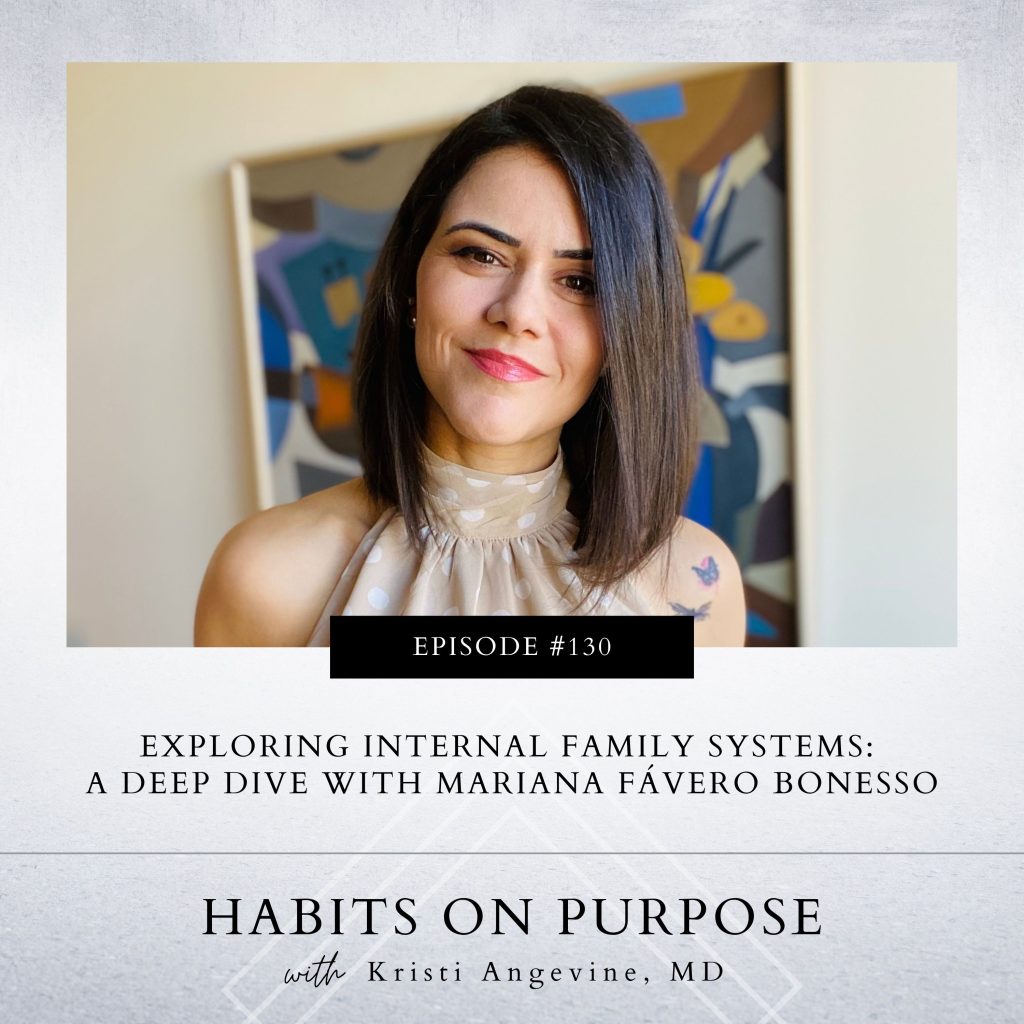
We all struggle with procrastination from time to time. It feels unavoidable, especially in our never-ending world of multitasking. But what is avoidable is linking this very human behavior with our sense of self and viewing such tendencies as a character flaw.
Returning to the podcast is Mariana Fávero Bonesso, a life coach specializing in overcoming procrastination and enhancing focus. Last week, she guided us on setting achievable goals and tackling procrastination without succumbing to anger and frustration.
Today, we’re shifting our focus away from procrastination to delve into Internal Family Systems (IFS). Whether you’re familiar with IFS or hearing about it for the first time, this discussion is for you! We’ll explore what IFS is, why it’s considered non-pathologizing, and how it can be used to heal and transform our habits.
What you'll learn from this episode:
- Why we may link a behavior to our identity.
- Internal Family Systems (IFS) as a model of psychotherapy.
- What’s different about IFS, specifically it being non-pathologizing.
- How to understand the self-to-part relationship and how it can be fostered.
Listen to the Full Episode:
Powerful Takeaways:
3:10 “I’m not one thing. I have a multitude of parts.”
9:19 “We just have parts that are doing their best with what they have and what they knew at the time.”
16:20 “The goal of IFS is to foster the self-to-part relationship.”
17:54 “Some parts of us can be outside or inside our bodies.”
26:30 “Listening to those parts instead of reacting to them and attending to them and taking care of them, makes a huge difference.”
Featured on the Show:
- Leave a rating and review for the podcast here!
- Follow me on Instagram!
- Click here to join the mailing list.
- Join the Habits on Purpose Facebook group!
- Click here to send me any questions that you would like addressed on the podcast!
- Mariana Fávero Bonesso: Website | Facebook | Instagram | Contact
- Internal Family Systems (IFS)
- No Bad Parts by Dick Schwartz
- Bev Aron, Deep Dive Coaching
Related Episodes:
Full Episode Transcript:
My main paradigm for approaching habits is using Internal Family System. And my guest from last week, Mariana Bonesso, shares a passion for IFS. Today we have part two for our conversation, and we focus on Internal Family System. Let's get started.
Welcome to Habits On Purpose, a podcast for high-achieving women who want to create lifelong habits that give more than they take. You'll get practical strategies for mindset shifts that will help you finally understand the root causes of why you think, feel, and act as you do. And now here's your host, Physician and Master Certified Life Coach Kristi Angevine.
Hello, hello, everybody. Last week you heard from the lovely Mariana Bonesso on procrastination and focus. As we talked, we decided that we just had too much to talk about to have a single episode.
So, this week's conversation is part two, and it's dedicated to exploring Internal Family System. We get into a variety of important aspects. What is IFS? Why do we both like it? What's it mean that IFS is non-pathologizing? What's the difference between talking about IFS and doing IFS?
If you already like Internal Family System and you want to learn more, this is going to be the perfect episode for you. If you don't yet know about Internal Family System, no problem. You can listen today, and then you can also go back and listen to Episode 49 and Episode 75.
Now, if you're new to the podcast, let me just say welcome. Thank you so much for joining and taking your time to hang out with me. This is your time to learn something new and learn something practical to help you better understand yourself and better understand the patterns you have for doing things.
I'm really happy that you chose to take your time and tune in here. So, if you like what you hear, I want to encourage you to go get on my email list. It's where you'll hear things that I don't necessarily share on the podcast, ideas that I've encountered, topics I'm studying, and tools that I use just with my clients.
If learning about upcoming free workshops and webinars is up your alley, just go to HabitsonPurpose.com. It's also the place where you'll be the first to hear about the much-loved, very popular 10-Day Habit Reset. It's 10 days of texts and emails that help you reset any habit or pattern that you have.
And the email list is where you're going to learn about the small group coaching programs, my one-on-one coaching, and more. Now, let's get started with Mariana Bonesso.
Kristi Angevine: Welcome back to the podcast. Mariana, I'm so happy to have you here. So, Mariana, can you introduce yourself to people and tell them who you are?
Mariana Bonesso: Absolutely. Hey, Kristi, thank you so much for having me again. And everybody, thank you so much for having me. It's such a pleasure to be here.
My name is Mariana Fávero Bonesso. I am a procrastination and focus coach, and I help people get things done that matters to them and transform their habits.
Kristi: So, if you haven't already listened to last week's episode, go back and listen to that. That was the first conversation that Mariana and I had. You can learn more about her. We talked about procrastination. We talked about focus. And during that conversation, I realized we just had too much to talk about and we needed to do it again.
She was so lovely to agree to come back on so we could get a little bit deeper into some of the things. So, if you haven't listened to that one, go back, or stay here and just go listen to it later. It's totally fine either way.
So, one of the things that kind of stuck with me from the last conversation we had, was when you were talking about procrastination and how we so often will link a behavior with an identity. And that can make it harder to change our behavior to something intentional.
Because we think, “Okay, that's just who I am. That's all of who I am.” We were talking about that idea in connection with the ideas of Internal Family System. And I know we both love Internal Family System, in terms of personally and for our coaching, and I would love to hear what drew you to IFS. What do you love about it?
Mariana: I had a coach in one of the programs that I was a client of, and she did some of the Internal Family System work. But I didn't know that it was Internal Family System until there was this one time that I was having a really hard time believing I could love myself.
I remember sitting in front of my mirror. I think at that point, I was able to access Self somehow, accidentally. And then, I just sat there and told myself, “I'm going to be here. I'm going to love you. And you don't have to receive it.”
‘You don't have to receive it’ because I was having such a hard time receiving love for myself. I didn't even know what that meant, what that was, what that would look like. And then, I told that coach about this experience, and she said, “Oh, what you're doing is what Internal Family System is about.
And once I started reading or researching on Internal Family Systems, I resonated so much with the language of “parts”. At that point, I already understood, from years of therapy, that I'm not one thing. I have multitudes of parts.
That made so much sense to me, because there were parts of me that were anxious. There were parts of me that were confident, insecure. And trying to unify them was very difficult. It's impossible, because we're going to have different experiences.
And I'm curious, how did you find Internal Family System?
Kristi: I found it by one of my dearest friends; shout out to you, you know who you are. We were talking about coaching, we were talking about our lives, and she mentioned it to me. She asked me if I'd read the book, No Bad Parts. And she talked to me about this. I remember thinking, “Oh, that's interesting.”
And I think it was either concurrent with doing the deep dive coaching that we both trained in, or it was right at the tail end of doing that certification, that I realized, “Oh, the work I'm doing with the deep dive coaching,” with Bev Aron, “that work, it actually overlaps a lot with the parts work. Okay, so maybe I should learn about this thing that my girlfriend is telling me about.”
So, I started learning about it and realized that there was a huge intersection with a lot of non-violent communication, having an embodied sort of resonance, presence, when you're coaching… That we learned through our coaching experience with the Deep Dive Coaching Institute… that I realized, “Oh, there's a lot of intersection here.”
But there are a lot of very specific things to Internal Family System that are unique, and I just got hooked. I got super interested in it. And the more I learned, the more I couldn't help but keep learning more. Because even on the surface level, it's complex and rich, and then you keep getting deeper with it. There's just so much there.
And I found it highly practical. It explained a lot of how I felt. It explained a lot of things that were challenging for my clients. It gave a framework that I liked, that it was practical. I liked that it explained that confusing state of our mind that seems like a bunch of conflicting things.
And then, I liked that it had a systematic nature to the fact that it was actually a system-based approach, that looked at the system as a whole, that sort of holistic aspect to it. I just loved all of that. And so, that's how I found it. That's how I got into it. It just was one of those things that I can't put down.
For me, it would feel like coaching, without that component there, would be missing some of the really fundamental aspects of what people are grappling with.
Mariana: Oh, yeah. The part that you said, the systemic thinking, that was to me, also the paradigm shift that made so much sense to the work that we do.
Kristi: Exactly. So, I think we should probably pause here for somebody who maybe doesn't know IFS, and to maybe get a little bit of an overview. Because I think that systematic and systemic aspects may not make any sense. If somebody's like, “What is IFS anyways?” So, I'll give my short little one liner. But maybe you can help me just add to it if there's something I'm missing.
IFS is a model in psychotherapy. It's a way of looking at the mind as having lots of different parts or sub-personalities. So, for today, with you, Mariana, I have a part that's very excited to speak with you. I have a part that's very attuned to the time and worried about going too far and messing up and taking advantage of your time. It's very quiet, but I can imagine, in the past, I would have had a very strong critical part that would be like, “Yeah, don't mess it up. Don't ask a dumb question.”
There are all these different parts, right? So, IFS posits we have all these different parts, but also posits that we have a self, with a capital S. Which is sort of our seed of consciousness, or the core being of who we really are; that's wise and calm, curious and confident, and patient and accepting, and all these things.
And the systematic nature of it is, the idea is that with all of these parts, the parts of us, they interact inside of us like a family. Just like an external family might interact. Where you might have parents who interact with kids, kids who interact with one another; they all interact and have certain relationships. So, that's the systems part of things.
What else would you add? That's the sound bite for Internal Family Systems, but what else would you add to that?
Mariana: You're beautifully articulate in your explanation. It's so clear. One thing that I would add, that is different about IFS, and this is one of my favorite things, is that it's non-pathologizing.
Kristi: I love that you brought this up. Because I was remembering that was one of the things that you said in our last conversation, that made me realize, “Okay, we need to keep talking about this.”
I love the title of Dick Schwartz's book No Bad Parts. It almost encapsulates the idea that we have a bunch of parts in our system, and if we believe that none of them are bad, all of them have positive intent… Like procrastination. I have a part that likes to procrastinate, and the results of my procrastination are that I don't get things done and it takes forever to do things. So, I might really think that part of me that procrastinates is bad and wrong and needs to be fixed.
But if we are non-pathologizing, then we can say, “Okay, no, there's a reason I have a part that does this. It's not something that's bad or needs to be fixed. It's something that needs to be understood.” Because maybe it's just in a role for a good reason. But it's in a bad role, and once it's freed from that role, then it's nothing to pathologize in the first place because we understand it better.
So, I think that's one way. Then it's not like we have parts of us that are wrong or bad or need to be fixed. It's like, “Oh, no, no, no. We just have parts that are doing their best with what they have and what they knew at the time. This is just how it comes out.”
I don't know how you would explain it. But yeah, non-pathologizing, I think that was one of my favorite parts about IFS as well.
Mariana: Because it's not a disease, right? Because there are a lot of people that say, “Oh, procrastination, you need a cure for procrastination.” I was like, “Yeah, it's not a disease. It's a behavior,” right? So, although we want to… If it was a disease, you take a pill, and then you get better. It would be easier, right? But then there's no growth there.
Pathologizing, to me, reminds me of being a disease or being a dysfunctional that is permanent. When actually, maybe it's a temporary dysfunction, or it's a temporary thing that we can process and reintegrate in a way that functions well for us, or that we can lead in a compassionate way.
Kristi: Totally. I love that. Is IFS something that you use in your coaching with your clients? Or is it something that you use just personally for yourself?
Mariana: I noticed that some of my clients are more receptive to IFS work and others are not. So, I try and gauge what the client needs and what they're receptive to, and I ask for permission. So, if for consent… Because that's another thing that I love about IFS. We just work with consent a lot, and I absolutely love that piece.
So, I use it with my clients. I have one client that took the course that you told me, and I took that course too. You were one of my influencers, or one of the people that introduced IFS to me. Thank you so much, because I fell in love with the model.
But I do use that a lot with that client, and on and off with another client that is way more cognitive. She's been using the model since 2012. So, she prefers that method over anything else, but she's very receptive to IFS too.
How about you? How do you integrate the IFS in your coaching, if any?
Kristi: There are two main ways I do it. One, I do teachings about it. I tell people about the model so they have a framework to understand things. Which is definitely very explicit; this is what the model is. These are categories of different parts. These are Exile parts, Manager parts, Firefighter parts.
This is how they might show up for you. This is how you get to use the language of parts to understand yourself, relate to yourself, and things like that. So, there's a teaching component.
And then there's the doing component. I do lots of things. There's telling and then there's the showing. And the showing part is usually more getting people to identify that there's a part present and see if it needs their attention. Check in to see how they experience it in their body, and then guide them through an inquiry process to see if they can unblend from the part enough to get to know it.
And going from there and seeing where that goes. And that part's the more organic, fluid, and depends on the client, things like that. I love that you mentioned the consent piece, because I do think it's important with anybody to always ask, for today, for this issue, if you're in a one-on-one session or group session, what approach would feel best for your system right now? Do you want to talk about something?
Do more of a cognitive top-down? Examine our thoughts, and examine things, and look at things, and talk about strategies and actions and behaviors that we could do. Or do you want to get more into somatic processing and investigate what's present that might be a little bit more emotions based and parts based?
Because sometimes there are days where people are like, “No, not today. We're not going to the body. I'm sitting in my car, my kids are in the back seat, this is not the time.”
Mariana: Yeah, absolutely. Even though the topic itself might be conducive to that approach, right? Asking what they need, I think this is so important. But I learned that in the hard way too, by just doing what I thought was best.
Kristi: Oh my gosh, all the hard ways we learn.
Mariana: All the hard ways we learn. But yes, oh my gosh. That's so good. I love how you explained the process in such a concise way, of the teaching and then the showing.
Kristi: I don't think I made that distinction in the beginning. I think when I first learned about IFS, it was kind of like when I first learned about coaching. I had a lot of enthusiasm, and I wanted to teach people all the things I knew. And so, I was doing more teaching as opposed to actually exploring.
I was teaching, calling it coaching, and helping… it was very helpful… but it wasn't necessarily exploration from a place of not knowing and actually doing the craft of coaching. It was more ‘let me teach you all these amazing things and talk to you and tell you.’ And I did a similar thing with IFS.
One of the people who I think of as a mentor now, I heard her talking in a consultation group. It was a group where people would come and bring tricky cases and things that came up in themselves. And we would talk through all these things. She said, “There's a difference between talking about IFS and doing IFS.
You can talk about it. And then you can help somebody meet their own parts, and meet their system in a way where you're just facilitating their experience. It's very different from talking about the framework and reading about the framework.
I remember hearing that and going, “Oh, I'm doing a lot of my part that likes to teach, that likes to talk about things, is very dominant, and is talking and telling and doing all the things.” It's super helpful, and at the same time, it's not the same thing as actually doing IFS.
It's really like you and I talking about a cookbook. Like, “Oh my gosh, do you see page 74? It's so beautiful. And then at the grocery store, there's these things…” and talking, talking, talking about cooking, and about the cookbook we love. Versus you and I in the kitchen cooking a meal. It’s two different things.
Mariana: Oh, my gosh, completely. It's a completely different experience. And also, I think it's so fun when the clients receive the information and they feel good, too. Because they're like, “Oh, I'm learning something new.”
Then we get feedback that they're learning something new. Except that the goal of the IFS is to foster the Self-to-part relationship. And then we're just here missing out on the great cookie that the client can have, if they were creating the cookie themselves.
And I can totally relate to that. I have this very dominant teaching part too, that I can talk for hours about that with my client.
Kristi: All right, so you just mentioned something really important, this Self-to-part relationship. And you also were talking about how we both have a very similar dominant teaching part that gets excited talking about that. I'd like to talk about both of these things.
I'm wondering if maybe you could talk a little bit more about how you notice when a part of you is present? How's that look for you? Because I think sometimes when people hear about parts work, they're like, “Oh, I understand. Like I have a part of me that wants to do this and a part of me that doesn't want to do this.”
But how do you notice when your big teaching part is present? Do you have a way you pick up on that?
Mariana: There's this big energy. It's a big emotion that I feel around my heart, here on my chest. Then it's almost like I become bigger. So, this part is very big. And it's almost as if she goes a little bit outside of my body; it's not completely embodied. So, it's a little bit outside of my body. Which some parts of us can be outside or inside our bodies.
And I realized that some of my parts are just around my body, especially this big part. But I don't notice until I notice the client just paying attention on what I'm saying. And then it's twofold feedback. I have to be present for what's happening for the client and present for this sensation, this big sensation, or big presence.
I ask that part of me to gently give me a little bit of space so I can relate to the client from the Self perspective, especially when I'm coaching from the self, from myself, is a little bit more effective than if I am letting the teaching part come and take over the whole session.
Because I remember, in the past, half of my sessions were teaching. And then I missed out on the opportunity to actually give the client what they came for.
Kristi: The way you're talking about feeling like that the part is big and outside… For somebody who's listening, who maybe parts work makes sense but they don't quite understand when we're saying, “Oh, the part’s big,” I have a similar experience.
When we talk about parts, sometimes we'll ask people, “Where in or around your body do you notice that part? How do you know there's a part of you that's feeling interested in teaching? Or how do you know there's a part of you that's feeling anxious or present?”
So, if you're listening to us and thinking, “What does that mean, feeling into your body, these parts?” That might be a sign that you might live from the neck up. Do a lot of thinking and have a lot of parts that are very cerebral, that broadcast from your head.
But when you start just sinking into your body and noticing, you'll notice what Mariana was saying, about noticing how something just feels very big, the energy is big. And it's not even necessarily bad. It's a noticeable thing. For me, I think I notice it… I love my teaching part. It's a great part. I'm glad I have that part.
And sometimes it does get a little bit, not bossy, but does take over in ways that I have to be mindful in advance. If my goal is not teaching, then maybe that part I need to sort of check in with beforehand and be like, “Okay, what I'm doing here, this is more exploration. If there's teaching involved, please show up. But if there's not, I'm going to need to lead with something else.” And so, that advance helps.
But then, in the moment, I think what I do notice, particularly in the past, what I would notice is there'd be a lot of talking from me, lots of leaning forward. I use my hands a lot when I speak anyways, but even more use of my hands. And sometimes it's fine, right? Sometimes that's great to teach, but that's not how I notice it.
Lots of talking and telling and kind of going quickly, versus when I'm exploring, I definitely don't have a knowing energy. I have no clue what we're going to find. I genuinely don't know, but I'm super interested to figure it out.
When I'm teaching and telling, I have a very clear sense of what I'm telling and talking about. I know the directions; like, I've been here before I can show you around. So, there's a certain energy to it that I can't describe it in words very well. But I see it in the pace that I speak.
Mariana: I love what you just said… Because the collection of thoughts that seem to be common in the teaching parts is, “I've been here before. I know this. I know where we're going.”
And that's such a great point that I haven't noticed before for myself. This is why I was taking some notes here. Because this is the exact energy of my teaching part, which is, ‘I know exactly what's going on here. Here's what's going on. I'm going to tell you everything because I want to share everything with you.’
So, I have the urge to share, and it sometimes can feel like an urge to share.
Kristi: I think this type of a part, it's not the same teaching part. I have a part that I don't know how to articulate very well. But a part of me that comes out oftentimes with my kids, my husband, because they're the people I see the most, that is very knowing and has ideas for what they should do or how things should go or how we could fix something or address something or maybe the best thing to do to figure something out.
It has a lot of ideas. It wants them to know. And it feels like they're very important. This part, it doesn't listen very well when it comes to my people. If they want to share something with me, they don't really want to listen. It just wants to tell them all the good ideas for how they can do whatever.
It's not an urge so much, but there's a forward propelling feeling that I notice is the opposite of curiosity. Maybe not the opposite of curiosity, but it's not open. ‘Let me tell you all the things,’ as opposed to, ‘and what's coming up for you? What do you think? How do you feel about this?’ It's not that.
And the reason I'm articulating this is because I notice that this part sometimes lands well with my people. Sometimes I feel like, “Oh, what great advice. Thank you so much. That was a great idea.” And other times it is the wrong tool for the job. It's like I brought the hammer, but I needed to bring a hug and silence.
So, Seth Kopald, who does a lot of work with IFS and parenting, said sometimes he will see his kids respond to him in a certain way that throws him for a loop. He's thinking, “Why are they looking at me like that? Why are they acting like that?”
It's the idea that their parts are contagious. There's a part of him present that elicited a part in his kid, and that the eye rolling wasn't just out of the blue. It's like that was the signal for, “Oh, there's something going on in me. My kid is letting me know.” And when you can pick up on that, sometimes his advice is just to be quiet. If there's a part of you present, maybe just don't speak.
And I noticed the part that wants to tell and do all the fixing, it likes to talk a lot. And sometimes if I can just say, “Hey, could you not talk for a second?” And I just get quiet, even if the parts here, but it doesn't come out so much externally, I will get a sense of, ‘was that a hammer when I needed a hug or not?’ So, that was a nice little tangent into Kristi’s parts.
Mariana: I absolutely relate to that. Especially with this idea of parts being contagious. That reminded me of a coaching session that I did once and this very certain part of me was present. I thanked the client so much in that session for saying what she said. She was like, “This is not my problem. This is not the problem that I want to solve.”
And my part was so certain that it knew what the problem was, and it knew what the solution was. And when she said that, that part of me felt completely ashamed. Because my inner critic came up and said some things in the session. And it was like, how do I recover from here?
So, it was a little discombobulating. But I was able to return and just say to the client, “Thank you so much for telling me that that was not the direction and for being so honest.” Because I couldn't see that that question was not the right question. I could see that when that part came up, a part in her came up too. I was like, “Hey, not here, not today.”
In relationships, even coaching-client relationships, parents and kids relationships, or even couples relationships, we bring up… Even our relationship here, right? I also have parts of me that are very concerned about whether this is helpful for people who are listening, and how are they going to use this? How can we tell them very clearly how they can do this work? Or how can they can apply this work? Am I doing this right? Am I being articulate enough?
So, I have all of those parts coming up too. It's fascinating how this work is helping us listen to those parts instead of reacting to them, and attending to them and taking care of them makes a huge difference.
Kristi: Yes, it totally does. And I love that you just now talk to the parts of you that are present here. Because people are listening to us; they hear your voice, they hear my voice. And they can probably imagine me sitting in my office and you sitting yours and us talking.
But the reality is, we each have a bunch of our parts that are coming up and forming what we're saying. All of our parts are softened back, and we're completely speaking from Self at the time. We are having a combination that's coming forward. So, if people really wanted a more realistic picture of our conversation, they could picture, I don't know, 20 different parts of me talking to 20 different parts of you.
It's a lot of things going on. And I think what you just did is so brilliant because you modelled what it looks like to name and notice your parts. Oh, there's a part of me that's worried if this is going to be helpful. There's a part of me that wants us to be helpful. There's a part of me that you didn't say this, but there's a part of me that's distracted thinking about my grocery list. Or there's a part of me that's whatever… There could be all these different parts.
And sometimes just being able to name and notice them, I find, is a way that we can get space from them. So, we're not making them go away. We're just getting just enough space so we can go, “Oh, okay. I, as the leader of my system, can't get enough space for my part so I can relate to them.”
And that's back to that Self-part relationship. It took me a bit to quite understand what that was when I first heard about IFS. What is Self, with a capital S, anyways?” I mean, it's this ineffable thing. It's hard for even therapists and people, coaches, who've been doing IFS for years sometimes to put it into words.
So, that idea of your core essence of who you are relating to parts of you seemed a little bit weird to me. I just didn't even understand. I was like, “This might just be a little bit too out there,” until I started understanding better. That, okay, this is just a way of relating to all the aspects of yourself in a way that's non-pathologizing.
And might sound, like what you just said a minute ago, like, “Hey, for the part of me that's a little anxious, could you just step back just a minute and let me lead this coaching call? Would you be okay?” And a part being like, “Yeah, fine. Sure, no problem. No way.” Hearing that, and then responding and having a little, brief internal dialogue without the part being at the driver's seat, and you, Mariana, being able to lead your coaching call or something like that.
So, is there a way that you think of a part-to-Self or Self-to-part relationship that might add to what I was just saying?
Mariana: It was very difficult for me to conceptualize that and internalize that concept. Because I think for so long I blended with my internal critics that my sense of Self was nonexistent. I didn't have a sense of Self. Even when I was coaching I wasn't in Self. I was more in teaching mode for a long time. So then, I didn't know. But I could have some glimpses of what being Self meant.
And once I started learning that being in Self meant I could feel compassion towards the shame that I felt, that I could feel compassion towards the disappointment, or curiosity towards the shame, that's when I started understanding what the difference was between having a Self and having parts.
Because for a long time I thought that I was the inner critic in my mind beating myself up for everything. When I started seeing, “Oh, this is not who I am. Me that exists, that can actually feel compassion towards that other human being, that's the real me.” And then I can just transfer that relationship to myself.
Then I started getting curious about what that would look like. Because to me it was completely foreign to think in terms of seeing myself as a human being. No, I need to be perfect. And being perfect is the complete opposite of being a human being. It's kind of dehumanizing a little bit when you think in terms of ‘I need to be perfect,’ the high standards, I couldn't feel compassion towards myself.
If I can feel compassion for the person living on the streets, for example, which is my very tender spot, I can feel compassion towards this mistake that I made today, towards that inner critic that is trying really hard to protect me somehow. Even though the language sounds a little harsh, it's with a good intent. But if that was true, so… Did I answer your question? I think I went into a tangent.
Kristi: Of course, now I can't remember my question. But you brought up so many beautiful points in describing that relationship with parts of you from a place of compassion and curiosity.
I think one of the things that I hear my clients talk about a lot is that they think that their critical parts or their part that can't handle things and feels ashamed or incompetent, that they worry that that's the real them. And that's all of who they are. I think what you described is realizing that you're having that awareness that you were quite blended with a critical part and thinking, “That's just me.”
Then that slow separation out, or fast, or just eventual separation out, where you could go, “Oh, there's a part of me through it. I'm seeing the world through that part's eyes. When I do, I think that's all of me. But when I get enough space, then I can be compassionate towards that critical part.” Or I can be curious about how come this makes sense? How come this came to be? How was this adaptive? How was this recognizing that, “Oh, that's the real me.”
The part that can have some space, have some clarity. I think that's where the magic is.
When hearing you talk about being blended with a part and not even realizing it was a part and thinking, “Well, that's just me. I just have a sharp inner critic and I'm just a very self-critical person,” I really think, oh, no, no, no.
To be blended to see the world through that part's eyes, it has a very distinct view. It's not calm, it's not patient, it's not loving, it's not compassionate. It’s none of those C or P qualities that we say Self is. For me, that's how I know when a part is present.
If it's absent of those qualities we've talked about, calm, compassion, curious, confident, if those things aren't there, if I'm not feeling playful, if I'm not feeling patient, then I can, with almost full confidence, say there's a part present. Guaranteed.
I may not even know what it is or who it is or anything, but it's definitely a part. It's definitely not this Self with a capital S.
Mariana: Yes. Oh, I love that. Can I ask you a question? One of my misconceptions was that initially, when I started getting curious about the work, and I think this is going to be good for everybody listening because my misconception was all of the emotions that characterizes being in Self, being connected to who you are at your core, they seem positive emotions.
To me, initially, I was thinking that if I am in Self, I'm always going to feel good. I should strive to be that way all the time because it feels much better than to be blended with other parts of me. How did you reconcile the idea of being blended and not being Self in some parts of your life, and sometimes experiencing negative emotions because of it?
Kristi: I, for sure in the beginning, thought I had this idea of Self is best and parts are problematic, and I should try to be 100% “Self-led”. My goal is to be passionate and confident and clear and creative and playful and patient, and all those things. That's where I should be. And when I'm not, that means a part is there and that's a problem, and I should get it to go away.
I didn't appreciate that parts are important. And parts that don't carry burdens, they're critical. Self, this is just my take, but I don't think Self cares about the time. Self is not looking at the clock right now and going, “You know what? I only have a couple minutes left.”
My timekeeping part, it's not burdened. It's watching the clock. I love that. It's so great to have a timekeeping part that watches the clock and things like that. I slowly but surely started realizing, “Oh, so parts, they have strengths. They have things that are very distinct from Self. When Self is maybe the facilitator of the system, or the kindergarten teacher of the classroom, but we need everybody here on the team to make me, me.”
That helped a lot. Then, with one of the IFS therapists I've worked with, she would constantly say, “Does this part need to blend with you right now to communicate?” Because sometimes parts need to blend. They need all of you to be able to express themselves.
And until they can fully express themselves, and then you can come back and you can meet them with a little bit of awareness later, they're perhaps not going to feel like they're fully seen and heard.
I started realizing, “Oh, even if a part is blended, that's not bad. If I can get to the point where I'm a 99% blended part, and 1% of me recognizes, ‘Oh, this is a very big part right here.’ That's enough.”
We just need a little bit of Self some of the time to recognize it. Then for deep healing work, of course, having Self from wherever to address those parts is going to be critical. But just for ordinary everyday life, I've now gotten to a point where it's easier for me to go, “Okay, sometimes I'm going to have a parts-led day and that's okay.”
Of course, I have parts that are like, “That's wrong. You should have more Self than parts.” I have those parts too, but that's kind of how I reconciled it. When I realized that it takes both. You can't just have one, they're all together.
It's like in that analogy of ‘if self is the sun and parts are the clouds, you have to have them both. You can't just have only sun. You have to have both.’ But just knowing both are there, and they can both collaborate is the best.
Mariana: Oh, I love that so much. Because I didn't even know how to put that into words, so thank you. Thank you for that.
Kristi: I will say, I do notice my timekeeper part is realizing that we need to wrap this up. And I feel like, again, this is so good. We're probably going to need a part three. I just think this has been so much fun, and I'm so glad we got to bounce ideas back and forth about Internal Family Systems.
So, my hope is that people listening to this will hear the verbiage we use in talking about Internal Family Systems, and that it will resonate with them as a way that they can maybe understand themselves better.
I would love it if the people that are listening, and they love how you're contextualizing things and explaining things, if they want to find you, learn more about your work, learn more about how you address procrastination and focus, how can they find you?
Mariana: They can find me either on my website, which is MarianaBonesso.com. Or they can find me on Instagram, if they use social media, which is @mariana_ fbonesso.
Kristi: Oh, perfect. Mariana, thank you so much for your time. I will make sure that we link you and all the show notes so people can find you. This is just so much fun.
Mariana: Thank you so much for having me, Kristi. This has been amazing. And thank you everybody for having me today in this episode. I can't wait to talk to you all.
Kristi: Everybody have a good day. Bye-bye.
Like what you're hearing about Internal Family System? Want to dive deeper into understanding your habitual ways of thinking, feeling and acting? If you want to apply the ideas from this podcast to create real life changes, private or small group coaching could be just what you need.
In private coaching, it's just the two of us working intensively on your habits. And this is available for women, men, physicians and non-physicians alike. For more details, just go to HabitsOnPurpose.com/private.
Now, if small group coaching is more your thing, I offer the Habits on Purpose for Physicians program. It's a six-month journey with a group of women physicians who are all focused on transforming the habits that take more than they give into ones that really nourish them.
So, whether it is second guessing, a harsh inner critic, people pleasing, overextending at your own expense, perfectionism, or feeling perpetual guilt for not being enough, all of these particular patterns have root causes that together we unravel.
In Habits on Purpose for Physicians, or HOPP, you learn practical tools and ideas. And you receive deep dive IFS coaching so you can uncover why you habitually think, feel and act as you do. So, if you're interested in stopping living on autopilot and breaking the cycle of exhaustion and overworking, HOPP is right where you need to be.
The program has bite-sized content designed for the busy doc on the go, weekly coaching calls, office hours for extra support, and an online community where you can get 24/7 written coaching support and accountability. And we keep the group size very small so we can encourage a close, supportive environment.
If you want to learn more about HOPP and join the waitlist, go to HabitsOnPurpose.com/HOPP. The next group starts in October.
But stay tuned. On the email list, you will learn about an early bird flash sale. During the sale, you can place a deposit to secure your spot in the October cohort before regular enrollment begins. HabitsOnPurpose.com/waitlist. Join the waitlist and you'll be the first to know.
I'll talk to you next week.
Thanks for listening to Habits On Purpose. If you want more information on Kristi Angevine or the resources from the podcast, visit HabitsOnPurpose.com. Tune in next week for another episode.
Enjoy the show:

