
Even the most accomplished people can struggle with procrastination. Whether it’s in business, our personal lives, or even our health, it can be daunting to attempt to tackle everything on our to-do lists—enough so that we may altogether avoid it. So let’s make these tasks more manageable, shall we?
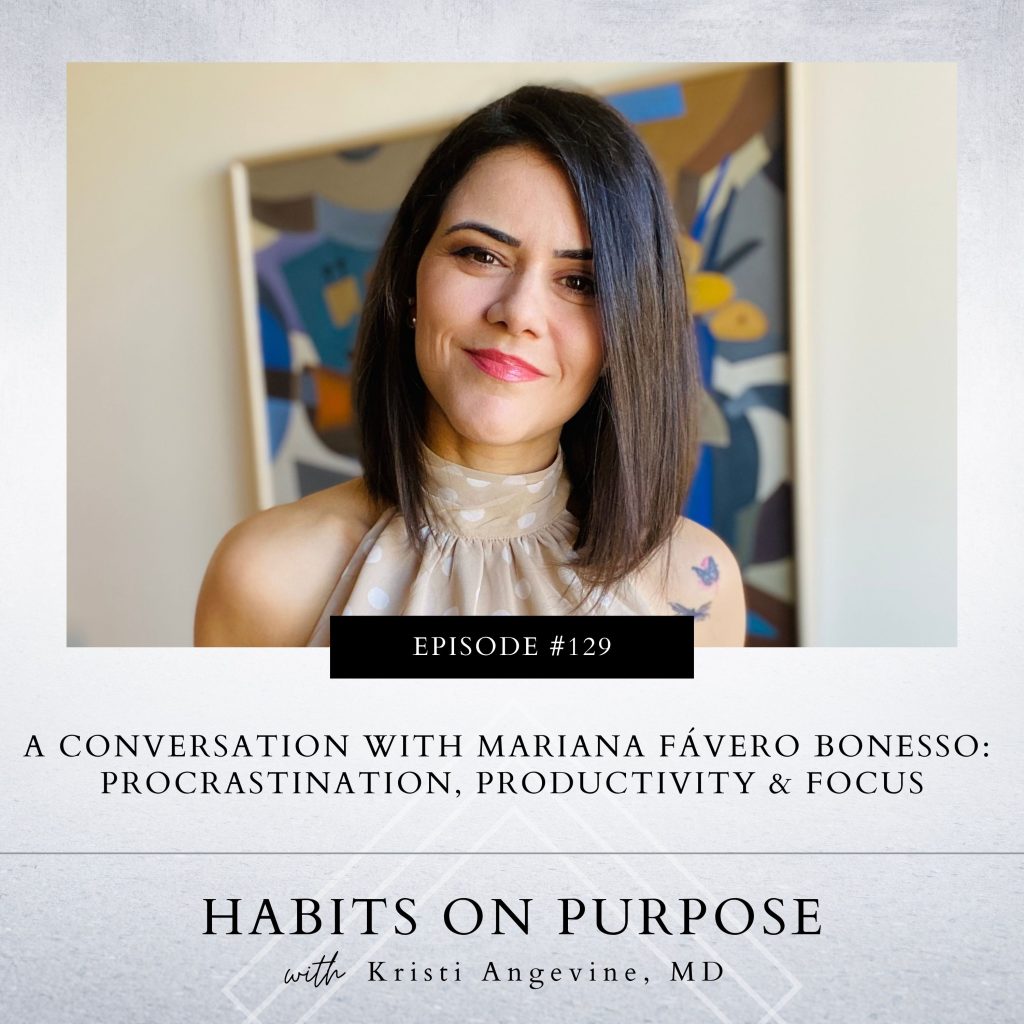
My guest today is Mariana Fávero Bonesso, a life coach specializing in overcoming procrastination and enhancing focus. Mariana works with high-performing individuals who often feel overwhelmed, helping them become more structured and execution-oriented. She’s here to share her inspiring story and effective methods.
Tune in as Mariana explains how to set meaningful goals and break them down into manageable steps. She’ll also provide valuable tips on overcoming paralysis, as well as strategies to prevent anger and frustration when procrastination strikes.
Even the most accomplished people can struggle with procrastination. Whether it’s in business, our personal lives, or even our health, it can be daunting to attempt to tackle everything on our to-do lists—enough so that we may altogether avoid it. So let’s make these tasks more manageable, shall we?
My guest today is Mariana Fávero Bonesso, a life coach specializing in overcoming procrastination and enhancing focus. Mariana works with high-performing individuals who often feel overwhelmed, helping them become more structured and execution-oriented. She’s here to share her inspiring story and effective methods.
Tune in as Mariana explains how to set meaningful goals and break them down into manageable steps. She’ll also provide valuable tips on overcoming paralysis, as well as strategies to prevent anger and frustration when procrastination strikes.
What you'll learn from this episode:
- The best way to set goals and make them more achievable.
- Ways to separate any habits of procrastination from your identity.
- Why allowing ourselves rewards is crucial to overcoming procrastination.
- How to avoid perfectionist tendencies.
Listen to the Full Episode:
Powerful Takeaways:
11:18 “There is so much unrealized potential in the world because of procrastination.”
15:39 “In a moment that your emotions are high, your intelligence, your capacity to think objectively is a little bit lower and reduced.”
19:11 “if you don’t acknowledge the progress, and you dismiss it and discount it, it’s actually harder to repeat the effective action.”
23:28 “Procrastination is not an identity.”
29:40 “One of the strongest forces in human personality is the necessity of being consistent and coherent with your identities.”
Featured on the Show:
- Leave a rating and review for the podcast here!
- Follow me on Instagram!
- Click here to join the mailing list.
- Join the Habits on Purpose Facebook group!
- Click here to send me any questions that you would like addressed on the podcast!
- Mariana Fávero Bonesso: Website | Facebook | Instagram | Contact
Related Episodes:
Full Episode Transcript:
Today's episode is a conversation with Mariana Bonasso, and we talk about these very things that are so common amongst high achievers. Let's get started.
Welcome to Habits On Purpose, a podcast for high-achieving women who want to create lifelong habits that give more than they take. You'll get practical strategies for mindset shifts that will help you finally understand the root causes of why you think, feel, and act as you do. And now here's your host, Physician and Master Certified Life Coach Kristi Angevine.
Hello, hello everybody. Welcome to another interview episode. My guest today is Mariana Fávero Bonasso. She has a PhD in Tropical Diseases and a fascinating story of how she switched careers. As a business owner and life coach, she has an advanced certification in Deep Dive Coaching, and she shares my passion for Internal Family Systems.
One of the things that I've personally struggled with since I was really young is procrastinating, waiting ‘til the last minute, pushing off that science project until the day before it was due, and then feeling terror about not finishing things. But then pulling it off just well enough that for some reason it made sense to repeat the cycle all over again.
And it became one of my patterns. I used to actually think that it was part of the fabric of my identity; I'm a procrastinator. That's just how I operate, always have. Now, I know differently. Now, I know it's a habit.
As such, it's simply a repetitive way of behaving that was as adaptive as it was maladaptive. Mariana is an expert in procrastination, and today you get to hear us riff on that, as well as a variety of other related topics.
I hope you like what you hear. So, without further ado, let's dive in.
Kristi Angevine: All right, welcome to the podcast. I am going to do my best to say your beautiful name. Mariana Fávero Bonesso, welcome to the podcast. I'm so glad we get to spend this time together.
Mariana Bonesso: Thank you so much for having me. And you pronounced my name beautifully, Kristi.
Kristi: I appreciate the graciousness of that. So, you and I have known each other for a while, but there may be listeners who don't yet follow you, don't know who you are and what you do. So, can you take a moment and introduce yourself?
Mariana: Absolutely. So, as Krist already introduced me, beautifully, my name is Mariana. I work with people who want to stop procrastinating and improve their focus. I'm originally from Brazil; you're probably hearing an accent here.
My origin story is I came from a postdoctoral background in epidemiology, and then I decided to become a coach. Kristi and I met during my advanced certification with the Deep Dive Institute, where I got the privilege to be instructed. Is that how you say it? Like, you instructed me in my certification. I think that's it for my introduction.
Kristi: If you keep not knowing if something is correct, I have this vague inkling that you shared something with me about your epidemiology study. Was there something tropical…?
Mariana: No, that's correct. I did my postdoc, my Master's PhD and postdoc in Tropical Diseases. I studied ventilation associated with pneumonia during my PhD. And then my postdoc, I did something else with klebsiella
Kristi: All of you MDs, PhDs out there, all of the researchers, all the scientists, Mariana is your people. All right, so I have to know; you've told me this before.
So, I have a sense of this, but people are always curious how somebody makes such a radical departure from one career to another, vocation. And I'm wondering, for you, how you discovered life coaching, and how you ended up making such a switch from what you used to do to what you currently do today?
Mariana: Oh, that's such a great question. So, during my PhD, I started having difficulties sitting down to write papers, read papers, because I really liked the experimental part of being in the lab and doing stuff with the tubes and everything with the bacterias, looking at them in the microscope. That part I had down. I had no problems getting things done there.
But I really wanted to come to the United States and collaborate with another researcher. And because I'm such a big picture person, bringing things down was very difficult for me to get something done. And breaking things down, especially when it comes to writing grants and making proposals, writing English… I wasn't very proficient back then… I didn't know how to take those small steps, at least in that area of my life.
So, I started getting interested in life coaching. Coaching helped me understand how to set goals, how to break them down into objectives, how to set small, doable goals in order for me to figure out if I am on the right path to make that dream come true.
I started getting more and more interested in coaching when I came to the United States and making that dream come true. Because I was like, “My gosh, this was a very powerful experience for me to learn to break something down.”
I completely transformed my life when I came to the United States, and worked for the NIH PI that I had. And with English becoming more fluent, I became more proficient, I found this podcast, The Life Coach School Podcast. And then, I started listening to that. Then I decided that I wanted to help people do the same thing and make their dreams come true. I really wanted to “save lives”, because that's how I got into the medical field.
Although I am a biologist, I went into the medical field because I wanted to really help human beings. But when I started getting interested in coaching, I was like, “I think this is where my mission is.” So, I completely made that shift once I came here to the United States, right after I finished my postdoc.
Kristi: Oh, my gosh. So, right after you completed your postdoc, you shifted into... That's incredible.
Mariana: Oh, thank you. That was so scary, Kristi.
Kristi: I can relate, and I know many people listening, I know they can relate. But what was scary about it for you?
Mariana: 1. I just moved to the United States. 2. I got a job at NIH to work in my field, and I said no, to just jump into this new career. And then, I took a job at a coffee shop, a local coffee shop, so I could have some money to pay for more coaching.
So, I was very fortunate to have my husband as the sole provider for me, but it wasn't an easy decision. Because I'm here, I'm alone. I'm basically on my own, right? Even though I have my husband and his family, I don't have any other family here, so it's a big risk for me.
And also, I came here in 2017, so my English wasn't... I had to learn to listen to nuances in order for me to coach people. So, it was a big risk. And it's still a little scary for some reason, but I keep going. I just keep on going now, at this point.
Kristi: I want to emphasize something that you said a second ago, because I'm thinking of my clients. They do research, or they struggle with writing, or they struggle with communicating in some form or fashion, like what you're saying about going from the big picture to the very almost piecemeal nature of doing grant writing.
There are people listening right now, nodding their heads going, “Oh yes.” I just want to emphasize that those people are not alone. This is not something that is a struggle in isolation, for doing small bits, and so I love that you just put that towards. And I love that you named that it was scary to make a big jump.
I'm sitting here sort of... I'm noticing myself thinking, “Oh my goodness, I struggle with some of the exact things you talked about,” or parallel things, and English is my primary language. So, I don't have that additional complexity of going from one language that I might think into another language that I'm trying to write in, or communicate in, or coach people in.
So, I have a part of me that's a little bit dazzled and wowed that you deal with that, right?
Mariana: Yeah, thank you so much. And yes, I would have loved to know that I wasn't alone, in those moments where I had to sit down to write a grant, or to sit down to write a paper.
And every time that the paper comes back, it's another moment where it's very difficult. Because you have to read all of the “criticism”, necessary criticism and feedback most of the time, feedback that you receive. And that's another moment that is very sometimes isolated for researchers and people in this field.
Kristi: I mean, if it's okay with you, I would love... I have some questions that I think make sense to ask now, but I would love to circle back to that piece, like the feeling isolated in the struggle with writing, and then in the aftermath of getting constructive feedback, that experience. Would that be okay to kind of loop back to that a little bit?
Because I think there's something really interesting there about the struggles that we can have upon receiving input from others on something that we've worked so hard on, that I think makes sense to talk about.
And before we go too far, one of the things that is crossing my mind is that hearing you talk about where you are now, and knowing that you do a lot of coaching that does help people with procrastination and focus, what I'm wondering is, what got you interested in focusing specifically on that? Was it the struggle with writing? Was it something else?
Mariana: I think helping people with procrastination and focus, to me, if I can help people put their work in the world… I know that each one of us has something meaningful to bring to life... And that means so much to me, because there is so much unrealized potential in the world because of procrastination.
And we can talk a little bit deeper about that, because I don't think it's a bad thing. But it's something that keeps us from helping each other with the work that these people… that everyone has to offer.
I think that there's a lot of collaboration that could come to life if we knew how to bring it to life. And that means so much to me. That is linked to my mission, because that helps people connect to life in a different way; through their work, through their creativity, through their desires that are unrealized.
Kristi: Did you struggle with procrastination yourself? Have you struggled with it a large part of your life? Did it show up in certain seasons?
For you personally to know what it's like to have that, and also have it linked to your mission; “This is why I want to help people.” Did it come up at a particular time?
Mariana: Yeah, during my Master's, I think I had it for a long time. But I didn't know the impact until my Master's degree, because I wanted to do what I did in my PhD in my Master's. I didn't want to do a PhD. I just wanted to do a Master's, a split Master's.
It was almost like I was so frozen, because it was such a big picture, and I didn't know the tiny steps I needed to take daily in order to make that happen. And when I finished my Master's, I realized, “Oh, I just cost myself two years of my life,” when I could have done this thing that I wanted to do.
Kristi: Oh, my goodness. Okay, I see.
Mariana: So, that was my biggest struggle, was to figure out what are the tiny little steps I need to take in order to take me from Brazil to anywhere in the world? I wanted to go anywhere in the world, but what do I need to do? Because my supervisor couldn't care more about me realizing my dreams. She had her own stuff to deal with, so I was pretty much on my own there.
So, I think that struggling with taking those tiny steps… And then that was where I realized I needed help with procrastination and focus. Because the focus piece is also important to take the steps.
Kristi: Totally. So, let's talk about that. You mentioned feeling a bit frozen. I think that's how you put it, with the immensity of something and not knowing the smaller steps.
I think everybody listening to this can relate to the big project, and that sort of deer-in-the-headlights freeze, and the inertia of even starting. Because you don't know all the reasons that make it hard to focus and hard to start. What do you do with that when you do feel frozen and you can't focus? Where does one start? Or where do you see a good starting place for people to help get out of that?
Mariana: So, there are two ways that I like to approach that. The first one is, if the level of feeling for me is too intense, I can't sit down to write a list without getting even more frustrated at myself. So, I'd much rather take a walk, and really take care of that feeling or that emotional state first. Do something.
Do something. Typically, people say, “Oh, you're just enabling me to procrastinate even more by taking a walk.” No, but if it's going to help you, you're going to be doing that intentionally. You're going to be doing that with a purpose, and consciously deciding that the purpose of that walk is for you to bring your cognitive functions back online.
Because in the moment that your emotions are high, your intelligence, your capacity to think objectively is a little bit lower and reduced. It's possible, but it's not as effective as when you're in a green zone, so to speak. You can't function well.
So, taking a walk, or doing something that will help you regulate your nervous system, and then coming back and jotting down, even doing just a download of ‘what are the steps I imagine that I'm going to have to take?’ Then refocusing, and thinking about ‘how could I put in order the steps that I need to put in order here, in order to achieve that goal?’
Lastly, I think rewarding yourself for that. Telling yourself, “Hey, I just took one step in the direction that I want to go.” We minimize the importance of this step, of putting our ideas together, as if that's not the first step. The first step is just jotting the first words on a blank piece of paper, that relates to the paper that I need to write, or doing the research. But creating a roadmap is the first step.
So, rewarding yourself, telling yourself, “I just took the first step.” Or even if your first step was to just regulate your nervous system, “I just took the first step.” So, what gets rewarded gets repeated. If you reward yourself in the direction that this is, the direction that I want to go, that is the new behavior that is going to start getting stronger.
The steps are: Pause when you feel overwhelmed. And then assess, is this a moment for me to do something towards my goal? Or is this a moment to regulate, to intentionally help myself feel better? And two, then you refocus, jot down, read that list. And three, reward yourself for taking that step.
Kristi: Thank you for recapping that, because I was trying to follow it in my mind, and then I was thinking, “Hey, we should recap this because this is so perfect.” That idea, that pause and regulate and acknowledge. That regulating is not just perpetuation of procrastination, it's an essential step to get you back to where you can focus.
And I love that you said, once you feel like you're closer to a green zone, or in a green zone, you can actually tap into your cognitive abilities. Even if you don't know the first step, you can imagine what your first steps might be. Just even imagining what they might be, then just picking, and then rewarding or even acknowledging.
I do think some people who listen to this podcast are quite harsh and critical. They have some really skeptical, cynical parts. So, they think, “It's kind of silly and cheesy to reward myself for going for a walk when I'm not getting my stuff done. What is my problem, that I have to stoop so low and acknowledge the most minute things,” right?
I don't know your take on this, but my thought is very similar to ‘you repeat what you reward.’ That if you don't acknowledge the progress, and you dismiss it and discount it, it's actually harder to repeat the effective action. And it's actually extremely practical to reward, or to acknowledge or to pat yourself on the back, for doing something no matter how small it is, because it works. And when you do that, it's easier to repeat it in the future. So, why not do it?
Mariana: I absolutely love it, how you put that, because it's super important for us to recognize that it's easier for us to reward the “big actions” and to judge the small actions. The point of this exercise is not so much to be “productive” in the productivity culture that we receive, but more so, this is a pattern interruption.
Because the alternative in this scenario would be to procrastinate and not do it at all, and just completely run the same cycle over and over again, like using two years of my life to not know what to do.
So, if I knew how to interrupt, in the moment that I decided to do my Master's, and if I had used a year to figure out how I'm going to take the actions, how I'm going to prepare for everything, I would have come a little bit earlier. My life would have been different probably. But everything happened in the way that was supposed to happen.
But if I had that process of interrupting, gently interrupting, the cycle of procrastination, noticing when I was procrastinating, and figuring out what I actually needed in that moment, do I need a plan or do I need to regulate? I would have accomplished some of the things a little bit faster than I did.
It seems so trivial and so small, but it's actually a very powerful tool for you to create some space between your habitual response and the response you want to have. So, you just create a tiny space so you can make a different decision there.
Kristi: I just love the language that you're using around this. And I know that must have been hard for you, but I'm actually very grateful that you had this two-year long… I don't know what you want to call it… bloated period of time where you learned things the hard way.
Because I think if you hadn't done that, we, on this side of things, wouldn't be able to receive somebody who knows what it's like to be in the pain of procrastination, lack of focus and overwhelm. We wouldn't know that. You wouldn't have had that experience. I don't think you would be able to teach it with so much… I don't know… such a great insight to it.
So, yes, it turned out exactly the way it was meant to turn out. I love that you pointed out that this is a simple-seeming tool, it's straightforward. I could go find my eight-year-old and say, “Hey, these are some steps when you don't know what to do.” And he'd say, “Great, okay, I'm going to go for a walk.” He would take them and run.
So, it's not something complex and complicated that we can't get. But there is so much power in something that is simple when you actually execute on it. And I think it's easy to just kind of dismiss things as, “Oh, it seems a little bit trite, or a little bit too simple,” when really it can, when it's repeated and executed, be really powerful.
I love that you gave something really concrete. You and I both love Internal Family Systems, and we see it as a powerful paradigm and method of coaching in general. And I'm wondering if, as we're talking about procrastination, if there's an intersection between IFS and procrastination that you find helpful, in terms of how you look at procrastination.
Mariana: Yes. Oh my gosh, I have so much to talk about. So, I'm going to start with the first piece. Oftentimes, we can identify ourselves with our behavior. Meaning, “I am a procrastinator.”
Kristi: Right. I've heard you say that procrastination is not an identity. Okay. Yeah, I see. Okay, go ahead.
Mariana: And I think that when we make into an identity, everything that we're doing that is actually helpful to regulate our nervous system, is read as a procrastination activity instead of having a new perspective of, “Okay, so instead of writing that paper, I went to the kitchen. And the kitchen now, it's spotless. It's clean. It's amazing and organized.”
And then, “I just procrastinated for two hours instead of doing my work. Except that, during that moment, I was able to regulate.” And if I can use that pattern interrupt at the moment that I realize that I am well-regulated, then I can just drop whatever I'm doing there and come back. That is the point that we start changing our relationship with procrastination.
But if I see that as evidence that I am a procrastinator, what am I going to do is to just keep perpetuating the habit that I don't want. So, if I see procrastination as, ‘oh, this is a behavior. This is not the entirety of who I am,’ I also don't need to blame that into my parts. And be like, “Oh, this is a part that just takes me there.”
No, this is a behavior, and I can separate that from who I am, for the entirety of who I am. These parts of me learned to regulate. This is what helps for those parts. Or when I go for a walk, I can access self a little bit easier than when I'm just here trying to bang my head against the wall.
So, I can use those tools to create some nuances in how I read those behaviors, versus, ‘oh, this was just a procrastination activity because I'm a procrastinator.’
I think that IFS was super helpful for me in that particular way of detaching who I am from the behaviors, especially for the behaviors that I want to adjust or regulate or change.
Kristi: That makes so much sense. I love that you sort of describe there might be a part of me that does that behavior, but that's not me. All of me doesn't procrastinate; that's a behavior that happens.
And then, I know for me, when I do this, sometimes I don't notice I'm procrastinating. I'm in it and I don't have that awareness, unless I do like you're saying and I pause and separate it out. When I'm in it, I will have some parts that are like, “Oh my goodness, what is your problem that you procrastinate?” That doesn't like the part of me that procrastinates, right?
And so, sometimes when I can just take that pause and separate it out, I can access that clarity. Like, “Oh, okay, so all these parts, the parts that don't even like each other, they're all there for a reason.” And I can see how that would be a great way to integrate that language into your pause. To be like, “Okay, it’s just a behavior.” I can notice that, and tend to that behavior, tend to that part.
It seems so much more manageable than me as a human down to every cell in my body, “I'm just the type of person who procrastinates, and what's my problem?” And then, for me, if I do that type of global… Like, ‘I'm just the type of person who…’ quick too, on the scene, is usually some critical talk. A part that's like, “Yeah, and you're stuck, and you're never going to get out of that.”
Mariana: Oh, yeah. I love that you brought that up. The critics, or the parts that dislike each other. Because that was also the shift, the biggest shift that I have with IFS. Which was to not pathologize those parts, to develop a relationship with them, and seeing them as ‘this is the language that this part uses because it thinks it's helpful.’
And I was like, “How in the world am I going to see those parts in that way?” Because the dialogue is so mean sometimes. But then, once I started making that shift, it helped me to create a more firm relationship with those parts instead of feeling so pressed. Because I felt so pressed by the critics, and even the fights that will happen, because I have contradictory or polarized parts.
Kristi: All right. This brings to mind that thing I wanted to circle back to; that there are isolating moments of writing. But specifically, also, when you get feedback on something. We were talking about writing, about getting your draft back from your grant proposal.
But I think anybody listening to this can relate to getting feedback, whether it's after they did a surgery, after they did a paper, after they did a grant, or after they gave a talk, or raised their hand at a meeting, and they get feedback after. I think many people have that experience. The feedback lands in their system, and their system just flourishes with a lot of either second-guessing, self-doubt, or criticism.
And I'm wondering, for you, what it was like to get feedback? And how did you eventually get to where you could deal with it in a way that maybe felt a little more productive?
Mariana: So, there are several things, I think. I'm going to try and summarize them. I still have some perfectionistic tendencies. And notice that I say “tendencies” and that I don't identify myself as a perfectionist. Because it's one of the strongest forces in human personality, the necessity of being consistent and coherent with your identities. So, this is why I don't identify. I try to not identify myself as perfectionistic because it's a cognitive distortion; it's not who I am, right?
Receiving feedback with my very strong perfectionistic tendencies was very difficult. Along with that, I have a little bit of rejection sensitivity too. So, even when there's no rejection, I would perceive the feedback as a rejection. I would be flooded with shame and disappointment and guilt, and I wouldn't be able to fully integrate the lesson because the shame, the guilt, and the disappointment would cloud everything.
Because it would make that mean there's something wrong with me, that wasn't “perfect” in that scenario. Except that IFS was super helpful for me in learning to deal with those parts of me that would bring those feelings, and see myself as a human being.
Because seeing myself as a human being meant that I'm here to improve and evolve. Now, that doesn't make receiving feedback easy. I don't know if it is an experience that a lot of people have, right? Receiving feedback can be very activating. Is that your experience too, when you receive feedback?
Kristi: Yes, it's extremely activating for me. And sometimes I'm prepared and ready to tend to the parts of me that get really activated, and sometimes I'm not. That's when it can be kind of just a tailspin for my system. So, it depends.
If I'm like, “You know what? I'm here to learn, and I expect that I'm going to get some input and feedback that's going to help me grow from that place,” it's not too jarring. If I'm not on sturdy ground, if my system is standing on for review, like plastic wrap that's got cracks in it. and somebody gives me feedback and I'm holding it, it's like the ground will fall.
I will fall through, and all of my tender parts, that have lots of things to say at any time, will come to the surface. The part of me that's like, “There's something wrong with me.” The part of me that likes to compare me to others unfavourably will be like, “Well, clearly you saw this coming.” It will be a cacophony of activation.
It's almost like a committee of people will come out of the shadows going, “Oh, I have something to tell you about this.” And it's not like, “Wow, we're so lucky to get feedback. This is going to make it even better in the future.” That voice is whispering and the rest of them are yelling.
So yes, that can be my experience of feedback. And in the past, that was my default experience. Knowing that's where I can go now, I can kind of tend to those parts that might show up in advance so that it's not as bad. It still can be, but I know to anticipate that.
Mariana: Oh, I love the language that you're using around that; ‘I can attend to those parts of me.’ Because that's a skill that we can strengthen.
Kristi: I think that's one of the things that helps me a lot. Those difficult experiences sometimes help me tend to work that I wouldn't realize, or tend to parts of me that I didn't even realize were there, that needed some tending to. And that can almost put it in a context of, ‘it's okay that this doesn't feel so great.’
This is the university curriculum you didn't know you needed for your psyche. I don't always remember that in the moment when I'm really struggling. Later on, I go, “Okay, this, I needed this. This was really helpful.” But every time that I can have 1% awareness, to go, “Okay, there's probably some lesson here that I really need to learn or something. I need to investigate. Which is why this is so hard right now.”
Mariana: Totally. And I love the way that you put that, because those parts, they show up when we're ready to listen to them, when we've created enough safety for them to say, “Hey, I think I need you a little bit.” It might not feel like the best thing in the world, because it often comes with some intense emotions that we didn't know we could experience.
But I think the way that you build around those parts within yourself allows for that safety and that compassion to be there, even if it's in hindsight, right? But eventually, the hindsight is what becomes your new established habits, the more you practice.
Kristi: Exactly.
Mariana: Exactly.
Kristi: So, Mariana, it is clear to me that I'm hoping I can persuade you to come back, and we can do this again and keep talking. Because I think we need to just talk about Internal Family Systems; talk about all the things even more. But as I'm thinking about what we've talked about so far, I feel like it's a beautiful mix of both of our experiences, plus a really set of concrete tips somebody can grab on to.
As we're wrapping up, is there anything that you can think of that maybe we missed? Something, at least for this conversation, that you want to make sure that we pass on to the listeners? Because it feels pretty complete. At the same time, I just want to make sure I open that opportunity up for you.
Mariana: Yes, I think the last thing that I would leave with would be that effective strategies to help change your procrastination behavior often include tools that not only help you manage your time, but also use your ability to manage your emotional state and your mindset enough to decide what you value in the long term.
I think that would be one thing. Because we typically try to solve procrastination with putting everything on the calendar, setting all those reminders. Except that if procrastination is the problem, leading to procrastination is an emotional state, then we're not addressing it.
This is why the time management tools are failing. Not because it's a “you” problem. Actually, we're trying to solve a behavior, it’s not solving the cause of it, with the time management tools. I think that's something important to remember.
Kristi: Especially when we have such a time management optimization industry here. I mean, I love a good planner, I love my planner, but there are all sorts of hacks and productivity tools and things that sometimes can make you think that that's where the focus needs to be, when it's actually a little bit, a layer or two, behind that stuff.
Mariana: Yeah, definitely. It's just like, “Oh, I just need another diet to solve my weight problem.” So, we're constantly putting the attention outside of us to solve an internal problem. I think that's something important to remember. I'm so glad you brought it back to that.
Kristi: That's so good. So, let's make sure that we have a part two to this. But in the meantime, for people who want to learn more about your work and how to find you, how can people find you?
Mariana: They can find me through my website, which is MarianaBonesso.com, or on Instagram @mariana_fbonesso; my name. And then, you can meet there if you want to say “hi.”
Kristi: Oh, that's so good. And so, for everybody who loves to go to the show notes, we'll have everything linked there. And we'll send out an email with all the links, as well. Mariana, thank you so much for this time. This is so fun. I really do feel like we could talk for hours and forget time, and have to stop in the middle after six hours of chatting.
So, thank you for taking some time out of your afternoon to chat about all these things.
Mariana: Thank you so much for having me, Kristi. And thank you so much for your audience to have me here this week.
Kristi: Awesome. Thank you.
Mariana: Thank you.
Whether you are a new listener or you've been around for a while, if you find the ideas on this podcast useful, if they've helped in any way, it would mean more than you know if you could leave the podcast an honest review; even a phrase or a sentence are just so helpful to grow the podcast.
The more the podcast grows, the more people learn ideas that help them feel more in control of their habits and more in control of their lives. Thank you so much for listening, and talk to you next week.
Thanks for listening to Habits On Purpose. If you want more information on Kristi Angevine or the resources from the podcast, visit HabitsOnPurpose.com. Tune in next week for another episode.
Enjoy the show:

