
Have you ever been so angry about something, voiced your concerns, advocated for a solution, maybe even cried over it, only to have nothing change? The situation remains the same, the person doesn’t budge, and your anger lingers, leaving you stuck. What now?
In this episode, I explore the exhaustion that comes when we’re angry about something that won’t shift. We may have done everything we can to bring change, but the world refuses to move. Instead of giving up or disengaging, it’s important to understand a different kind of resolution. This kind of resolution doesn’t rely on anyone else seeing your perspective or the situation matching your vision.
You’ll discover why anger becomes exhausting when there’s no external resolution, what emotions typically hide beneath it, and how to redefine resolution as an internal process rather than an external outcome. You’ll also learn practical ways to work with your anger so you can continue advocating for what matters without being undone by what you can’t control.
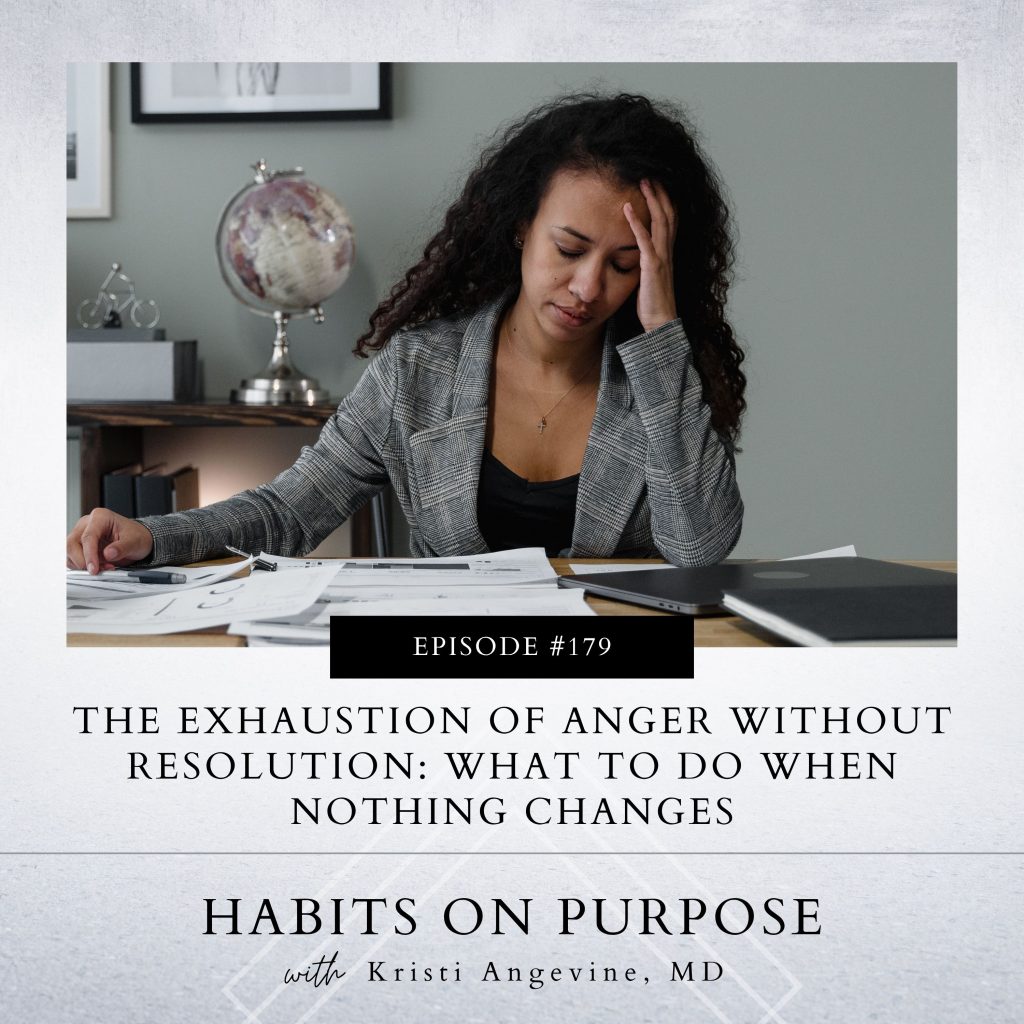
In this episode, I explore the exhaustion that comes when we’re angry about something that won’t shift. We may have done everything we can to bring change, but the world refuses to move. Instead of giving up or disengaging, it’s important to understand a different kind of resolution. This kind of resolution doesn’t rely on anyone else seeing your perspective or the situation matching your vision.
You’ll discover why anger becomes exhausting when there’s no external resolution, what emotions typically hide beneath it, and how to redefine resolution as an internal process rather than an external outcome. You’ll also learn practical ways to work with your anger so you can continue advocating for what matters without being undone by what you can’t control.
What you'll learn from this episode:
- Why we crave external resolution and what we’re really seeking when we want others to change.
- How anger becomes exhausting through cycles of resistance and rumination, not the emotion itself.
- Which vulnerable emotions typically hide beneath anger.
- The difference between superficial awareness and a deeper understanding of your emotional patterns.
- How to redefine resolution as internal peace rather than external agreement.
Listen to the Full Episode:
Powerful Takeaways:
5:30 “Anger itself is not intrinsically exhausting. What actually drains us is staying stuck in a cycle of anger.”
8:33 “What if resolution didn’t have to depend on anyone else? What if resolution meant you found internal peace?”
14:19 “What deeper needs or fears might your anger be trying to protect?”
15:25 “Awareness is powerful, but awareness with depth and compassion is so much more effective, maybe even transformative.”
Featured on the Show:
- Leave a rating and review for the podcast here!
- If you’re interested in connecting with me for private coaching, go to HabitsOnPurpose.com/private.
- Follow me on Instagram!
- Click here to join the mailing list.
- Join Habits on Purpose for Physicians (HOPP) small group coaching program here!
- Join the Habits on Purpose Facebook group!
- Click here to send me any questions that you would like addressed on the podcast!
- Join us in the next Habits on Purpose for Physicians small group coaching program.
- It’s not too late to join us in the Awareness to Action Week.
Related Episodes:
Full Episode Transcript:
Enjoy the show:


That kind of anger, anger in the face of no external resolution, is what we're exploring today. Let's dive in.
Welcome to Habits On Purpose, I’m your host, Physician, Master Certified Life Coach, and IFS Practitioner, Kristi Angevine. Let’s get started.
Hello, hello, everybody. Welcome to Episode #179. I'm Kristi Angevine, physician turned habits coach, Internal Family Systems practitioner, and host of this podcast, where we explore the deeper psychology behind why we do what we do.
Now today, we're diving into what to do with anger when nothing changes. When the situation you're upset about stays the same, the person involved doesn't budge, and you're left to live in that reality. This has been a really rich topic of discussion in the Befriending Anger course that just wrapped up. And it's something that I've personally grappled with too.
So if you've been listening for a while, you know that these episodes often reflect the very lessons that I need to hear myself, and this one is no exception. For anybody who's new here, thank you for joining. My goal with each episode is to help you leave with a richer understanding of why you do what you do and to give you some really practical and concrete things that you can apply in your everyday life.
I want you to finish the episode and leave with something that helps you show up more deliberately for yourself and others, rather than sleepwalking through life on autopilot, feeling like a shell of yourself. I really believe that we need all hands on deck and each of us showing up as fully as we can. And what that means is knowing ourselves, both our strengths and our blind spots, and building the skills to keep meeting ourselves and meeting life with as much clarity and insight as possible.
And yes, as I say that, I have a part of me that realizes, wow, that sounds a little bit like some personal development junkie had a few too many drinks, got tipsy, and grabbed the mic at the party. But it's true. The essence of this podcast and my mission with my work is to empower you to deeply know yourself and to learn a practical sort of skill set and practical tools that help you do what you're meant to do in this life. And we use habits and habit change as the doorway into this. So grab a sip of coffee, settle in for your commute or your walk or the cozy couch time, and let's talk about today's topic.
Now, as I discuss anger in the face of situations that don't change, I want you to bring to mind a time that this has happened for you. It can be something that happened a long time ago. This can be a topic that just started today, or it could be something that you notice as a recurrent theme for you, maybe a relationship issue that just kind of stays the same despite what you would like it to be, or something that has persisted in your organization that just really hasn't budged.
First, I want to talk about the idea of resolution and why we want it so badly. For many of us, when we say we want resolution, what we're really saying is, I want agreement. I want the other person to see my point of view. I want them to really hear it and appreciate where I'm coming from. And then I want them to do something that aligns with what I think they should do. And I want the situation to change in a way that matches my vision and feels good to me.
But here's the hard question. What if resolution by that definition isn't possible? What if the person you're angry with never sees your perspective? What if they never apologize? What if they don't agree that the way you're looking at things makes any sense? What if they never change? What if the situation stays exactly as it is?
I want you to pause here and ask yourself, what comes up in you when you consider that? Why does it feel like a problem if nothing changes? The answers to these questions are going to point you toward exactly what's at the heart of why it's difficult to face something not changing. Later in the episode, I'm going to circle back and redefine resolution. Not as something external that relies on things beyond our control, but more as an internal process that can really change how you approach things that don't change the way you'd like.
And a side note here, changing how we consider resolution does not mean that we're going to stop caring or stop working for change or justice. It simply means that we are going to alter how we view and experience external circumstances so they don't dictate our ability to feel steady inside.
So next, why does anger feel so exhausting, especially when nothing changes? You've probably noticed that anger, when there's no resolution, can feel deeply exhausting. One of my lovely clients calls it the purgatory of anger. And I just love that phrasing. But here's something important. Anger itself is not intrinsically exhausting. What actually drains us is staying stuck in a cycle of anger, leading to craving external change, leading to resisting what's actually going on, then feeling disappointed, then ruminating on every detail, and then cycling back to anger without a solution.
When we get caught in that loop, the anger starts blending with a bunch of other emotions, oftentimes emotions that we haven't yet identified or named. Emotions like fear, sadness, grief, powerlessness. And then it becomes heavier. It's not the anger itself, but the unacknowledged emotions underneath it and the endless wishing that things were different that wears us out.
And here's the thing about anger. There's usually something underneath it. And it oftentimes seems easier to stay in the cycle of anger and resent than it does to feel more vulnerable emotions that are underneath anger like rejection or loss or powerlessness, or disconnection. Our lived experience is that it is easier to avoid those tender emotions. They seem harder to be with than staying on the hamster wheel of anger and resistance, but that's only because we were never taught how to feel them in a way that doesn't seem like it's going to be destabilizing. And this is because all of us absorb the idea that if we allow big, vulnerable feelings like grief or sadness, they will take us over, we won't be able to function, and PS, they're a sign of weakness to even feel them.
But here's the truth. It's not actually easier to stay in the purgatory of resisting anger and churning, and resentment. That is actually the harder thing to do. So let's name what might be underneath anger. Sometimes there's confusion, sadness, grief, loss, rejection, powerlessness, insecurity or exclusion, unworthiness, a longing for something that we can't get, disconnection.
If anger is our cue that we are witnessing an injustice or experiencing a value being compromised, a boundary being breached, or an unmet need, when things externally don't change, we are oftentimes left with what's beneath the anger. And these things that we're left with sometimes can be a really powerful combination of things that really reveal something deeper that is just asking for our attention.
Now let's come back to this idea of resolution and redefine it in a way that could be a bit more useful than the way we conventionally look at it. What if resolution doesn't have to look the way we've always imagined it to be? We usually think of resolution as something external. These people agree with me, they validated my perspective, and then they change. But what if resolution didn't have to depend on anyone else? What if resolution meant you found internal peace? You felt internally at ease. Not because you stop caring or you stop working for change or you just give up, but because you stop letting the lack of external change completely unhinge you.
This is where we shift from thinking of resolution of a problem as an external thing to thinking of it as the inside job that you do. What I mean by this is, say you get angry about something, and you do all the things where you process your anger, you figure out exactly why you're angry, you pursue change, pursue being heard, and the very thing that you are angry about doesn't change. But if in that moment, you remember, what's coming up in me in the face of no change, it's my next layer of work. And my resolution means me looking inside and figuring out what's actually getting stirred up in me in the face of something not changing. And that's powerful work.
When you can do that work, this does not lead you to just giving up or disengaging. This actually opens the door for you to advocate more fiercely for seeing the change that you want to see and being able to function in the face of things not going the way you'd like them to go, so that you exit that spin cycle of anger and churning and ruminating.
So, resolution as an inside job means paying attention to and basically making it your job description to really hone in on what's going on behind the scenes when my anger did not actually result in external change. When you have that knowledge, you don't stop advocating, you don't stop setting boundaries, you don't stop seeking justice, but you do reclaim your energy and clarity. So you're not at the mercy of things you can't control. But you're aware of the tender emotions that are beneath your anger, and you can tend to them even if nothing outside of you changes, even if the deep internal healing is not yet completed.
So this brings me to talking about how deeper awareness changes everything. Now, when you think of awareness, what comes to mind? Oftentimes people think, well, I just, I'm aware of my natural tendencies, I'm aware of my thoughts, I'm aware of my feelings, I'm aware of what I usually do. I have awareness in the moment and awareness retrospectively. Now, to really leverage awareness, we need to be very clear on the difference between awareness simply as a superficial act of noticing and cataloging and awareness as an action that includes deeper understanding.
So when it comes to anger, here's the difference between awareness and noticing your anger and truly understanding it. When your awareness of your anger is more superficial, you might say, I'm angry because they are wrong and they won't change. And then you stay stuck in that loop of getting angry, burning out, and feeling powerless when they don't change. But when your awareness deepens, this is what happens. You'll say, I'm angry because I wish this were different. And under that wish is a hurt, a grief, a fear, a rejection. And when you can say it like that, then you can tend to those deeper feelings, even if you don't fully heal them. And knowing where your anger is rooted, you can stop spinning in resistance and start the work of caring for yourself.
Now, an example in sort of more ordinary, non-mental emotional life of this would be, let's just say you are either biking or you're driving, and you are riding along, driving along, and you recognize like you lose a little bit of attraction, like your tires are not connecting with and gripping the road or the trail. You're losing a bit of attraction, and you don't really know why. So you go investigate. When you investigate, let's just say you notice that there is a slow leak on one of your tires.
So, let's just say you're in the middle of nowhere and you know that this is the case. And maybe like your, you're by somewhere where maybe you can put a little bit of extra air in your tire. Like there's a farm and they have an air pump and somehow you can put a little extra air in your tire, but it's not the real fix. It's not the thing where you've gotten a new tire, you've actually fixed the problem.
So you continue driving or biking. And with this new awareness of what's actually going on that's creating the decreased traction, the next time, a mile or two down the way, that your traction is compromised and you feel the bike moving away you don't expect, you have this deeper understanding of why. And so you're not sitting there wondering like, oh my goodness, what's happening? Why don't I have good traction? You go, oh, I don't have good traction. It's because of this problem. I totally understand. And now I also know what to do about that. And you can have this deeper awareness and an understanding that does not rely on the outside world to change, and also does not rely on you needing to go fix the slow leak, doesn't require you to go fix whatever tender emotions that are there, but can help you approach things differently.
So, I want to pass on for you some questions that can help you work with your anger in the face of things not changing. And there are five of them. So, number one, what do you believe would be different if the situation changed? What more tender, vulnerable emotions might you be able to avoid when you stay angry and ruminate? What deeper needs or fears might your anger be trying to protect? If you stopped wishing things were different, what would you be left with? And then, what does peace look like here if it comes from the inside?
Now, as we wrap up, here's what I want to leave you with. Just remember, anger, it's an emotion that we often misunderstand and for good reason. And it can be even harder to know what to do with it in a situation where the thing that we're infuriated by is not changing. But there is a way to approach it that's more uplifting than exhausting.
So, you may not be able to change what other people think or feel, or do. You may not be able to change a company's perspective on things or an unfair system, but you can stop fighting the wrong fight. You can reclaim lost energy that you normally spend resisting reality. And you can do this by bringing in a depth to your awareness and really focusing on what's really going on when you're angry and what really comes up for you in the face of things not going how you'd like.
Awareness is powerful, but awareness with depth and compassion is so much more effective, maybe even transformative. And all of this together allows you to have a sturdiness and a flexibility in facing things that don't go how you wish they would. So instead of being drained in this purgatory of anger and resistance and resent and powerlessness and unnamed emotions, you can keep showing up for yourself, for others, and even for the causes that you really care about without being undone by the things you can't control.
So this week, I want to really encourage you to turn toward your anger and not just notice it, but listen to what's beneath it, because that is where your freedom lies.
So if this type of topic and reflection resonates with you and you'd like more support applying these ideas in your real life, we are currently midway through the Awareness to Action Week, and you can still join and pick right up where we are. This is a free experience, and it includes live teaching calls. They're all recorded and hosted on a private podcast so you can listen to them later. Group coaching and discussion, Q&A sessions, and access to a private online community. It's designed to take the ideas that I share here and help you actually apply them in your everyday life so you can feel more in the driver's seat, no matter what comes your way. And you can join us at habitsonpurpose.com/preview, and I would love to see you there.
Thank you so much for listening. I have two more things for you. Number one, if you've been enjoying the podcast, it would mean the world to me if you take a moment and leave a review or share it with somebody you think could benefit from this message today. Number two, if this episode sparked something in you and you're ready to take things to the next level, HOPP small group coaching might be just perfect for you. We take everything that you love in the podcast and help you apply it in your life with teaching, coaching, office hours, personal written support between our calls, all in an intimate group with other people doing the same work. We get started soon, and there are still spots available in this round. More information about how to join and all the details are at habitsonpurpose.com/hopp. That's HOPP. Until next time, be kind to yourself, and I will talk to you soon.
Thanks for listening to Habits On Purpose. If you want more information on Kristi Angevine or the resources from the podcast, visit HabitsOnPurpose.com. Tune in next week for another episode.