
Whether it’s at work, at home with your family, or during your social interactions, we all experience anger from time to time. While those of us socialized in the West have been taught to see anger as something inherently bad, it can actually be quite a valuable emotion. Allow me to explain.
Anger is not only a natural emotion; it is actually a signal alerting you to three main ideas: that there has been a boundary breach, a value has been compromised, or that you have just witnessed an injustice. And if we embrace anger, it can radically change our lives.
Listen in as I reveal my go-to tool for managing anger—not by suppressing it, but by inviting it to take a seat at the table within our system. This approach helps you explore the root of your anger with compassion and curiosity, leading to a deeper understanding and appreciation of your core values.
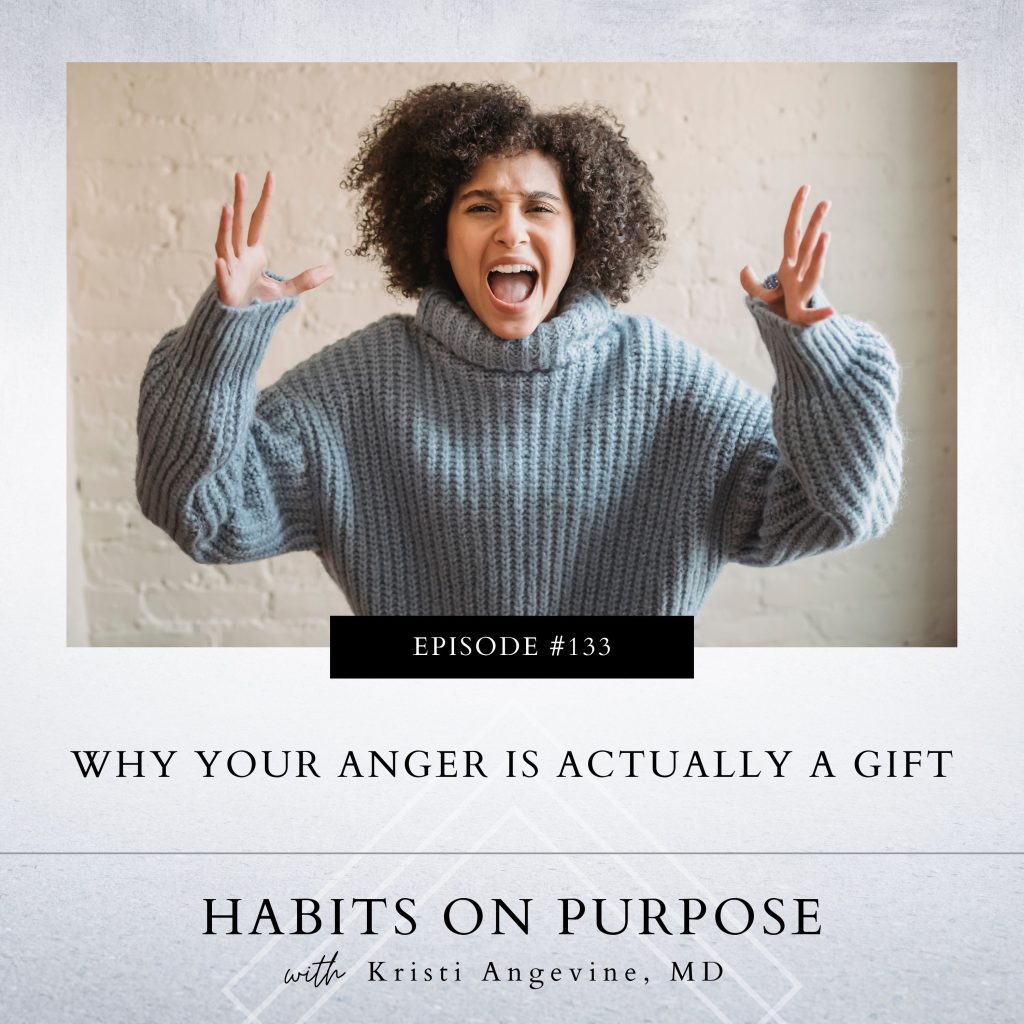
Whether it’s at work, at home with your family, or during your social interactions, we all experience anger from time to time. While those of us socialized in the West have been taught to see anger as something inherently bad, it can actually be quite a valuable emotion. Allow me to explain.
Anger is not only a natural emotion; it is actually a signal alerting you to three main ideas: that there has been a boundary breach, a value has been compromised, or that you have just witnessed an injustice. And if we embrace anger, it can radically change our lives.
Listen in as I reveal my go-to tool for managing anger—not by suppressing it, but by inviting it to take a seat at the table within our system. This approach helps you explore the root of your anger with compassion and curiosity, leading to a deeper understanding and appreciation of your core values.
What you'll learn from this episode:
- Why we’re wrongly taught that expressing anger is something to avoid at all costs.
- How anger can be used as a signal to identify new information for our consideration.
- The three ideas to which the emotion of anger alerts us.
- What the CCOP (Compassion and Curiosity on Purpose) tool is and how to use it.
Listen to the Full Episode:
Powerful Takeaways:
5:02 “Knowing what to do is one thing and being able to actually apply it is another skill altogether.”
8:20 “Rather than being a destructive force or a sign of immaturity, anger is actually just a signal.”
10:10 “Whether it is a boundary being crossed, a value being violated, or an injustice that we’ve witnessed, it is simply a part alerting us to new information.”
16:36 “Anger is a gift. Anger is a friend with important information.”
20:37 “It’s not something to be feared or suppressed or fixed. It’s just something to be understood.”
Featured on the Show:
- Leave a rating and review for the podcast here!
- If you’re interested in connecting with me for private coaching, go to HabitsOnPurpose.com/private.
- Follow me on Instagram!
- Click here to join the mailing list.
- Join the Habits on Purpose Facebook group!
- Click here to send me any questions that you would like addressed on the podcast!
Related Episodes:
- 10: Stop Asking Dead-End Questions
- 9: Making Decisions Ahead of Time
- 8: The Truth About Your Inner Critic
- 7: How to Feel Better Now Part 2
- 6: How to Feel Better Now Part 1
- 5: Imagining What’s Possible
- 4: The Power of Narrating Your Experience
- 3: You Might Be a Perfectionist If…
- 2: The Root Cause of Your Habits
- 1: The Habit Change Advice You’re Missing
Full Episode Transcript:
Enjoy the show:
Today's topic is one I've been meaning to discuss for a really long time. It's something I think that many of us experience, but oh so often we struggle to fully embrace and understand. And that topic is anger. If you've ever felt that anger's a problem, something you wish you felt less often, or an emotion that you should hide, dismiss, or feel ashamed of, this episode is for you. Let's dive in.
Welcome to Habits On Purpose, a podcast for high-achieving women who want to create lifelong habits that give more than they take. You'll get practical strategies for mindset shifts that will help you finally understand the root causes of why you think, feel, and act as you do. And now here's your host, Physician and Master Certified Life Coach Kristi Angevine.
Hello, hello, everybody. Welcome to my new listeners. Hello to my older listeners. I am recording this in my usual spot in my home office in Central Oregon. And the reason I even mention where I'm at is I haven't been here in over a month because my family and I went on a ridiculously fantastic adventure.
We spent about 5+ weeks on a tiny Greek island in the Aegean Sea, and it would take many episodes for me to share what the experience was like and all the things I learned and all the things we experienced. I can't speak for my entire family, but I think it's safe to say that all of us had a really life-changing experience.
It was filled with many memorable things, lots of difficulties and ups and downs, and all the things that come with international travel and making transitions from a place of familiarity to a place of unfamiliarity. Overall, I would say that we so enjoyed the connection and the fun that unplugging and slowing down allowed for us to have.
And to say that it's been disorienting to return home is an understatement. Just as a tiny example. Being without a car, without the need for a car for a month. Walking everywhere on marble streets. Seeing masses of feral cats everywhere we would go.
And spending lots of time trekking up and down windy, curvy, stair-lined paths in the city, to then returning to the States where even in our really lovely, very walkable town, everything feels insanely spread out. Where we have to drive our car to get just about anywhere, is just one of the many things that feels very surreal about transitioning from this tiny island back to our home.
So although I really love where I live, and although we are now over the jet lag and we are slowly but surely working on the global fatigue that kind of comes from all the travel, there are lots of things that just feel kind of off and feel different. It's like I can't unsee that different way of living.
Being there changed a lot for me. I had a lot of A-ha experiences that I'm still processing and still figuring out. So if you've ever felt drawn to slow travel, whether it's domestically or abroad, and you haven't already made it part of just your normal everyday life, I highly recommend it.
So, before we left to go to Greece, I had been noodling on how to talk about anger on the podcast in a way that was going to be palatable and useful and wasn't just going to be the same old, same old that you hear.
And before we get into discussing what is now one of my favorite emotions to learn from, anger, I want to share something a little bit personal that just occurred for me recently. As I was preparing for this episode, I found myself wrestling with these familiar feelings of doubt and perfectionism.
I noticed a part of me thought, “What can I possibly have to offer? I have no idea where to start. This is going to take forever. What I'm going to offer is going to be nothing of use to anybody. It's just going to be a waste of airspace. People are going to hate the podcast. They're going to skip the podcast. This is just going to be a waste for everybody involved.”
In hindsight, I can see now that it was classic second guessing, procrastination, perfectionism, fueled by this fear that what I was going to share just might not be very valuable. And the irony was not lost on me. Here I was getting stuck in the very struggle that I help my clients navigate.
Intellectually, I know what to do when this happens. But knowing what to do is one thing and being able to actually apply it is another skill altogether. So as I was feeling tortured and miserable and procrastinating on figuring out what is to say on the podcast, thankfully it hit me.
This struggle that I was in was actually the perfect illustration of an idea at the heart of what I wanted to talk about when it comes to anger. So let's get into anger. Let's examine it, and I will circle back to how this connects with the struggle I was having before this podcast with self-doubt, second guessing, and procrastination.
So as we get started, I want you to bring to mind a time that you felt angry. This could be a time where you felt a small flash of frustration, maybe even just a brief bit of road rage. Or it could be a time where you were furious, you were livid for days, and it kept coming up and kept coming up and kept coming up.
I want you just to think about how you feel about having felt so mad? When you had it, did you try to push it away? Did you feel impatient that it kept coming back, if it was recurrent and long lasting? Did you judge yourself for being angry?
If you're like many of my clients, and many of us in general, there might be a negative connotation surrounding anger, and you may have a lot of negative interpretations about being angry. Many of us who were socialized in the West have been taught to see anger as something inherently bad. It's a character flaw, it's unprofessional, it's immature, it's even shameful.
And we pick up on messages that suggest that anger is something that teenagers feel, but not something for mature adults. Anger is seen as unbecoming, especially if you're a woman. And we're taught that expressing anger is something to avoid at all costs. That anger is something that you should hide.
Anger is risky. Anger is something that can offend people. If you are publicly angry or you express your anger, you might get rejected, you might disappoint people, you might get fired.
And when it comes to interpersonal dynamics, some people have a narrative that anger is not synonymous with good, healthy relationships. It sounds like, “Good moms don't get angry with their little kids. Good partners don't feel angry with one another. Good doctors, good teachers, good leaders, they don't get mad.” And if they do, they don't show it, or they express it in a very elegant, metered way.
But what if I told you that anger is not only a natural emotion, but also an extremely useful one? And that if you can embrace the anger for what it is, a repository of useful information, you can radically transform your relationship with this one particular emotion, and that will be a game changer?
Anger is like a door chime that rings when the door to a store is opened. It's like an alarm that gets tripped. And it has an extremely valuable role. And this is its role. Anger alerts you to three main things. It alerts you that there has been a boundary breach, a value has been compromised, or that you have just witnessed an injustice.
So rather than being a destructive force or a sign of immaturity, anger is actually just a signal. It is a signal that alerts you to important information. Did you witness someone being bullied? Anger shows up. Have a clear boundary that was explicitly violated? Anger shows up. Feel mischaracterized or witness somebody else be mischaracterized? Anger shows up.
Anger alerts us to a boundary breach, a value that has been compromised, or shows us that we have just witnessed an injustice.
Now, I don't know about you, but if somebody came to me and said, “Hey, listen, I'm going to send a friend of mine with you and they're going to be here with you on this trip you're taking. They're going to let you know if anything has been compromised, anything important… if any injustice happens, or if there are any lines that are crossed, boundaries that are breached… and they're just going to let you know.”
My first thought would be, “Amazing, that sounds great. That sounds like a useful person to have on a journey.” Well, that's what anger does. Now, you know I love Internal Family Systems, so let's shift Internal Family Systems and think about anger in that context.
Through the lens of IFS, anger is an emotion that comes from a part of us, a part of us that has a good intention. All of our parts carry valuable information and they have positive intent, even if the positive intent is not obvious at first glance. And just as there are no bad parts in our system, there are no bad emotions.
In this way, we can think of anger not as this enemy or character flaw, but simply as an emotional experience that is calling for our attention. When we experience anger, it's because a part of us is trying to alert us that something feels wrong. Whether it is a boundary being crossed, a value being violated, or an injustice that we've witnessed, it is simply a part alerting us to new information that we get to consider.
Now, to keep this really concrete, I want you to imagine that you had a friend. This friend would send you a text when they detected or picked up on something that was wrong or dangerous. They're really accurate at their detection, and this is what they would do. They would just shoot you a text and let you know.
When it comes to anger, the mistake that many of us make is that we judge, resist, or attempt to suppress or dismiss the anger. The mistake that many of us make with anger is that we dismiss it, we judge it, we resist it, or we attempt to suppress it or bottle it up.
And this makes a lot of sense, right? If we've been conditioned to think that anger is something that we should be embarrassed by, something that makes us less than professional, that shows how we are less mature, something that is risky to the integrity of relationships, of course, we're going to try to get away from it.
So what I want you to do to keep this kind of tangible, is I want you to imagine your anger is a person. And imagine that this person's job is to just alert you to problems. Imagine that this person calls you up or they shoot you a text that says, “Hey, at around 5.30 this evening, your value of transparent communication and honesty, it just got stepped all over by so-and-so.”
And then about two hours later, you get another message and it says, “Hey, just so you know, I saw so-and-so was being treated unkindly in the break room and it was blatant snobbery and meanness.”
Let's just say that this person just always sends you a text when they detect that something is wrong or something is dangerous. This would be pretty good information to know, right? Now imagine being upset with this person every time they shared this information. Or imagine that you were ashamed that this person would visit you and talk to you.
Imagine you just blew this person off or you pretended they weren't there or you completely invalidated their concerns. If this happened, the person whose job it was to tell you this information, they might try to message you again. They might say, “Hey, did you get that message? Did you see what happened?” They might turn up the frequency or the volume of their messages.
They might increase the intensity of their messages in order to get the information through. And this is what so often happens with anger. Just like a text coming in from a friend, we detect it, we feel anger. But we so often will instantly push it down, bottle it up, judge it, beat ourselves up, tell ourselves that we shouldn't feel it.
And then if we keep feeling it, either we eventually feel mired and resent, which is what anger turns into when it ferments for long enough. Or it builds and builds and builds and eventually we just snap and our anger just bursts out of us in this explosive, loud way.
What I would like to offer to you is to imagine the difference that we would experience if instead of pushing anger away, we just noticed it and we accepted its presence as something useful, and then invited it to have a seat at the proverbial table in our system.
And when it showed up, we treated it with the same openness and respect we have for other emotions. Imagine feeling angry and then pausing and realizing, “Wow, there's some important information here,” and just tuning into whatever that data is.
And then imagine working to understand the reason that you're angry and using what you learned to guide your decisions so that what you do is more aligned with your core values. This is the type of relationship with anger that I would like to present.
This is what's possible when we see anger as a precious, useful part of our psyche's internal team. So what do you think? How comfortable would you be embracing the feeling of anger? Now, many of you might think this is just crazy talk. I mean, how do you embrace anger without just becoming enraged, angry all the time? Or somebody who's just prone to being negative or cynical or upset?
What I want to do, is I want to give you a really practical tool that can help you change your relationship with anger, and frankly, befriend your anger. Or if you're going to use IFS terms, befriend the part of you that feels angry rather than see your anger as a problem to be fixed.
And the tool I love for this is a tool I call C-C-O-P. This is Compassion and Curiosity On Purpose. So here's how you use this tool. The next time that something happens and you feel angry, I want you to start noticing the early signs of anger.
Notice when your anger, on a scale of 1-10, is maybe a two, a three, a four, or five. And the reason for this is you want to notice it before it's an eight, nine, or 10; before it's way too out of control and too much.
So whether it's a tightening in your chest, a clenching of your jaw, feeling like you're starting to see red but not quite seeing red, a surge of heat, as soon as you notice an early sign of anger, pause. Take a moment and name what you're feeling. Simply say to yourself, “I'm feeling angry right now. This is anger.” And after you do this, you need to be compassionate on purpose.
So what's this look like? To be compassionate on purpose, remind yourself, “Anger is a normal human emotion. Everyone feels angry sometimes. It is a sign that I have picked up on some injustice. Where I am perceiving a line was crossed. I bet there's a good reason I'm feeling this way.”
After you are compassionate on purpose, be curious on purpose. And the way you can be curious on purpose in this particular situation, if you don't know exactly how to inquire and how to learn what this anger is here to show you, is just simply ask yourself this one question, “What is the injustice? What's the boundary breach or the value that has been compromised here?”
So by pausing, normalizing and validating the feeling, being compassionate on purpose, and then being curious on purpose for what the feeling is there to show you, you will shift from a reactive state to a reflective state. And this will allow you to understand the root of your anger.
This might sound like a leap if you don't have an easy relationship with your anger, but anger is a gift. Anger is a friend with important information. And anger can be an activating kick-in-the-pants emotion that drives you to effectively act.
Now, you might not yet be persuaded that anger is a gift, but I'm hoping that you can be open to the idea that anger is not something to be ashamed of. It is a valid, natural emotion that all humans experience at all ages, all genders, and all cultures.
Once you slow down and attempt to understand it, that's how you start changing your relationship with it. And eventually, you can stop seeing it as a sign of weakness or immaturity or being out of control. You can start recognizing that it is a powerful, useful emotion that is basically a guide.
At the beginning of this podcast, I shared how I was feeling really stuck. I was second-guessing, I was having all sorts of perfectionistic thinking, and I was doubting myself and procrastinating on this episode. Behind all of this was this really deep insecurity and this worry about not being able to share anything of value. And underneath this insecurity was a feeling of ineptitude and inadequacy.
For a variety of reasons, I didn't want to just be with those emotions of inadequacy, ineptitude, and insecurity. So what'd I do? Well, I tried to push them away. I tried to fix them. I tried to do all sorts of things to not feel like that, which led me to procrastinate.
But thankfully, because I do this work often, it hit me that there's a good reason that I'm feeling what I'm feeling. And if I could stop and use the CCOP tool, I would be able to stop resisting, stop procrastinating, and figure out what was really going on for me.
So this is what I did. I paused. I tuned into how my body was feeling, what emotions were there. I named what I felt. I basically said, “Wow, I'm feeling worried, insecure. I'm feeling inadequate.” And then I validated and normalized what I was feeling; aka I used compassion on purpose. And what this sounded like is I reminded myself that what I was feeling was normal. And not only was it normal, but it's extremely common. And it's okay to feel this way as part of my creative process.
The next step was I got curious. I asked, “How come I feel inadequate? How come I'm worried about the value? What is going on for me that this is what's here? This is what's getting stirred up,” and I just listened. I heard a part of me that was just scared; scared of failure, scared of judgment, scared of being mediocre, scared of rejection.
And this is not an unfamiliar sort of narrative that I have, particularly when I'm tired, particularly in times of transition. And by going through CCOP, Compassion and Curiosity On Purpose, it helped me loosen the grip on the reins. And by allowing whatever messages needed to be voiced and heard and understood, I was able to exit this merry-go-round of second-guessing self-doubt.
Things just softened because I slowed down, inquired of what I was feeling, and that helped me understand what I was feeling. And by understanding it, basically being with the very thing I didn't want to be with, everything softened and faded.
And the same thing is true of anger. When we stop pushing it away, stop trying to fix it, stop treating it like a problem that needs to go away, we can learn why it's there. So just like I had to reframe my own struggles with perfectionism and doubt, I want to invite you to reframe your relationship with anger and how you think about it.
Consider what it would be like to see it as a part of you that's just trying to communicate something valuable. It's not something to be feared or suppressed or fixed. It's just something to be understood.
Now, the final piece to having a healthier relationship with the emotion of anger is to understand what you think and believe about anger; anger for yourself and anger for others. To this end, I encourage you to take some time to investigate your thoughts about anger.
Anger is a neutral entity until we have thoughts about it. So what beliefs do you hold about anger? Where did these beliefs come from? Are these beliefs serving you or do they keep you miserable? By bringing these thoughts and beliefs into the light, you can start to shift them. And you can begin to see anger for what it really is, a signal, a protector, and a guide.
So let's recap. Although we are socialized to see anger as a problem, it is not a flaw to be ashamed of. In fact, it is a gift, and you can think of anger as an advisor, consultant, or friend. This emotion simply serves as a signal to alert you to appreciate that something important has been compromised.
When you notice anger, you can use what I call the CCOP tool, Compassion and Curiosity on Purpose, so that you can slow down, tune in, and learn what that emotion is trying to communicate to you. When you do this, you will get a much better appreciation for what your core values are and a much calmer relationship with this emotion.
And remember, just as I had to adjust how I was approaching my struggles with insecurity, doubt, perfectionism, and procrastination for this podcast episode, you can adjust your relationship with anger in a way that you can understand it. Treat it with curiosity, treat it with compassion, and you will find that it has very, very important insights to offer.
Just imagine, if you are somebody who has younger people in your life, or somebody who is in a position where you perhaps are teaching or students that you work with, if you can model a healthy relationship with the emotion of anger so that other people see that it's possible to honor your anger, to learn from your anger, and not just bottle it up.
This is how we start making community-wide change and cultural changes. So thank you for joining me today on the Habits on Purpose podcast.
I hope that you as a new listener enjoyed what you learned. If you are new here, I do encourage you to go back to the beginning. Episodes 1-10 give you a really solid foundation for some of the premises that I talked about on this podcast.
And once you've listened to those, if you just flip through the other episodes, you'll find things that you're drawn towards. You can just pick and choose what works for you, or you can just binge them all in sequence.
So if you found this episode to be helpful, I would love to hear from you. Leave me a review, share the episode with a friend, or feel free to reach out to me directly. You can do this by joining my email list and then pressing “Reply” to any email.
Until next time, have a great week.
Like what you're hearing on the podcast and want some more? If you want to take the ideas that you're learning here on the podcast and apply them in real life so you can get real changes, coaching one-on-one or in a small group may be perfect for you.
My coaching comes in two flavors; small group coaching for women physicians, and private coaching for anyone; men, women, physicians, non-physicians. To learn more about private coaching, go to HabitsOnPurpose.com/private. I keep a very small group of private clients so that each client gets a lot of individual attention, and I currently have a few openings.
The coaching I do is a combination of different modalities, including cognitive, somatic, and Internal Family Systems informed approaches. I would love to connect.
If you're a woman physician and you're interested in having a small group experience with a community of like-minded physicians who are working on their habits, you should join me in the next round of Habits on Purpose for Physicians.
Habits on Purpose for Physicians, otherwise known as HOPP, is a six-month coaching program where I help women physicians design deliberate habits. We spend six months teaching and coaching in an intimate group where you can work on changing patterns that take more than they give.
So whether it is second-guessing, a persistently ruthless inner critic, people-pleasing, overextending at your own expense, perfectionistic thinking making you miserable, the perpetual guilt of not doing enough or not being enough, your patterns have root causes just waiting to be unravelled.
And in HOPP, you learn practical tools and ideas and you get deep dive IFS coaching so that you can find these root causes and then rewire new habits for the rest of your life. So to learn more and join the waitlist, go to HabitsOnPurpose.com/HOPP.
When you join the waitlist, you'll be the first to hear about enrollment. We start in October, and enrollment is first come first serve. We cap the group to keep the community small and intimate. So check out group coaching at HabitsOnPurpose.com/HOPP, or private coaching at HabitsOnPurpose.com/private.
Talk to you later.
Thanks for listening to Habits On Purpose. If you want more information on Kristi Angevine or the resources from the podcast, visit HabitsOnPurpose.com. Tune in next week for another episode.

