
How does embracing your authentic self shape your mindset around money? In this special episode, we dive into the powerful connection between intuition, courage, and financial well-being. Joining us to share her game-changing insights and money habits is the amazing Dr. Latifat Akintade.
A gastroenterologist, practicing physician, and founder of MoneyFitMD, Dr. Latifat is committed to helping women physicians take charge of their finances, live the rich life they were born to live, and create wealth without burning out. Today, she’s sharing her background and methodology for achieving financial liberation.
Listen in to learn what it means to practice full authenticity, how emotions like fear and regret can be gifts, and how to align your values with your financial investments. Dr. Latifat also provides practical steps to start your journey to financial freedom today and plenty of real-life examples to inspire your success.
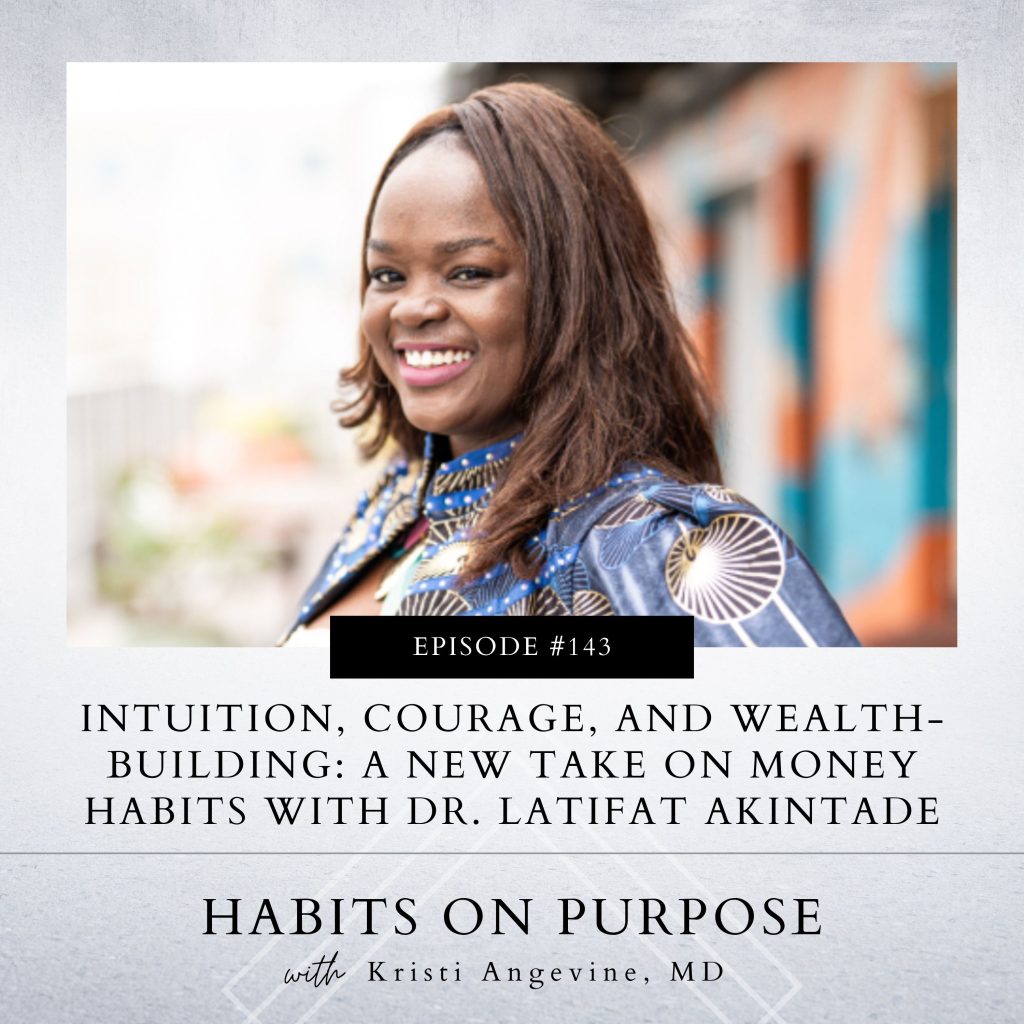
How does embracing your authentic self shape your mindset around money? In this special episode, we dive into the powerful connection between intuition, courage, and financial well-being. Joining us to share her game-changing insights and money habits is the amazing Dr. Latifat Akintade.
A gastroenterologist, practicing physician, and founder of MoneyFitMD, Dr. Latifat is committed to helping women physicians take charge of their finances, live the rich life they were born to live, and create wealth without burning out. Today, she’s sharing her background and methodology for achieving financial liberation.
Listen in to learn what it means to practice full authenticity, how emotions like fear and regret can be gifts, and how to align your values with your financial investments. Dr. Latifat also provides practical steps to start your journey to financial freedom today and plenty of real-life examples to inspire your success.
Enrollment for the HOPP small group coaching program is open until November 3rd! If you’re grappling with imposter syndrome, self-doubt, people-pleasing, or all of the above, this is your chance to break free from these patterns. Secure your spot here!
To discover how private one-on-one coaching can beautifully align with creating the life you desire. Click here to explore the possibilities!
What you'll learn from this episode:
- Why emotions like fear and regret can be valuable lessons, but shame rarely is.
- Ways to strategically manage your time and money for future success.
- How to turn down the noise and discover what you really want in life.
- Four simple steps to begin your financial journey of doing rather than passively consuming.
Listen to the Full Episode:
Powerful Takeaways:
19:25 “In order for me to be able to practice in full authenticity, which is where my secret sauce is, my authenticity. I needed to always have a choice.”
20:15 “Many times we think negatively about certain emotions like regret, fear, but sometimes it can be a gift. My avoidance of regret in the future is the gift that made me take action.”
28:48 “When you start to align your money and your investment with [your purpose and values], you will feel rich in the way that doing it, “the right way,” would never, ever make you feel.”
48:23 “The problem is not that you don’t have time—it’s that you’re not being strategic with that time.”
54:13 “The most important thing with investing is to make it simple. Simple beats complex. In fact, there is data.”
Featured on the Show:
- Leave a rating and review for the podcast here!
- If you’re interested in connecting with me for private coaching, go to HabitsOnPurpose.com/private.
- Follow me on Instagram!
- Click here to join the mailing list.
- Join HOPP small group coaching program here!
- Join the Habits on Purpose Facebook group!
- Click here to send me any questions that you would like addressed on the podcast!
- Dr. Latifat Akintade: Podcast | Book | The Money School
Related Episodes:
Full Episode Transcript:
For today's episode, we're going to dive into two things you might not ordinarily put together. What does being your authentic self have to do with your mindset around money? Well, today we're going to get into the intersection of intuition, courage, and money.
Money is a topic that's at the heart of so many things. On one hand, it's simple. It's simply a currency. On the other hand, it's quite complex. How to make it? How to use it? What's enough? Who says it's enough? How do you invest? What do you do with debt?
Not to mention the angst that can come if you feel like you don't quite understand money and finances and investments as much as you'd like to. My guest today is Dr. Latifat Akintade, and her mission is to empower women to feel confident around money while they build wealth and create freedom, and do it while being true to themselves. Let's get started.
Welcome to Habits On Purpose, a podcast for high-achieving women who want to create lifelong habits that give more than they take. You'll get practical strategies for mindset shifts that will help you finally understand the root causes of why you think, feel, and act as you do. And now here's your host, Physician and Master Certified Life Coach Kristi Angevine.
Hello. Hello, everybody. I am so happy to have you here. Well, I have another conversation episode.
Before we get started with introducing today's lovely guest, I want to tell you about a time sensitive offer just for women physicians. Habits on Purpose for Physicians, or HOPP, small group coaching, is open for enrollment until Sunday, November 3rd, 2024.
If you already know you want in, I want you to pause right now and go directly to HabitsOnPurpose.com/HOPP and sign up. Because once the spots are full, enrollment will close until the summer of 2025.
Now if you are on the fence, or you're not quite sure what HOPP is, who is HOPP small group coaching a fit for? See if you can relate to this. If your habits take more than they give, and you struggle with things like rumination, perfectionism, people pleasing, feeling like an imposter, second guessing, a ruthless inner critic, then HOPP is going to teach you how to unpack these tendencies and change them to ones that are not so draining.
If you regularly feel rushed, overwhelmed, out of control, lots of guilt, frustration, shame, irritation, and perhaps you even deep down feel inadequate, defective, or maybe just a generalized sense of a lack of belonging, HOPP will help you unravel these feelings so you understand the root causes for them.
But HOPP small group coaching isn't just about awareness and understanding, it's also about helping you make real world changes in your everyday life. Want to stop being so reactive? Want to curb doom scrolling? Want to stop emotionally eating, shopping, drinking, escapist reading, binging on Netflix? Want to start saying no without guilt?
How about leaving the OR and not ruminating? Leaving work at work so you can be present at home? What about just liking yourself, and not feeling like a never-ending self-improvement project with a never-ending to-do list?
In HOPP, you get an intimate group of women physicians who truly understand you, a sense of shared humanity, and coaching with an emphasis on Internal Family Systems. The program is six months, with weekly coaching and weekly office hours.
And it's everything I wish I would have known; so that you can feel less stuck and more agency more quickly than I did. And over the course of six months, you develop a robust mental/emotional set of tools and skills that you have for life.
We start November 5th, 2024 and you can get all the information with the dates, the times of the calls, the HOPP philosophy, what other physicians who've done the program before are saying, when you go to HabitsOnPurpose.com/HOPP.
This program helps you take the ideas you learn on this podcast and actually apply them in your real life for real change.
Now let's shift gears and let me introduce today's amazing guest, Dr. Latifat Akintade. Latifat is a gastroenterologist and an expert on money and money mindset. I will let her continue her introduction.
Kristi Angevine: So welcome to the podcast, Dr. Latifat Akintade. I am so excited to have you here. I'm also so excited that your name came out of my mouth without too much of a stutter.
I'm just going to say, before you even introduce yourself, you and I were talking before the podcast and there was a moment where I was thinking, “Oh my gosh, I wish we had pressed record as we were chit chatting, because some of the things we were talking about, I think are going to be so valuable for the people here.”
So we will get into it. But before we do, for the people who don't yet know you, can you introduce yourself?
Dr. Latifat Akintade: Absolutely. Thank you for having me here on the podcast. It's a pleasure to come chat with you, with people listening, but also it's been a pleasure just chatting with you before sharing our conversation with the world.
And my hope for this episode is that people will get whatever it is they need to get, at least one thing that can hopefully make a difference in their financial life.
But for those that haven't met me, I'm Dr. Latifat. I'm a GI doctor practicing physician. I'm a mama of three little ladies, and I'm also the founder of Money Fit MD, which is a platform that is 100% committed to helping women physicians take charge of their finances, live the rich life that they were born to live, and create wealth without burning out.
And I'm sure we'll go into more details about how I got in here and all that good stuff, but I think that's a good intro for now.
Kristi: Oh, it's a perfect intro. I want to know about the inception of your journey and how you got to where you were. I know that we could probably sit and talk for a weekend about all the complexities. So I'm going to want to know about that in a second.
But first, can you tell me where you are calling in from? Where are you in the world?
Latifat: I'm in Sacramento, California right now. If we were talking last year, I could have been in any of, I don't know, 20 countries. But at this moment, I am in a place we call home right now, which is Sacramento.
Kristi: Amazing. And of course, teaser for everybody listening, we get to hear a little bit about the fact that Latifat and her family traveled around the world about a year ago, and were in a bunch of different places.
So I would like to know… We've met before at speaking places, but we've not been able to sit down and chat like this. And so I know little bits about you here and there and little things. But I'm curious, is there something that you could share that maybe is something that people who see you on Facebook or see you in places, maybe they don't know about you? Like a hobby or something… That in the first five minutes people don't usually get to know that you could share?
Latifat: People don't know that I'm such a homebody. I am very, very content with the simplest of things. I will have a great weekend just hanging out with my family in our backyard, in the hammock. But also, I'll have a great time just sitting down and hanging out with my friends.
I don't know if people know this, but relationships are so important to me. Trust is really, really important to me. I don't try to make people trust me, but I try to maintain a general level of trust for myself. And I hope that spreads across to other people. But I hope to never compromise on that part, and just how much relationships truly feed my soul in the best way possible.
Kristi: Oh, so good. So this is the perfect segue. I mean, talking about relationships and your relationship with your goals and with your work and with money, your work as you described, really helps other people examine and understand, and then deliberately design, their relationship with money and all the things that are related to that.
Can you share a little bit about how on earth a physician does what you do? Found your way into not only learning about money, but teaching and empowering other people to have a radically different relationship with it?
Latifat: Ten years ago, if you told me I would be talking on a podcast or speaking or publishing books and doing all the things that I do now, I would have laughed at you and said you were smoking something. Because that was not the plan I had for my life. That was not the trajectory. If we did a cross sectional, just cut through my life at that point and we looked into the future, this is not what we would have anticipated at all.
Because, literally, eight years ago I knew nothing about money. I did not know where my money was. I did not know who owed. I had student loans, but I didn't even know how much I owed or who I owed it to.
My only goal, my only desire, honestly, was to be a good GI doctor. That was my goal. If I died being one of those attending of 10 years and I could smell your diagnosis from 50 feet away, that would have fed my heart to the biggest content.
But I also knew that… At that point I had two kids. Now we have three kids... I also knew that if the only thing I focused on was that, that I was going to end up hating that. That if the only thing I focused on was the academic part of being a good doctor, that I was going to regret my decision to become a doctor. That I was not going to be the kind of mother that I wanted to be, and that I would live a life of regret and apologizing.
And the reason why is … many in your audience may know this… but unfortunately, we live in a world where the systems of medicine were not necessarily made with minorities in mind. And if you're a physician that cares about disparities to any extent, there will be a moment in time when you may clash with the people that are paying you.
Clinically, my goal was to do IBD, which I do inflammatory bowel diseases like ulcerative colitis and Crohn's. And those are best done in an academic setting or large hospital system. So I knew I was going to be working for someone. But that thought eight years ago was the fear of that future that I was going to have if all I did was focus on being a doctor only.
What got me to start to look at my own personal finance and say, how do I create my money so that I will always have a choice? How do I create my money so that I'm never afraid of my family's safety, security, or stability financially? How do I make sure that if someone decides that I was going to get fired, that it was not going to be the most devastating thing that could happen to me in my life?
And what that meant was learning finances. So I was like, okay, I need to figure out who I owe and what I owe, because here I am making attending money, but it doesn't feel like it. It's coming and going and I have nothing to show for it. It's almost as if I was still making a fraction of this, which is what we made as fellows and as residents.
So I knew that it wasn't just how much I earned that mattered. It wasn't how much I earned that was going to create choices for me. Freedom, for me, was what I did with the money that I was earning. So I started learning what a budget is. I hate budgeting. I still do. I still don't do traditional budgeting. Spreadsheets, I hate spreadsheets. I still do. I hate memorizing.
You would think that as a smart physician and a smart human, like all your audience probably is, that a 401k… What is a 401k should not be a hard thing. I've learned things that are more complicated than that. But for some reason I just could never remember what a freaking 401k was.
So I was like, okay, I need to figure out how to actually do money in a way that's going to make sense and be successful for me. So I started changing how I did money. Instead of budgeting, I started thinking about my spending plan. How do I want my money to work for me? Where do I want my money to go?
Instead of trying to memorize all the terminologies, I'm like, okay, memorizing is not the most important thing, doing is the most important thing. So I'm not going to try to memorize what a 401k is anymore. I'm just going to do what a 401k is. I'm going to pretend that life is up to date, or life is a dictionary where I can refer to the definitions whenever I want.
And you would be surprised by how that changed everything for me. Where instead of letting myself be blocked and not doing, because I thought I had to memorize first, I started creating results and then the memorizing and the learning came after. Because now I don't have to memorize what a 401k is because I was doing it.
So what I realized was that the best way to actually do money is to do money. And that's how things started changing. Where now, instead of trying to find the best system, I just started doing. My debt started going down. I paid off student debt in two and a half years instead of the five years that I wanted to pay, without taking extra shifts, without hustling.
And I'm like, this stuff is actually working. However, at no point did I want to start a business. I was not interested in it. I was not an entrepreneur. And part of that was I grew up in a family where I was the only physician, the only science people. I have accountants in my family. My sister's a lawyer. And so they did all the things.
And Latifat was the nerd, was a science nerd, right? So I labeled myself as a physician, not a business person, not an entrepreneur. So the entire time I'm learning money and doing money and making progress and investing in real estate and doing all this other stuff, at no point did I ever make the link that it was possible that I could do this.
And then I started helping people. I started helping my friends. They were paying off their debt. I would have primary care doctors that are having multiple six-figure, seven-figure net worth, because they're doing what I was telling them to do.
But I don't want a business. It is not for me. And then the pandemic happened at the very beginning. I watched healthcare systems freaking out, firing nurses, firing doctors, physicians earning way more than I am clinically were worried about their income. I had zero concern about money.
And the beauty of that was I could focus on the things that money directly couldn't do, like the mental health of my kids, making sure my parents were fine, making sure my community was encouraged. Because, remember, people were stuck at home and going crazy. But I could go out because I was a physician.
So I would get donuts and literally do drive-by with donuts to encourage people. I could focus because I was not worried about money. And it was at that moment that I was like, okay, I don't have a choice. I have something that works without hustling, without judgment, without shame. And I have to teach people.
And that is how The Money School and Money Fit MD and all the other stuff came into being.
Kristi: Thank you for sharing that. That's such a gorgeous story in so many ways. I have a feeling somebody listening to this is probably going to press pause and go for a walk and just think about how they have something similar that they want to do but they have a bunch of blocks. I really think this is going to inspire somebody to take action on this.
I have a question for you about… So I love how you recognized, “Oh, I'm trying to memorize this stuff versus do this stuff. And when I reverse the script and I just go and do, and start doing, well, wouldn't you know? I started learning. And then I don't have to force myself to memorize. It's just naturally internalized, and therefore I haven't memorized.”
I think a lot of people listening to this podcast are of the mindset that you go and you learn and you do the intellectual part of things and you research and you make sure before you take action. And there's a time and a place to do that, right? If you don't know how to drive a car, perhaps getting in and just getting on the Autobahn, maybe not the best idea.
And yes, there's a time where the actual, real learning is just as you said, it's in the doing. So my question for you is, what helped you start doing when that was not your norm?
Latifat: To be honest with you, what forced me to do was my fear of the undesired future that was waiting for me if I didn't do it. One of the things I didn't share earlier was, I grew up in Nigeria. I moved to the US when I was 18. I lived in L.A. I went to UCLA for college and then UCSF for med school, moved to New York for residency, and then came back to California for fellowship. And then I stayed in California afterwards.
And one of the things that… I'm grateful for my journey, for the good, the bad, the funky, the ugly. But many people demonize student loans. But for me, my parents were primarily in Nigeria. Student loans for us were… My siblings and I, five of us, lived together when I was in med school.
Student loans are how we made sure that electricity bills were paid. It was how we made sure that our rent was paid for all of us, including my youngest sister. My youngest sister was still in high school at that point.
There's a lot of work that should be done on student loans, but I needed to reframe my thoughts from “this is horrible” to “I'm grateful for this thing that has helped me be able to afford to become a physician. Because without it, I would not.”
So that helped it feel softer, to even address my student loans. Because it wasn't the thing that I hated, it was this thing that I was grateful for but I did not want to drive into my future.
But the other part of that was, there was a time in my life when I went five years without seeing my mom. And that was a sacrifice that she made, and we made, because she thought it was what was best for me to be able to do the things that I wanted to do as a physician.
And so when you ask what helped me take action, it was my fear of regret. I did not want… I knew I loved medicine, but I knew that burnout was becoming increasingly more in medicine. And I knew that in order for me to be able to practice in full authenticity… which is where my secret sauce is, is my authenticity… I needed to always have a choice.
But I did not want to regret being a physician. If I was stuck to anything, or I was practicing medicine in a way that was not in line with what I thought was best.
The other part of that was that I did not want the people that I'd sacrificed, including my mom, to regret the sacrifices. Because we made all of that sacrifice, and look at her life; she's burnt to char, not enjoying her life. I did not want that. So the fear of regret in the future was what compelled me to face my finances and actually do the things that I did not want to do.
And I share that because everybody has that equivalent, and what we focus on grows. I think many times we think negatively about certain emotions like regret, fear, but sometimes it can be a gift. My avoidance of regret in future is the gift that made me take action.
And so for your audience, the question becomes, what is it about that thing you don't want to do? What is that emotion that can either draw you to do what you want to do, or repel you from what you don't want enough to push you towards the action that you need to take?
That's how emotions, honestly, can be a foil that actually helps you grow and do your finances.
Kristi: I love how you describe this. Because I do think there's almost like a common trope in personal development, where there are certain emotions that are problematic; anxiety, fear, panic, shame, powerlessness. Certain emotions that we're like, no, those ones are troublesome. We need to focus on determination, strength, confidence, and willingness. Those are going to be the effective ways.
And what I'm hearing you really put to words is that there are no bad emotions. Sometimes the emotions that we do demonize, if we're willing to just really look at them closely and feel them, be with them, there's always something really, really valuable in them.
What I'm hearing you say is, and this may just be my take on it, but I'm hearing you say there's a fear of this future regret. And it sounds like it wasn't… I'm getting the sense it wasn't just fear, but there's fear. And then there was an honoring of all the work that people had done in the past. And a desire, a core longing for something different.
It's almost like the fear was a cofactor and an equation that opened you up to be like, “Oh no, I'm not doing that. I'm going to do something different.” Which seems like it opens the door for other emotions that help you take the steps.
Latifat: Absolutely. I mean, regret is probably one of my… I don't want to say “avoiding regret” … but regret is probably one of my most useful, and probably one of the most useful, emotions that we could have. Because regret is a guide, in my opinion, that helps you do the things that you need to do so that you don't visit, necessarily. Not that you cannot if you had to. But I really think it's a gift, honestly.
And some of the best decisions that I make, and how I spend my time really, a lot of it is based on… maybe not a lot, but some of it… is based on what is that thing in future that I would wish I had done or created or served?
But I do want to say something about the emotion piece. The only one that I've not found to be helpful at all… and I don't think of it as an emotion, it's almost a mindset… is shame. Shame is probably the only one that is useless, not helpful. And I'm saying it's an emotion, even though it's not, necessarily. It's a mindset.
Because there's nothing helpful or useful about shame. And it's very, very common when it comes to money and finances. I experienced it early in my money journey and it delayed my ability to do the things that I could have done. And I see that a lot in so many humans, where “I should have done this. I should have known.”
Even though nobody taught you how to do money. Nobody taught you how to invest. But still, there's that expectation you have of yourself that can make you start to have a mindset of shame, that actually ends up hurting more than helping. So shame, there's nothing useful about it.
The other ones can be foils that push you to what's the desired outcome that you want, and to taking the action that maybe you otherwise may not be taking.
Kristi: Yeah, that's such a great way to put it. I'll find there are some particular emotions that I think are a little trickier. And the way I've come to look at shame overlaps with yours. In the sense of where there's shame and there's a sense of, “I'm not enough, I'm not good enough. I'm bad,” that staying in that, you can sort of see where that would lead if that was the dominant paradigm. Right?
And I always think of shame as almost an entity with which we can have a relationship. Where we can go, “Okay, fascinating. I have shame around this. I wonder how come that showed up for me? It showed up for some reason. I wonder what I can do to understand where its roots are? How come it grew? So that I don't get stuck in it. Stuck in the forest of shame and never leaving.”
That's the useless part. Shame, awful, bad, is the lie that we believe. “How come it's there?” So I can understand it. And then it's not there or it's different. Anyways, yes, shame is such a… I mean, gosh, we could spend months talking about the complexities of shame.
Latifat: Maybe we shouldn't.
Kristi: So look, this gets me too. I have heard you, when you have little offhand comments when you have been speaking at conferences, and then in your copy I've read, you make reference to… I don't think you say alignment, but living your life with your truest self. And I get the sense from seeing some of the things that you have done with your business and with your life that you are really doing that.
You're being very, very deliberate in ways that I think are so inspiring to see. And I'm wondering if you can talk about what you mean by “your truest self” and why that's hard for some people?
Latifat: Absolutely. And thanks for saying that. And you're 100% right. I call it “the rich life.” The rich life. Okay, I want you guys to just imagine right now we are… I don't know, let's just say Disneyland. I don't know why that came to mind. Maybe because my friend just messaged me that she's going to Disneyland.
So let's imagine that we're going to Disneyland. And we're just you and I, no kids… the audience and I, no kids. And the reason why is we don't want to focus on the kids, we just want to focus on us. I want you to think about what would be a delicious experience in Disneyland.
For you, it may not be the rollercoaster. It may be some dessert that you love so much that is specific to Disney. Maybe their pineapple whatever that thing is. I want you to imagine that feeling you have when you just do that thing, experience.
It may be a specific ride. It may be a dessert. It may be an experience. It may be a favorite character. And at that moment, it fills your heart and you're like, “Oh yes, it was so worth the wait, the line,” right? That experience, or what ignites that emotion or feeling, is going to be different for me.
And the goal is not for us to be indulging in the same thing to get that experience. It’s getting what you need to get to create that experience. And that is what the rich life is about. It's about listening to and doing the things in your own life that are specific to you, that create that deep sense of satisfaction and home, right?
So a rich life is you living the life that you're meant to live. And that affects everything that you do. It affects how you spend your money. I will say that many people will tell me things like, “I'm earning multiple six figures, I'm earning seven figures, but it does not feel like it's meant to feel.” And the reason why you don't feel rich, even at that income, is because it's not going to the things that you value deeply.
It's not going to the things that feed your heart. And the reason why, is because as we've grown through life, the older you are, the more gone through life you are. Which means that you've been dragged through culture, what culture describes as “important”, what you should be spending, should-should-should-should.
What a physician should look like. What a woman should act like. And all this other stuff. Many times, people will talk about things like, “How much should I be spending on this?” And I'm like, “I don't know. What gives you joy?”
Eating out may be important to you, but maybe babysitting is where I want all of my money to go. Right? So when you know the things that are of value to you, in the season that you're in, when you understand the reason or understanding the purpose for which you're here in this moment… and it doesn't have to be a huge, crazy purpose. It may just be, “My purpose at this moment is just to hang out with you.” We're here, right?
And now let the things that you do, how you spend your money, how you spend your time, how you spend your attention, flow with those deep values that are not because culture or people or the medical system are defining for you. That is what authenticity is. And that is living a rich life.
And when you start to align your money and your investments with that, you will feel rich in the way that doing it “the right way” would never, ever help you feel.
Kristi: Yeah. So this brings me to… I was curious to ask what common things you see your clients really struggle with? I was thinking initially… I'm curious about the money things that they struggle with. But I'm more curious now about, when it comes to your clients doing what you just described, really unlinking their core desires with the indoctrination from either society, family, whatever, in that process of really getting in touch, what are some of the things that you notice people grapple with?
Latifat: It's silence in the noise. Silence in the noise. There's so much noise. What should I do? What should I be doing? Where my time should be going. How much a doctor should work. What a parent should be like. How much work a parent should do.
I've literally coached people, where I know that their rich life… Maybe they came to me at different levels. So people come to me and some of them are like, “I know nothing about money.” And some come to me already doing things about money but they're not creating that rich life. They're not creating that wealthy life. They're not growing their net worth as much as they could be doing.
And many of the times it's because of that misalignment between what their soul, what they actually want, versus what they're saying they want. And what they're saying they want is what culture wants them to say. People would say things like, “I want to quit medicine.” Some of them, it's not that they want to quit medicine, they just want to cut down on work, change the setting in which they work, or turn up the volume of what they're doing outside of the clinic rooms.
So part of it is teaching them how to trust themselves, that inner guidance, and teaching them how to increase the volume of that. And so when we're doing things like their goals, what they want to do or see in three months with us, what they want to do in six months or 12 months, it is not based on what everybody and their mama is telling them. It’s what their inner guidance is.
And when we focus on that, I'm telling you, the transformations that I see are, I mean… I'll give you an example of an email I got literally two days ago. This is someone that's been in my world now for a little over a year. When she came in… I mean, I got her email and I just responded and I was like, just wow.
But when she came in, she was like, “I have no money to invest. The only investment I'm doing right now is investing into this community by paying to be here.” And it's been a year. For the first time in her life… and she's been an attending for over 10 years, I want to say.
For the first time in her life she maxed out her retirement accounts. She had more than one option at work, and she maxed out all of them. She bought her dream home. They went on an international trip for the first time, as a family. She bought her first syndication. And the only goal she has left to do this year, that we're going to make sure she gets done, is buy land, right?
All of this for someone that a year ago was like, “I don't have money.” And the reason why I share that, is sometimes what we see can be very, very deceiving. We think that what we see is all there is. We think that what we see is the determinant of our future, but it's not. If we keep doing things the same way, yes, it will stay the same.
But if we're willing to quiet the noise and ask ourselves, “What do I really want?” If we put that down, we actually execute on what we know we want, we put on mental earplugs about everything else, and spend our money in accordance with this, you would be shocked by what you would do in 12 months.
Kristi: Okay. So this is, everybody who's listening here, this is a bit of homework I'm going to give to everybody; to see what you can do to try to turn down the noise and just really, really listen to what you want. I mean, right there, that would solve so many things for so many people that are grappling.
So I'm curious. You mentioned at the beginning of the podcast that you’ve been… I don't know how many months it's been since you got done with this worldwide tour with your family. Where you guys were living out of these teeny, tiny suitcases traveling the world. And you talked about deepening your roots in the best way possible by doing this trip.
I would love to hear a little bit about what made you decide to do the trip. I know, again, we could share forever. I'm curious, hearing you say what you just said, is this process of turning down the noise and being really clear about what you want, did that connect to you and your family making this decision to travel like this?
Latifat: Absolutely did. I try to be honest about what I share because there are so many assumptions that people make. So if you hear that we traveled around the world, you will imagine, and maybe think, that it took us years to plan that. And that it was on our bucket list. I have no bucket list, actually. I don't have a bucket list of any sort.
Because most bucket lists are based on other people's desires and interests and what people are telling you to do; not really what you want. I don't have a bucket list. I don't need one. But 2022 was when we decided that we wanted to travel.
It just started with a thought of, how amazing would it be for our kids to be exposed to cultures with different languages? And we're like, “Hmm, that would be nice.” But I was practicing pretty much full time then, as a physician, and I had no plans of quitting my job because I love what I do. I'm so grateful for that, even as a practicing physician.
And so we said that. But then we're like, “Meh, we're just going to go away to Aruba.” At that time I was speaking at an event in Aruba. And we're like, “Whatever, it's all good.” And then we went back to work.
Honestly, my faith is really important to me. And I know that you have a really diverse audience. So for you, maybe it’s your gut feeling, or maybe an idea. But for me, I just had this thought and this clarity that this is what we're meant to do. It was a deep knowing. Deep, deep knowing we would. And I said, okay, sure. We will. We can do this in a couple of years.
And the knowing, and in my opinion, this was God, “No, now.” And I was like, “Well, I guess we're going to do it now.” Literally, that was in August of 2022. I told my chief of whatever, without signing, I was like, “Yo, I'm going to be out of here. So I need us to start hiring people, even before I give my official notice, so we can make sure that…” because I love the people that I work with. This is not a punishment for them or my patients. So I wanted to make sure that they were prepped.
So I gave about four- or five-months’ notice. I was like, “Just so you know, I'm going to put in a 90 days’ notice. But I just want you to have a pre-earlier notice.” And so March of 2023 was when we left, we got on. I quit my job. They asked if I wanted to take a leave of absence, and honestly, this is not something that I recommend to everybody necessarily.
You have to have a high enough level of trust and faith and earlier preparedness. Because even before we knew we were going to take the trip, we had done the things that I recommend that people do. Which is to invest. Invest. Invest aggressively, harvest slowly, patiently. That's my thing that I always tell people when it comes to what their money should be doing for them.
And because we did that, it made it easier to obey and take a leap of faith. And so that's how we started. I said, “I think I'm actually meant to quit because I don't know where I'm going to be at the end of this.” And so I quit my job as a GI doctor.
People were like, “Are you burned out?” Nope. I was not burned out. I just knew that I was meant to do it. I want people to know that that's enough reason; you don't have to wait to burn out. You don't have to wait to hate where you are.
My mother-in-law came when they were doing a send-off party for me at work, and she was like, “I've never seen so many Americans cry at the same time.” I thought it was really funny, right? But the point is, I did not hate my job. I was crying. I did not hate my job. They did not hate me.
So I left that position because I just knew that it was what I was meant to do. And it was the most life-changing thing ever. Because for the first time in our lives, we unplugged to the deepest level. Which meant people said, “Are you going to do a blog?” I said, no. Because I know us physicians, we will find another reason to work at something.
So the only work that I did, really, was I still continued my Money School, with The Money Coaching School for women physicians.
And that was 2-10 hours, max, a week. The rest of the time was just spent doing mostly nothing: Reading my Bible, meditating, praying, being with our kids, sitting down on the floor, being in the ocean for countless hours, walking, journaling. It was the defrosting of our lives in the best way possible.
And I tell people… I've had many members now in our school that have taken a sabbatical. Sometimes they do two months or three months or four months. And I tell people, “If it's less than a month, don't call it a sabbatical.” You need more than a month. Because it takes at least four weeks to start to even defrost. For your brain to understand that ‘we don't have to get ready for Monday.’ That takes a month.
I believe that everyone should take at least three months, if possible six months, because there's something magical that happens when you get past the point of being bored, right? You have to get past the point of being bored in order to literally open up a whole new world for yourself.
And so that's what I meant by “our roots got deepened last year.” In just who we are outside of the noise, outside of culture, outside of expectations. I still don't know what I'm going to do when I grow up; that's what I tell people. But I'm spending every breath that I'm being given as a gift to do the things that I know to do right now. Which is to serve humans, serve women physicians, and connect with people like we're doing here.
Kristi: There are so many things that you said there that I know are real. I'm picturing certain people listening to this thinking, “Okay, that is so validating for me to hear.” “That it takes time to defrost,” I think is the phrase you used. I always think about how it took me a long time for my psyche to kind of thaw and all, and to actually feel somewhat well rested after many years of not.
And I do hear people, they will comment a lot, “Well, I had the weekend and I slept great. My little whatever device said I got eight amazing hours of sleep. I just don't understand why I'm still so grouchy, crabby, and tired.” But things take time. There's something to that.
So thank you for putting that to words, and for sharing the honest experience that you had and what you did. I love that. I mean, I don't care what we call it, that deep inner knowing that sometimes stands in the face of what you thought you were going to do, or what sounds logical or sounds safe.
You're like, “Oh no, I'm leaving today.” “Oh, okay.” It's not a universal thing, but I think there's a very shared experience of having that deep knowing and what it feels like. And you're like, “Oh, this is just too important to not do. It may not make sense, and yet I can feel it.”
Latifat: I will say that it is too important to not do. But even knowing that it's too important to not do is a level of awareness. Because it's very… and I know this is for your audience right now… it's very easy to ignore it and talk yourself out of it. Because it is not going to make sense. But it is not meant to make sense.
It is not meant to make sense as physicians, and I know some in your audience are not physicians, but as professionals, as humans, many of us have an analytical mindset. Which is so important. An analytical mindset is how you build a house. Without that analytical mindset, a house will not be built.
However, that is what has helped us so much as physicians to be who we are: take care of our patient – assessment – plan – result. But it is only going to take us so far, because the only way to be able to chart new territories is not with the analytical mindset. It is more with that other one that we don't talk about enough.
It's the faith. It's the nudging. That's the only way. Literally, what you want is on the other side of the path that you're yet to chart. But if you don't give yourself the gift of stopping, listening, and taking the leap of faith that it's going to require to find that new path, you will always burn out.
And I say that with a lot of kindness. You will always burn out. You will not find the satisfaction you're looking for. You're going to wonder why it's not working. And the only reason why it's not working is not because there's something wrong with you. It's because you've not given yourself the gift of listening and obeying the nudge that you're getting. It is not going to make sense.
I’ve coached so many people on this. One of my amazing women is literally going through this right now, where she's at that crossroads. She's done everything. She has a lot of resources. She's great. She has assets. She's built a life that many people would admire right now. But she's at a tipping point.
And I said, “I'm going to give you one week to take two hours and write down what that thing is, what the dream life that is nudging you, that does not make any sense. Because if you don't write it down, if you don't create that script, you're never going to create it.”
And when you don't create it, you're going to wonder why your life is not working. It's going to look good on the surface. People are going to look at your life and admire the life you have because it's everybody's dream, but it is not your dream in this next season, right?
So it's the next level that literally is calling for you. And I promise you that if you do yourself the favor of just listening, taking it down… don't ask how, just write it down. That's your only job. Because when you ask how, your analytical mindset takes over.
But you're meant to chart new territories with this God feeling, with this inner knowing, with God, with your faith, right? And then you now use your analytical mindset to build the house. But you cannot chart new territories unless you do it.
So whatever that's for, I love you, giving you hugs virtually. I know it's not easy. We've all been there. But that's exactly why you tuned into this podcast today.
Kristi: I have no words. That's perfect. I think that emphasizing “it doesn't have to make sense…” It won't make sense. And be mindful of the skeptical, analytical objections that come up. And for the audience listening here, just know they're coming and know you're going to have what I call the “how factory.” But how am I going to do it? How is that going to make sense?
And of course that's going to happen, but there's a very different feel to that. I mean, I don't know about what it feels like to you, but I can tell when it's my analytical… Even if it's very smooth and soft, like, “Well I don't know. Maybe that's just a little bit silly. What we're really meant to do is…”
But it's got a certain kind of narrow type knowing that's very different than when there's that inner knowing that's like truth with a capital T. Whatever you want to call it, right? It's got a different feel. And oftentimes, to your logical analytical mind, it's like chicken little, “Ach! Let's run and hide. Let's put that in the back drawer.”
So I love everything that you said about that. I am compelled. A part of me really wants to bring up something that you mentioned when we were off air. You know, one of those times where I'm like, “Okay, this is lovely. I would love for the audience to hear this.” We were asking each other how we're doing, how are we today? How are we right now? What's going on? And you said, if I can remember this, you said, “I'm amazing.”
I said, “How are you doing?” “I'm amazing, but not because life is perfect, but because I am so equipped.” Can you riff on that just a little bit? Because I think a lot of people need to hear your answer to that.
Latifat: Absolutely. Life is never going to be perfect. I'm not expecting that. I was telling you earlier that we got back to the US, and a month later my mother-in-law died; not expected. She wasn't sick. She was unwell for three hours and died. This is in Nigeria.
So we had, thankfully, spent six weeks during our travel… Which again, I'm so glad when… Listen up, y'all, I know you're still skeptical, people. You're like, “But Latifat…” Listen, I'm telling you that I'm so glad I took the time off last year without even fully understanding why. Because we spent six weeks in Nigeria. We got to experience her in our home, the way that my kids had never… It was such a gift, right? If we didn't do that, if we just snoozed and said ‘later’, we would not… we would have missed out on that.
Anyway, there's a lot that's happened this year, but the bottom line is I'm so equipped for it. And part of that is physical, but part of that is also spiritual. Because I know I don't have my own back completely by myself. God's got my back, right?
I'm spending time meditating, growing, being where I'm meant to be, knowing that there's… Again, not everybody may identify with this, but there is “the nothing”, there is the self – I’ve got this, and there is “God's got me.” And that's when I say I'm equipped. I have the tools for myself, and beyond the tools that I have, I'm taking care of.
Doesn't mean that life is going to be perfect, but regardless of what happens, it's a knowing, it's a belief that I choose to believe, right? And if I believe that things are not going to be well, it's also a choice of a belief that I choose to believe.
But are you willing to practice your belief enough that it becomes… seems like a fact and not even a thought? I think that's where that is, where I know that I'm so equipped, because I either got it or God's got it. That there's literally nothing… I don't care what happens, we're good. And that's a thought that I've practiced enough by daily prayer and meditation.
I shared to you that on Thursday I have four hours that I have a lot… and I'm saying this because I know you guys are like, “She must have time.” I don't have… Listen, y'all, I will tell you, and I'm not trying to brag, I have the Money School for women physicians, which is an amazing community I'm grateful that I host.
I host two podcasts. One is about a money community and one is more of a faith based one that I do with my husband. We host a prayer call every morning from Monday through Saturday. We host a small group. We just finished a four week mini-series on marriage success, where we had people come to us. Amazing. I have many siblings. I have Soxydoc, which is my socks company.
I practice part time, but I practice clinically. I’ve got three kids. So I'm telling you to say that there is never going to be a perfect time for you to “have time.” You're just going to have to decide what is important to you and choose to do that.
And part of what is important to me is my refueling and making sure that I got this. That conclusion is the result of work that is done in private. And what that means to me is, on Thursdays I spend four hours, no phone, nothing, in this room, journaling, praying, meditating, my Bible. Just building myself from the inside out, so that I can say that whatever happens, we've got this.
So whatever that is for you, if you're not taking the time… Can I make more by working more? Abso-freakin-lutely! But again, it's not about how much you're earning only. But are you investing that money to make money for you? So that’s when I'm sitting down in this room for four hours.
I know the money that I've invested in the stock market is making money. I know that my real estate portfolio is making money. I know that the things that I've had my team do, delegating to my team, is working even without me. Right?
So the problem is not that you don't have time. The problem is that you're not being strategic with the time that you have. You're not defining what you need. Not just what culture wants you to do with your money, time and attention, but what you need to do with what you have so that you can create what you need to create.
The other thing people will say is, “But she,” if I'm your GI doctor, “You must make a lot of money.” I've coached primary care doctors to negotiate so badassery-wise that some of them actually earn more clinically than I do. So it's not a matter of…
Again, I want to just have us debunk the fact that it's all about what we earn. Yes, what you earn is important. But what you spend on, whether it's investments, assets, or liabilities… And I know I keep coming back to that, because it is important. And when you learn how to do things the right way, then time becomes a thing that you can invest in, in a way that becomes an asset for you, that flows your life.
So that no matter what life brings your way, you’ve got it too.
Kristi: I just love all of this for so many reasons. And to think of what I would like to ask you… There's like a hundred things I would like to ask. This is great. It's the best thing. Definitely my planning part is like, “Oh yeah, there's a part two. There's a part two to this conversation at some point in the future.”
I'm wondering, we've talked a lot about internal mindset and personal work things, and I know this contributes to the specifics of money, about what you teach. I know it's all connected. I'm wondering, for somebody who's listening to this, who you have really sparked a chord for them and they're like, “Okay, there's some stuff here that I want to put into action.”
Is there anything that you can think of, based on the things we've talked about… about truest self and about listening and about some of the struggles that people have… that might be something practical so that somebody could very simply take that first step towards the doing instead of the passively consuming?
Latifat: Absolutely. I'm going to share four things that I think would be helpful for your audience.
Number one is: Where is your money going right now? That's the very simplest. Because everybody listening has something coming in, right? It may be a lot to you. It may not be a lot to you. But whatever it is, just where is your money going right now?
What I like to ask people is, if you look at what you're spending on, did you know you were spending on this? Did you know you were spending this amount on this? Is what you're spending proportional to the return of investment that you're getting?
And when I say “return of investment”, that is not just only in terms of the money you're getting back, but also the time it's freeing up for you, the satisfaction and joy. For example, for us and childcare, something that I would pay for, a nanny, if you want to pay for a babysitter for example, there are certain things we do.
My husband and I would go on a date. Every Friday we have a date lunch. Sometimes we do more than one date. The amount that we spend on that date, the amount we spend on a babysitter to watch our kid, priceless, right? So it may not give us money back, but it gives us increased quality of relationship and intimacy back.
So asking yourself that question of, where is my money going right now?
And a simple question that I like people to ask is… Well, another simple question. Guys, just do this. Take this and go do it. The other question is, six months from now am I going to be glad that I spend this way or am I going to wish I had my money back?
Because you don't need to create a budget to be successful. I don't have a traditional budget, even now. But these questions can be guiding lights for you so that your money can start to align better along with what is valuable for you. So that's number one.
Number two is: If you work at a job, if you have a W-2, many times they would withhold taxes. And the reason is not because you're not an adult that can do it yourself. It's because the IRS does not trust your spending. They're like, if we don't take our money, she's going to be telling a story in 12 months.
So guess who is more important than the IRS? You. Your future self is more important. Your 65-year-old self, your 45-year-old self, your 80-year-old self. It doesn't matter how old you are, but that future version of you is more important than the IRS, in my opinion.
If it was good enough for the IRS to take money before you spend a penny of it, why don't you do that for yourself as well? And what I mean by that, is investing into your future first. So if you have a 401k, 457, 403b, Roth IRA… And if you don't know what those are, good. Because you don't need to. Go Google it. And now ChatGPT can even do it for you.
Just figure out if those are things that you can potentially do. And how can you do that even before you start spending on other things in life that you want to spend on? Because what if you create a habit, right?
And I love that we're having this on a habit podcast, but it becomes a habit that actually will serve you. The only reason why I could take a YOLO… It was a complete YOLO year off, which was amazing. I would do it again, in less than a heartbeat even... is because of the same principles that I'm recommending and teaching you guys.
Which is, invest first and then spend the rest. If you do that, you will not think. Because the mistake people make is thinking, “I will invest what I have left.” But if you keep doing that, you may never have anything left. Because there's never an end to the things that we can spend on in life.
So invest first, and then spend the rest.
And the third thing that I'm going to share that is really, really simple is this: Many people think that there is some secret pathway to invest in. There's no secret pathway to invest in. The most important thing with investing is to do it. Make it simple; simple beats complex.
In fact, there is data that simple index funds… Again, wink, wink, if you don't know what that is, no big deal. Because guess who didn’t before? Latifat. And I'm doing quite well… But asking yourself… Simple index funds based on data, are not inferior to more complicated, actively managed funds by some financial advisors. So you can go Google Bogleheads 3-Funds. Go look at that. Read about it. If it's in line with what you want to do, go do it.
Simple, diversified; it's good enough. I've never invested in an individual stock, even though I have clients that have. If there's something they care about, they can invest in individual stocks and make it like fun money that they're willing to lose. But don't put all of your eggs in one basket.
So simple. I do simple index funds, and I personally do real estate and business. And those are the things. We don't do a lot of crypto. This is not financial advice. I'm just educating you on the fact that complex does not mean successful. Simple works, and you're going to be good.
And the last thing is this, and this is maybe the most important thing, which is: Do it imperfectly. Your job is to find every way to do this imperfectly. I share that because I know y'all are smart, savvy people, and you're going to be saying, “I'm waiting for the perfect time to do it perfectly.” That is not going to happen.
Even as a money coach, my job, my goal for myself every year is to find ways to do my money imperfectly. I'm never going to do it perfectly, but that's why I've taken lots of actions and that's why I've created results. So it's a good way to avoid analysis paralysis, procrastinating, fear-based way of doing money, which is usually either underinvesting or not doing anything at all.
So I hope those are practical and can help you guys. But if you do them, six months from now your finances will be different.
Kristi: Yeah, that's brilliant in so many ways. And I love the, not just sort of soft permission, but the very directive; go, do, find a way to make this imperfect, and do it imperfectly so that you get out of your own way. What I love is, if somebody listens back to the four steps that you give, and the questions to ask yourself, and the things to do.
You can trade out money for a lot of things. Where's my time going right now? Where's my energy going right now? Where are my values right now? Am I investing in them for six months from now or just doing something for you? There are so many ways you can go with those questions. They are so universally applicable. I love that.
So I know there are so many things we can talk about. I want to make sure people know how they can find you. We'll include that, of course. And the people who love the show notes, you can go there and find all the links. But somebody who's listening, who wants to find you, how can they find you and learn more about you and work with you?
Latifat: Absolutely. The easiest way is, if you’re listening to the podcast right now, you can go find the Money Fit MD podcast. It's as simple as that. We have over 250 episodes; you can start in Episode 1. And I will tell you that if you listen to all 200, you will not be the same person afterwards. That's the easiest way.
I have a book... I know some of your audience are not physicians... So the podcast is available for anybody, but also, the book that I wrote last year, which is called Done with Broke. The money guide for women physicians who want to do their money without hustling and grinding.
I will be honest with you, the stuff that I wrote in that book is what took me from owing about $200D to getting to seven figures within five years, without working extra shifts or anything like that. So it's a good money management tool for less than $20 bucks that anybody can buy. I've heard from physicians and non-physicians, and men and all this other stuff, about how it's really just changed how they manage their finances in a way that is practical.
If you're a woman physician and you're like, “Latifat, I've been following you. Okay, this is all great, but I need to work with you because I need help with my brain,” then The Money School is something that we created as a result of that need. Which is where people come in and work with me for 12 months.
Some of them I've extended for more than 12 months. I get messages from people that are like, “Please, don't kick us out.” I'm like, “No, we're not going to kick you. You can renew for another year.” But it's an opportunity that we get to work together with a group of women, we call it a “money village” that's like no other money village, because we really stand with our principles of no judgment, no shame; not one size fits all when it comes to money.
I've never invested in land personally, but I have members that are invested in land because we teach you what you need to do. We connect you with resources. We're here to serve you. We're here to help you live and create that rich life and wealthy life.
And what makes that easy for me is that I don't have to guess whether you can or not, I already know you can, even before I met you. So when we're teaching you, when we're coaching you, when we're answering your questions, it's because we already know what you're capable of.
Nothing gives me more joy than when we meet together at that time. When you now start to see what you're capable of. It gives me so much joy. So if you want to learn more about that, all you have to do is just go to MoneyFitMD.com/call, and you can schedule a call with one of our members so that we can see if you have the right fit.
It may not be. And if it's not, we're happy to point you in the right direction. We literally are here to serve. And those are the best ways to find us.
Kristi: Thank you so much for all of the things that you shared, and for the work that you're doing. I’m just really grateful. I'm grateful that we had this conversation. I love that you outlined some things that are not only really deep, but also very practical. So thank you for your time. It was great to have you.
Latifat: Thank you for having me on. We're going to be recording for my own podcast. I cannot wait to empty out your brain for my audience. But I have to say thank you for the work you do. I mean, habits are not only critical… They're not just important, they're critical… But more than that, I think habits are… It's not rare to hear someone talk about habits, but to hear someone talk about it the way you do, with such kindness, it's not common.
And I will say that hearing your voice on your podcast, there’s something so soothing about it that just nudges you and says, “You can do it too. You can do it too.” I wish that was more common, but it's not. So thank you for the value that you give to this world, and for your audience that are listening.
If you guys have never left her a review, if you've been listening to more than one episode and you haven't, I don't know what the heck is wrong with you. You're like, “Latifat, wait, no.” I know it's not my podcast. That's why I can tell you to go leave her a review, because that's your way of saying thank you.
It takes a lot of work and money to create podcasts. So if she's doing that, please leave her a review as your way of saying thank you for the work that she does.
Kristi: Well, I'm going to just relish that beautiful compliment you gave me. Thank you for that. I don't think anybody's put it to words in that way, that speaking with kindness, but that really resonates.
And I have a part of me that wants to say, people, I didn't ask her to say that. How beautiful that she'd say, “Hey, please go leave a review.” How fun. So good. From one podcaster to another, amazing.
And we get to speak here soon on your podcast, which will be great. So everybody, please go listen to that episode once you start bingeing her podcast. Awesome. Well thank you so much, and have a beautiful rest of your day.
Like what you're hearing on the podcast? Want help taking these concepts and ideas and actually applying them in your everyday life? That's what coaching with me can help you do. In my coaching practice I help high achievers change their habits from ones that take more than they give to ones that are much more empowering.
If you're interested in connecting, go to HabitsOnPurpose.com and join the email list. I will send out emails that will give you information about private coaching, about upcoming small group coaching opportunities, about webinars, workshops, and all the things. And all of this helps you get to know me a little bit better.
Now, if you already know that you are ready to work together, so that you can understand yourself better and be more intentional, we can hop on a call to see if private coaching is a fit for your goals. Go to HabitsOnPurpose.com/private to learn more.
And if you're a woman physician and you want the community piece of getting to the heart of your struggles, alongside other women who really get it, get on the Habits on Purpose for Physicians Small Group Coaching waitlist at HabitsOnPurpose.com/HOPP. The next group will start in October, 2024.
Take care and have a great week.
Thanks for listening to Habits On Purpose. If you want more information on Kristi Angevine or the resources from the podcast, visit HabitsOnPurpose.com. Tune in next week for another episode.
Enjoy the show:

