
Do you bristle when things do not go according to plan? In this episode, we explore how the habit of trying to control everything becomes one of the biggest time wasters and energy drains in your life. When you pour effort into things that are not fully under your control, you lose time, and you exhaust your mental, emotional, and physical resources.
Many of us do this without realizing it. Trying to manage other people’s feelings, reactions, or interpretations drains our energy and leaves us feeling ineffective. I explore why the urge to overcontrol develops and what changes when you shift your attention to the small category of what is genuinely yours to manage, rather than the much larger category that is not.
By the end, you will understand how to get back into the driver’s seat of your life by putting your energy where it has real impact. When you redirect your attention toward what is actually in your jurisdiction, you free up time, capacity, and confidence. You can make clearer decisions, tolerate uncertainty more easily, and move through your life with a greater sense of agency and ease.
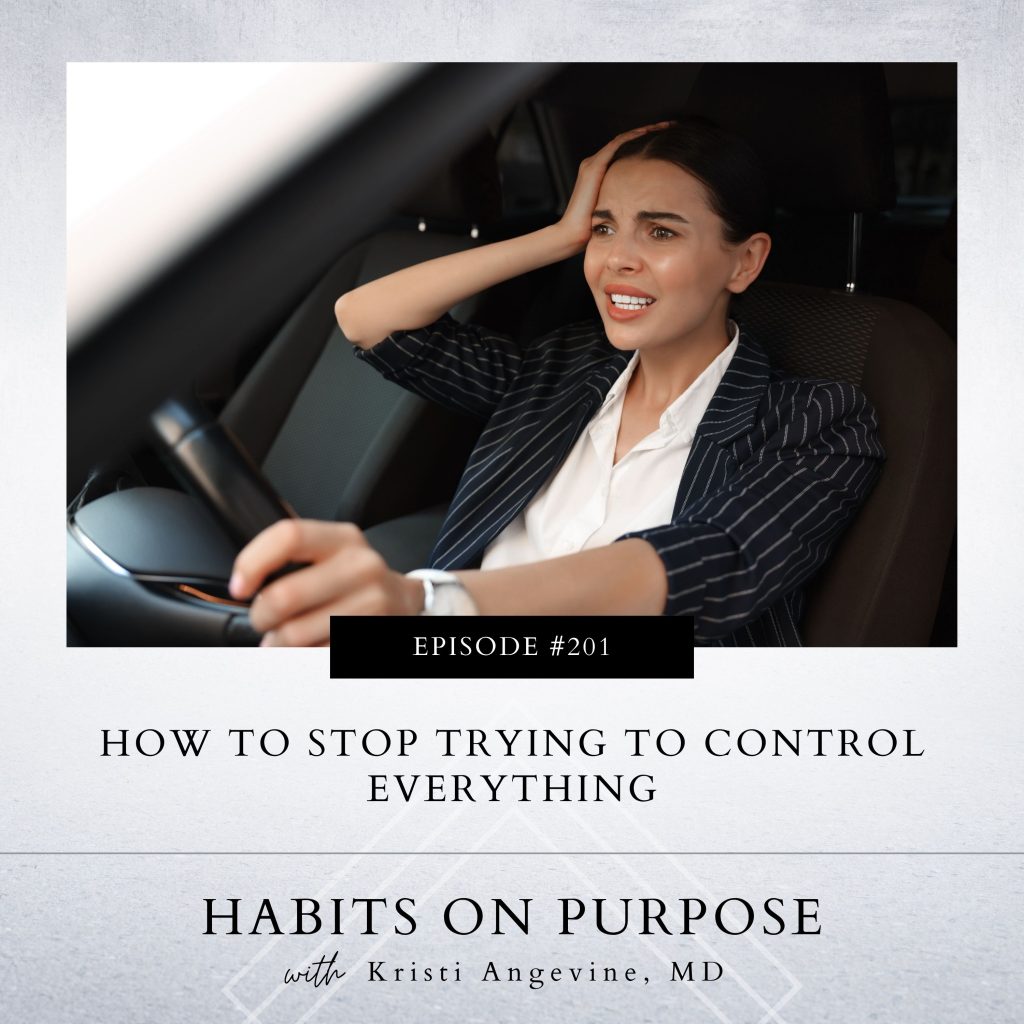
Many of us do this without realizing it. Trying to manage other people’s feelings, reactions, or interpretations drains our energy and leaves us feeling ineffective. I explore why the urge to overcontrol develops and what changes when you shift your attention to the small category of what is genuinely yours to manage, rather than the much larger category that is not.
By the end, you will understand how to get back into the driver’s seat of your life by putting your energy where it has real impact. When you redirect your attention toward what is actually in your jurisdiction, you free up time, capacity, and confidence. You can make clearer decisions, tolerate uncertainty more easily, and move through your life with a greater sense of agency and ease.
What you'll learn from this episode:
- Why the habit of overcontrolling drains your time, energy, and attention.
- The three categories of control and how to spot which one you’re operating from.
- How trying to manage other people’s feelings and reactions keeps you stuck.
- What truly belongs in the small bucket of full control and why it matters.
- A practical way to shift your focus so you reclaim your agency and move through life with more ease.
Listen to the Full Episode:
Powerful Takeaways:
2:38 “If controlling all the things had a reliably positive outcome, I would not be talking about this on the podcast.”
6:11 “When you dedicate a lot of your brain power towards things where you actually have no control, you’re going to feel out of control, and you’re going to get nothing done.”
7:51 “When you stop trying to control other people, it might lead to an easier, more fun, more fulfilling interpersonal dynamic.“
12:00 “Even if my worst fears were to be realized, I would ultimately handle it, navigate it, get through it.”
Featured on the Show:
- Leave a rating and review for the podcast here!
- If you’re interested in connecting with me for private coaching, go to HabitsOnPurpose.com/private.
- Follow me on Instagram!
- Click here to join the mailing list.
- Join Habits on Purpose for Physicians (HOPP) small group coaching program here!
- Join the Habits on Purpose Facebook group!
- Click here to send me any questions that you would like addressed on the podcast!
- Join us in the next Habits on Purpose for Physicians small group coaching program or join the waitlist.
- Click here to join the Habits on Purpose newsletter for extra tools, prompts, and stories between episodes.
- Byron Katie
- Martin Seligman
- Sir John Whitmore
Episodes Related to trying to control everything:
Full Episode Transcript:
Enjoy the show:


Welcome to Habits On Purpose, I'm Kristi Angevine, a physician, Master Certified Coach, Internal Family Systems informed practitioner, and host of this podcast, where we explore the deeper psychology behind why we do what we do.
Hello, hello everybody. I am super excited and really glad to join you today. If this is your first time listening, thank you for tuning in. This podcast is meant to be your weekly dose of really useful, highly pragmatic information that will change how you experience yourself and your life. The key philosophies of the podcast are that your habits are not just your morning or bedtime routine. They are not just the way you brush your hair or how you do your to-do list. Your habits are the default ways that you think, feel, and act.
Habits of behavior, habits of emotion, and habits of thought are learned. And as such, your habits can be unlearned. And the beautiful thing is your habits all make sense because at some point in time, they began as a solution to something. And when you can become aware of what your habit solve for, you'll better understand why you do what you do and why you emotionally respond the way that you do. Now, habit change is notoriously seen as brutally difficult, but it need not be.
Once you learn the tenets of how to make real change, it's much easier than you think. And I know because my habits ruled my experience and my identity for decades. And I had no idea how to change it. I overworked, I people-pleased without even realizing I was doing it. I was a master at overthinking, overcomplicating, and self-doubt drove second-guessing that really just eroded my self-esteem. I coped with food, overworking, drinking, exercise as escape, and I had no clue what to do about it.
And what I learned the long, slow way is what goes into this podcast and into my coaching programs, so that you don't have to take as long to understand yourself and get back into the driver's seat of your life as I did. So get yourself comfortable, set the volume on your ear buds wherever you'd like it, enjoy your walk, enjoy your drive, enjoy just laying on the couch and listening.
And let's talk about control. Do I have any control freaks listening? Any control enthusiasts? Do you bristle when things don't go according to plan? Do you really dislike disorganization and chaos? Do you really enjoy controlling all the things?
Well, welcome to the club. You're in great company. Now, if controlling all the things had a reliably positive outcome, I would not be talking about this on the podcast. My metric for something is, does it work? If something works and has fewer negatives than positives, great. If it sort of works some of the time, but has a high cost, why bother? Why not find a better way?
And that's what we have when it comes to control. When we try to control things that we actually cannot control, that are not fully under our control, we waste time, and we waste mental, emotional, and physical energy. When we do this, we're actually getting out of our lane or out of our jurisdiction and we're deluding ourselves about the potential impact.
Now, even if you're not religious, this Byron Katie idea applies. She says there are three kinds of business in the world. There's mine, yours, and God's. The weather, that's God's business. How your partner acts, that's their business. What you do, that's your business. As the Stoics would put it, there are things over which you have full control, things where you have partial control, and things where you have no control that are out of your control.
So let's talk about the different categories. What are things that are not under your control? Weather, how other people act, how other people feel, what other people think, what other people believe, how long someone else takes to do their surgery, car accidents, how someone interprets you, how someone responds to you, how someone responds to a particular medication, when you were born, what socialized messages were around you when you were born. These are things where you do not have control.
Now, how about things that are partially under your control, things that you can influence? Well, you can influence who's voted into a leadership position. You can influence your health, your income, your fitness, how your pets behave. And what about what's fully under your control?
This category is very small. Take a minute and think, what are the things in your life that you have complete, 100% full control over? If you have a long list, take a look at that list and really examine, is there genuinely full control? The main thing that is in this particular category is you have full control over what you choose to believe.
Now, yes, we inherit many messages from our family, our childhood, our professional training, and we are socialized to absorb certain value systems, ideas, beliefs. And we can't control what was handed down to us and what we inherited just by virtue of when and where we were born and how we were raised, but we can control what we choose to continue to believe. Which makes it so important to examine what you do believe. When you don't know what you believe, you can't decide consciously if you want to keep it, change it, or ditch it.
So I want you to picture three different-sized buckets. There's a teeny bucket, there's a medium-sized bucket, and there's a huge bucket. The huge one is filled with all the things in life that you cannot fully control. The medium-sized one is filled with the things that you can partially control. And then the teeny tiny one contains the things that you can fully control, your beliefs and your conscious choices.
Put the majority of your energy toward the smallest bucket. Do your best with the medium bucket and let go of the big bucket. As Epictetus says, quote, "There is only one way to happiness, and that is to cease worrying about things beyond the power of our will," end quote. Most of us put enormous amounts of energy towards trying to control things that we actually cannot control. And when you dedicate a lot of your brain power towards things where you actually have no control, you're going to feel out of control, and you're going to get nothing done.
We see this when we people please to try to get other people to like this, when we conform so other people will accept us. We try to fit in even if it's inauthentic. We try to be seen in a certain light. We try to do everything perfectly to avoid the judgment from others. We walk on eggshells in an attempt to make sure somebody doesn't get mad. When we're doing this, we're trying to control things we cannot control, and it's a recipe for exhaustion, depletion, and feeling zero agency.
So what I want to invite you to do this week is I want you to start noticing, what are in your three different buckets? What's out of your control that you're trying futilely, desperately to control? What's in the medium-sized bucket that you can influence and you can try your best with, but you don't ultimately have 100% full control over. What would change if you let go of trying to control the things that you can't? Imagine that extra brain power and energy and time that you'd have.
So, Martin Seligman, a prominent figure in positive psychology, he outlines six domains to flourish. These are positive emotions, engagement, positive relationships, a sense of meaning and purpose in your life, a sense of accomplishment, and physical health. When you stop controlling the things that are not your business, that are out of your control, you're more likely to get a sense of accomplishment, a sense of agency, and more positive emotions more regularly.
And we can even surmise that you'd have more positive relationships, for sure, a more positive relationship with yourself. And likely when you stop trying to control other people, it might lead to an easier, more fun, more fulfilling interpersonal dynamic.
Now, the next part of this that's really important to talk about is to find out why you want to control things that you cannot fully control. I've got an example to illustrate this. This is a dynamic between my husband and I that used to really plague me. My husband would be doing something, and I would hear him sigh or I would hear him say something like, "Sheesh." And I would ask, "Oh, what's going on?" And he would say something like, "Oh, nothing." And then I would ask a little bit more, like, "Oh, what do you mean nothing? What's going on?" And he would say something like, "Oh, I'm just thinking about things. I'm just reflecting."
And what would happen for me, and I wonder if you can relate to this is a part of me would get really anxious. Inside my mind, I'd be thinking, "Wait a second, your body language says something is bothering you, but you say nothing is bothering you. So there's a discrepancy here. Oh no. That means something bad is going on. There's a reason that you're not saying something."
And this part of me would go a little bit nuts, imagining all these possibilities, mostly the negative ones. Oh my gosh, you say you're just thinking about things, you're just reflecting. What are you reflecting about? Is it politics? Is it the weather? Is it home projects? Or is it some grave disagreement that I don't know about? Is there something bad going on? What did I do?
Right? This part would be super anxious and panicky. And so in my mind, I'd be thinking, if it wasn't something big and bad, you would just put it to words, no? So this sort of under-the-surface anxiety would drive me to ask again. I would say to my husband, "So, what kinds of things are you thinking about? What kinds of things are you reflecting on? What's up?"
And when he would say, "Oh, nothing, nothing in particular," the part of me that was anxious would just be undone. It would want to make him open up, to hurry up, to have him share, and it would want to make him see immediately how his vague comments were totally making me stress out.
Now, notice, it's not what my husband would say or not say that would make me anxious. It was what this part of me was thinking that created that anxiety from within my own system. He says, "Oh, nothing," and I would make it mean, "Oh my gosh, it must be something." Whereas a buddy of his might hear him say, there's nothing going on and think, "Oh, cool, no biggie. I guess you just need some more coffee, and if it's important, you'll just share later. Moving on."
So when I started noticing this trend, this worry about things, and I recognized that I was really trying to control how my husband communicated. What I didn't do is go, "Oh, you know what? I'm in his business. I just need to try to stop controlling him and just instantly feel better."
Now, if I was a robot, I would do a program update. I would remove the things that weren't working. I would update some software that remove the desire to control things I couldn't control, and then I would be fine. But I'm not a robot.
So what I had to do is sort of reflect, and I asked myself, why exactly do I want to control how this human is communicating? And when I sat with the part of me that would get really anxious, I learned that this part was worried that there was a problem between us. And it was also worried that I wouldn't have access to the information that would reveal this problem, and one day it would catch me by surprise.
And so that's all well and good, right? But then I had to ask a little bit deeper of a question. So what? What's the problem with not having access to information and being caught by surprise? What's the problem with having a problem between us? The problem was this part didn't think I could handle it and didn't want to feel the feelings that I predicted that I would have.
So I imagined the worst case scenario and really, really fleshed it out. So out of the blue, he would share some irreparable challenge to our relationship. And then I would feel rejected, unlikable, damaged, ugly, out of control. So, no wonder I wanted him to communicate differently.
But when I got really clear and took a minute to really understand my fears, I realized that, yeah, it wouldn't be comfortable, but I can handle discomfort. I know how to get support. I can figure things out, even unanticipated things. So even if my worst fears were to be realized, I would ultimately handle it, navigate it, get through it.
So then my fork in the road was this. Am I going to keep ruminating on these conversations, worrying about things, imagining terrible futures that I won't be able to handle? Or was I going to go the other direction and going to call it what it was? This is me trying to control something over which I do not have full control. In an ironic effort to avoid feeling out of control, right?
And then remind myself that my business is to tend to my beliefs. So in this particular theme, I started to work on the belief that I can handle, and I will handle anything that comes my way. I looked back on my life to see where this was true, and I looked back to see where I didn't think it was true. There were indeed situations that I didn't handle as I would have liked, but I still got through them. I lived, I learned things, even the excruciating things, ultimately contributed some value.
And then I thought about what would change if I really internalized the idea, otherwise known as, if I really deeply believed the idea that I can and will handle anything that comes my way? Well, what would happen is I would no longer have to grip so tightly to trying to control how others act. In this situation with my sweet husband, I wouldn't have to try to covertly change the pace he shares things with me and repetitively ask him questions like, "So what's on your mind?" I could just stop all that.
And this opens up so much more in other areas of my life, completely unrelated to my marriage communication. I can make business decisions more quickly. I can be open to trying new things. I can be open to failing and then trying something else.
Which means I'm going to learn more, grow more at a faster pace, and refine what I offer in my business, and in that way be able to help other people more. I can be less worried about doing things imperfectly, not only in my business, but in other areas of my life, like parenting. Which means I can kind of just start showing up as myself.
Now, does all this mean that I won't ever ask my husband what's behind a sigh or a comment that I perceive as vague? No. But it does mean that I'm not going to be so clingy and anxious about his answer, about his pace. And it also means I'm not going to be angry about how he communicates.
So when it comes to control and controlling things that you can or cannot control, I have three things for you to do this week. Ask yourself, where am I trying to control things I cannot fully control? Why am I trying to control things I cannot fully control? And finally, what would change if I put most of my effort toward the smallest bucket and just did the best I could with the medium bucket?
Now, if you love this kind of approach to changing your experience and changing your habits, you will love coaching. According to Whitmore, coaching is simply the process of, quote, “unlocking people's potential to maximize their own performance,” end quote.
Coaching is a systematic approach to having a very distinct type of a conversation that helps you understand yourself better, facilitates you seeing where you have control, and helps you understand what beliefs you've been socialized to have and see which ones you might want to change. And it builds in practical techniques to maximize the domains that Seligman references.
My particular coaching is a mix of cognitive mindset work plus somatic and internal family systems-informed approaches. It's practical, and it helps you get to the root causes of why you do what you do. In my work, we use habits as the doorway to self-understanding and maximizing your potential so you can really enjoy your life. So you can dish out so much more love and care to your family and friends and community, and you can do it from a cup that is full.
So if you want to learn more about my coaching and get on my email list, if you're not already there, go to habitsonpurpose.com. From there, you can find everything. There's information about private coaching, there's information about my small group coaching program for women physicians, and there's information about how to get on the email list. So if you're not already on the email list, join the email list, and I'll give you practical tips, ideas that I'm thinking about, straight to your inbox. Have a beautiful week, and I'll talk to you later.
Thanks for listening to Habits On Purpose. If you want more information on Kristi Angevine or the resources from the podcast, visit HabitsOnPurpose.com. Tune in next week for another episode.