
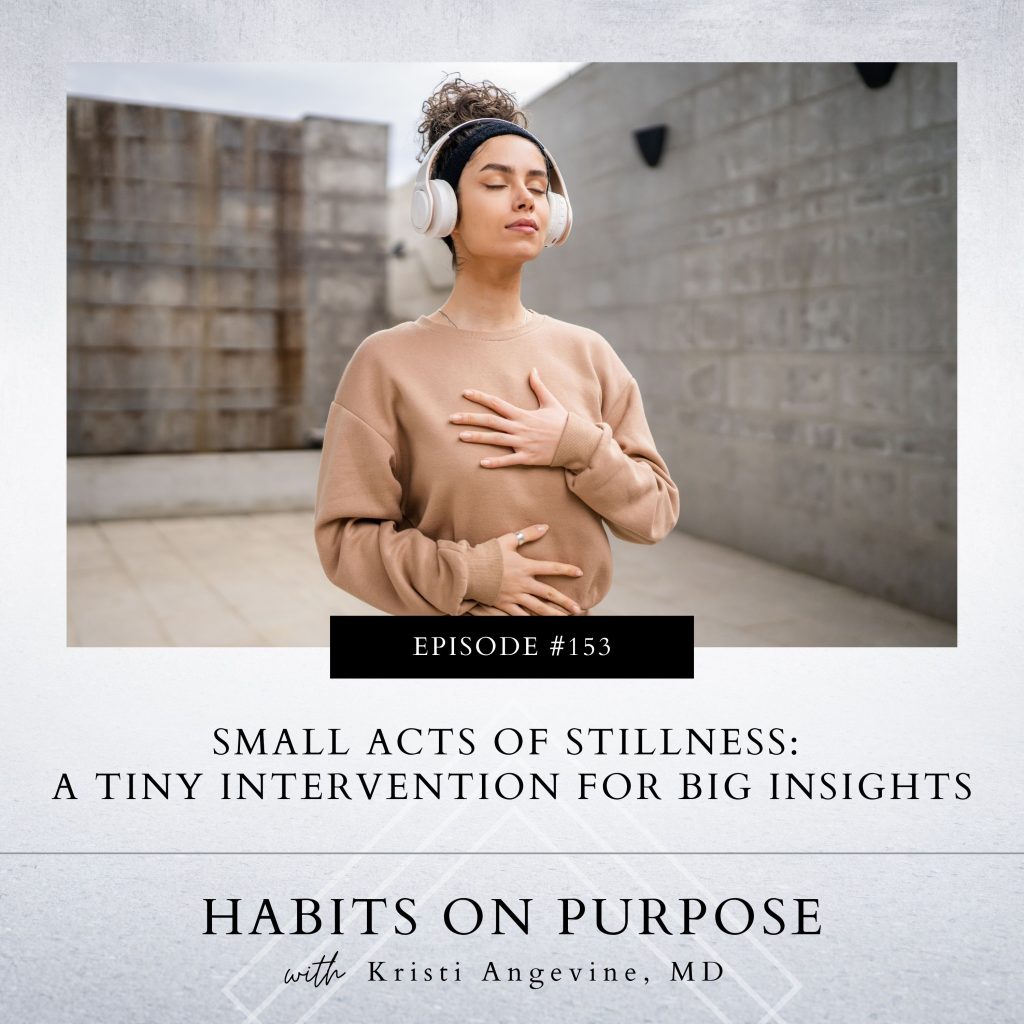
Have you ever stopped to consider how often you truly slow down with intention? Not because of fatigue or a scheduled event, but simply to be present in the moment? In our fast-paced lives, it’s easy to overlook the power of deliberate slowness.
What you'll learn from this episode:
- How deliberate slowness differs from fatigue-induced or event-driven slowness.
- The profound benefits of slowing down, such as reduced stress, increased clarity, and improved emotional regulation.
- Practical ways to incorporate intentional slowness into your daily routine, even for just 60 seconds at a time.
- How slowing down can help you reconnect with your true self and gain a fresh perspective on your thoughts and emotions.
- The science behind the benefits of slowing down, including its effects on cortisol levels, neuroplasticity, and heart rate variability.
- How to use deliberate slowness as an adjunct to introspective work and habit change.
- The power of combining intentional slowness with introspective prompts to elicit a felt experience and deeper self-understanding.
Listen to the Full Episode:
Powerful Takeaways:
11:17 “Slowing down is like a reset and a check-in. It helps you see what’s going on inside you that’s easy to overlook in the ordinary pace of life.”
12:02 “It’s suggested that when you slow down for even just 60 seconds, your dopamine levels can balance out, neuroplasticity is enhanced, and your heart rate variability is improved.”
14:05 “Slowing down is like a timeout in a sports game. You can take a breather, you can step back, get a little perspective, you can adjust your game plan based on what you’ve just experienced.”
10:31 “Slowing down even just for 30 seconds, it’s really highly practical and it’s really highly effective. It reduces stress, it increases clarity, and it can help you understand what’s going on underneath the surface.”
Featured on the Show:
- Leave a rating and review for the podcast here!
- If you’re interested in connecting with me for private coaching, go to HabitsOnPurpose.com/private.
- Follow me on Instagram!
- Click here to join the mailing list.
- Join HOPP small group coaching program here!
- Join the Habits on Purpose Facebook group!
- Click here to send me any questions that you would like addressed on the podcast!
Related Episodes:
Full Episode Transcript:
Welcome to Habits On Purpose, a podcast for high-achieving women who want to create lifelong habits that give more than they take. You'll get practical strategies for mindset shifts that will help you finally understand the root causes of why you think, feel, and act as you do. And now, here's your host, Physician and Master Certified Life Coach, Kristi Angevine.
3,234 tiny plastic beads arranged carefully in a rectangle. Itty bitty 4mm high cylinder tubes secured by only 2mm plastic pegs. Yes, parents listening will recognize this as a pile of perler beads. Slowly ever so slowly I carried the 3,234 piece creation my son made from the kitchen table to the island in our kitchen. My hands level, making a slow turn, delicately lifting and setting down each foot like my life depended on having a still upper body. Pausing to lift my eyelids to make sure my path to the cutting board was still clear, I moved in slow motion without any trembles. I guided the beads to a soft landing like you would set down a sleeping baby.
My son had spent a couple days making a quite elaborate design and cautiously ferried it from the kitchen table to the back office so that we could close a door so that the cats wouldn't scatter his hard work. And as I was carrying that placemat-sized sea of perler beads to the cutting board to eventually get ironed, it hit me. I don't slow down often. Not like this. Focused, smooth, careful, very slow on purpose.
Now, I slow down for fatigue. I slow down because of exhaustion or impending collapse. Or I slow down because of a scheduled event that calls on me to slow down, like watching a movie or taking a long drive. But even in those times, I reflexively bring in many things that keep my insides moving. My phone, podcasts, talking to a friend, a notepad by my yoga mat. Even when staying inside on a rainy day, reading to my kids, I read kind of quickly. And I love my pace. My home-based pace is one I really enjoy. It's kind of sped up. It's more coffee than chamomile. And this bead transfer event, which I've done many, many times before, but for some reason just really stuck with me, it brought to light this fascinating realization that I don't actually often slow down on purpose like I do when perler beads are involved.
So what does this have to do with anything? Well, in that slowed down moment, carrying that intricate design to the cutting board, I noticed something. No, I didn't notice anything in particular, but I recognize that I was able to notice in a very different way than usual. It was like slowing down a car to pull off and see a vista or stopping walking so that you can say hi to someone.
Now, intellectually, I get all this, right? When I go fast, I experience the world in one particular way and sure, if I slow down, that way is going to be different. No big whoop, right? And I teach clients the critical importance of actually pausing and slowing down so they can better understand what's going on internally with their thoughts and feelings. But intellectually understanding and having a felt sense and a bodily experience, these are two very different things.
And ironically, I also teach this idea as well, that there is a big difference between intellectually and theoretically getting something in our brain versus feeling it. So despite teaching these things multiple times per week, it was fascinating for me to recognize that I don't do this in this particular way that often.
So try this for a second. If you have a moment, right now, I want you to take 30 seconds and just slow down. Stop everything that you can stop. See if you can notice your heartbeat without manually feeling your pulse, or just notice your breath without changing your breathing, or take out your phone and hold it in the palm of your hand and pretend there's a tiny pool of water on it that must not spill and gently move your body a step or two.
If you're like most of us, slowing down is not what you do except when it's time to cozy up in your blankets for bed. And there's nothing wrong with the fact that you may not slow down on purpose very often. There's nothing morally superior or magical about slowing down on purpose, but there are benefits to it. And yet these benefits are very easy to overlook, even when you teach people about them every day. And especially easy to overlook when you're in the aftermath of the holiday season and when you're in a time where there's a New Year's resolution frenzy that characterizes the season you're in. So let this podcast episode be your reminder.
Now, last week, if you listened to episode 152, I offered three different prompts that help you connect with the real you and I'll remind you of them here. They were number one, what part of me do I want to reconnect with this year? Number two, the real me knows blank. And number three, deep down, I have always known blank.
Now, the cognitive way you explore these prompts is you write them down and you think, and you just fill out whatever you fill out, whatever thoughts come to your mind. The experiential way that you can answer all of these is to build in deliberate slowing down as you answer them.
Now, before I outline all the benefits of slowing down and the benefits of slowing so much that you're not really doing much of anything. I want to elaborate on what slowing down might actually look like and how we can keep it really realistic because you've got a busy life to tend to, slowing down might seem like the last thing that you can actually do while you continue with all the stuff that you want to do.
So before I tell you what the benefits are of slowing down, I'm going to tell you what it could actually look like and then hopefully you can draw some inspiration from these ideas and come up with something that you can use in your life.
Slowing down can literally just be one extra minute to slowly brush your teeth with your eyes closed. So you do your two minutes, you're done, you're about to take your toothbrush and rinse it out and put it back where it goes, but instead, you just stay there for an extra minute. And I'm not saying to all the dentists out there who are cringing that you should overbrush and hurt your gums. I'm just saying, move your toothbrush very slowly and feel what it feels like. You can even just sort of like gently move it through your mouth, or you could just stand there and do nothing. Obviously don't fall over, right? But you can just stay for that extra minute and just slowly move.
Another way that it can look is you can stop and simply let your mind wander for 60 seconds. Now, this is very different than just randomly noticing that your mind has been wandering and that you've been daydreaming for a while, this is different because you are on purpose stopping and deliberately letting your mind wander.
Slowing down can look like a slow walk where you feel as much movement as you can. The way your heel touches the floor, the way the middle of your foot glides down, then your toes, then the lift of your other foot, the move of your arm, the touch of your arm against the fabric of your shirt, and just slowing down, even if it's just for two steps.
It could look like taking 60 seconds every time you get in or out of your car, just to visually appreciate something, to notice the colors, the textures, the shape of something, or to mindfully do a grounding exercise like box breaths.
It could be to linger at your phone for a few minutes before you open it, before that face ID lets you into the wonderful world of your phone, before you check your email, and do nothing but just gaze around or tune into your emotional state inside.
It could just be slowing down one task, washing your face extra slowly, tying one of your shoes really slowly, taking a moment for an extra stretch, or you could balance something on your hand and carefully move it from one area to another, kind of like my Perler bead experience, so that you can get that intense focus that comes with literally having to slow down in order to hold something steady.
You can pick anything you want, just find some way to slow something down and either do something very simple or on purpose, do nothing, just for a few moments. And here is what you may notice when you slow down.
Your mind chatter might get really quiet. You might conversely hear the chatter in your mind with more clarity. You might notice your body. You might notice your energy level. You may remember something that you have forgotten about. A memory or a person or a song or a book title may bubble up into your consciousness in an unexpected way. You may notice an emotion that you thought was gone, but really was just boxed up and pushed to the back corner of your psyche.
Slowing down could be luxuriously pleasant and pleasurable. It could also reveal how exhausted you are, or it could be extremely uncomfortable because uncomfortable emotions present.
Or if you've got a thousand things on your to-do list and there's not enough time to get to those things, the weight of slowing down might feel unbearable in that moment. Now I'm not really selling this to you, am I? So let me tell you why on earth should you slow down on purpose?
Slowing down, be it pleasant or not, is a way to recalibrate. So if your life feels frantic, if you like, you know, heart analogies, if it's like atrial fibrillation, slowing down is an effective diastole and systole. Slowing down is like a reset and a check-in. It helps you see what's going on inside you that's easy to overlook in the ordinary pace of life.
It's like a timeout in a sports game. You can take a breather, you can step back, get a little perspective, you can adjust your game plan based on what you've just experienced. You can check in to see if any of the new information that you've gotten recently changes what you need to do next. You can check in to see if there's anything that you need at that moment. Taking one minute to slow down and do almost nothing can lower your cortisol and it can reduce feeling reactive.
It can also restore your default mode network into action. Your default mode network is involved with memory consolidation, planning for the future, as well as creativity. It's also suggested that when you slow down for even just 60 seconds, your dopamine levels can balance out, neuroplasticity is enhanced, and your heart rate variability is improved. And all of this can combine to be very grounding and help with emotional regulation, your ability to feel your emotions without being flooded by them.
Now, slowing down or taking a moment to do something that requires intense focus done very slowly, or doing absolutely nothing. All of these different things, they can sound very different, but in reality, they activate a similarly beneficial experience internally. And this can be the one tiny intervention that you can pretty easily operationalize in your life. And it can also be something that you add to a larger project that you've got going on, or you can add to introspective work as an adjunct to any other thing that you're doing to better understand yourself or change a habit. Now I use this technique often, despite the fact that it kind of threw me for a loop when I noticed that, wow, I don't slow down in this particular way as often as I thought I might. I actually do slow down quite a bit.
I notice that I use it right after I get unexpectedly irritated or I have a really tense interaction with someone. So after the desk settles, like after I have a tiff with one of my kids, while I'm off doing something else, like taking our dog outside or I'm taking out some garbage, I will slow way down. I will notice my breath. I will stare off rather lazily into the distance. I will notice the sound of a passing car or I will really focus on feeling what it feels like to have cold, crisp air go in my nose, down my throat, and out my mouth as I breathe. And this deliberate break in my usual pace lets me notice what's behind my irritation.
Sometimes I'll do this before I journal. I think I've said this before, I really like to drink coffee early in the morning, usually in the dark. I'll grab my cup of coffee and I will move it insanely slowly from where it's sitting through the air to my mouth and I will smell it and then at this point I don't really go very slow I take a sip and then I set it down and then I slowly make a few micro movements in my neck and my chin before I settle into being nearly perfectly still it's almost like I'm invisible and these quiet slow movements they kind of set the stage and help me to tune inside to whatever's going on inside of me.
Sometimes I'll do it before I record the podcast, especially if a part of me is feeling really rushed or behind and even just a short buffer it's kind of like taking you know if you have a jar that's filled with water and glitter and dirt and you've shaken it and then you set that down and you just let it be still for a moment, that's what being still is when I'm in a rush feels like. And once I do that, I can access more presence and be more calm.
Slowing down even just for 30 seconds, it's really highly practical and it's really highly effective. It reduces stress, it increases clarity, and it can help you understand what's going on underneath the surface.
So I'm curious, what comes up for you when you think about slowing down? Or when you think about on purpose, really doing not much of anything? What comes up when you think about just letting your mind daydream and wander on purpose? Would there be anything hard about this? What would be easy about taking a few moments just to visually or notice something with one of your senses.
Now I want to bring this back to the prompts from last week in episode 152. If you did those prompts in a written fashion or just mentally, I'm going to invite you now to use those same prompts to elicit a felt experience. Now if you didn't do the prompt from last week now it's your chance to pair those prompts with a deliberate slowing down and this is what this looks like. Pick one of the prompts and every time you do the slowing down or the do-nothing intervention that you come up with that works for you, bring it to mind and see what comes up for you.
Now as a reminder here are the prompts:
1. What part of me do I want to reconnect with this year?
2. The real me knows blank.
3. Deep down I've always known blank.
And I would love to hear what this looks like for you and what you discover. For me, sometimes it's really easy when I slow down, and it's very welcomed in my system. And other times it's extremely difficult for me. And it really just depends on my state of mind and what's going on in my life and kind of what the tenor of the season I'm in is like, but regardless of whether it's pleasurable, welcomed or uncomfortable, there is always a benefit.
So I would love to hear what it's like for you. And the way you can do that is to join the email list. It's on habitsonpurpose.com. You'll see it says, join the newsletter and simply to any email you get, just press reply and let me know if this topic lands with you and what it's like to slow down. Or you can go on and if you are so inclined, leave a rating and a short little sentence of a review and let me know what resonated for you and that can make up your podcast review, which I will be so appreciative of. And just know that when you join the email list, I read every reply and I will respond to you personally. I also read every review. And if there's ever anything that you wanna hear about on the podcast, or you want me to know about, that is how we can correspond, through email, and then also you can say anything you want in a review. So until next time, I will talk to you soon.
Are you on the Habits on Purpose email list yet? I send community emails with practical information, habit change tips, and announcements about workshops, lectures, and in-person events that I'm going to be attending. I share things that I don't share here on the podcast, and I let you in on what I'm studying, what I'm learning, and what I'm going through in my life.
When you're on the list, you can always press “Reply” and ask me a question. And you'll hear back from me; not from my team, not from AI. You'll hear back from me.
So to connect in your inbox. Go to HabitsOnPurpose.com and join the email list. You can also find me on Instagram and Facebook. And get ready for it, eventually … gasp … you will find me on TikTok once I actually open an account.
Take care, and I look forward to connecting.
Thanks for listening to Habits On Purpose. If you want more information on Kristi Angevine or the resources from the podcast, visit www.habitsonpurpose.com. Tune in next week for another episode.
Enjoy the show:

