
There can be times, especially at work, when we feel like we’re just going through the motions, more machine than mindful human being. When we’re stuck in those states, we pay for it—mentally, physically, and in our relationships. If you’re feeling that way, I promise this episode will provide you with hope.
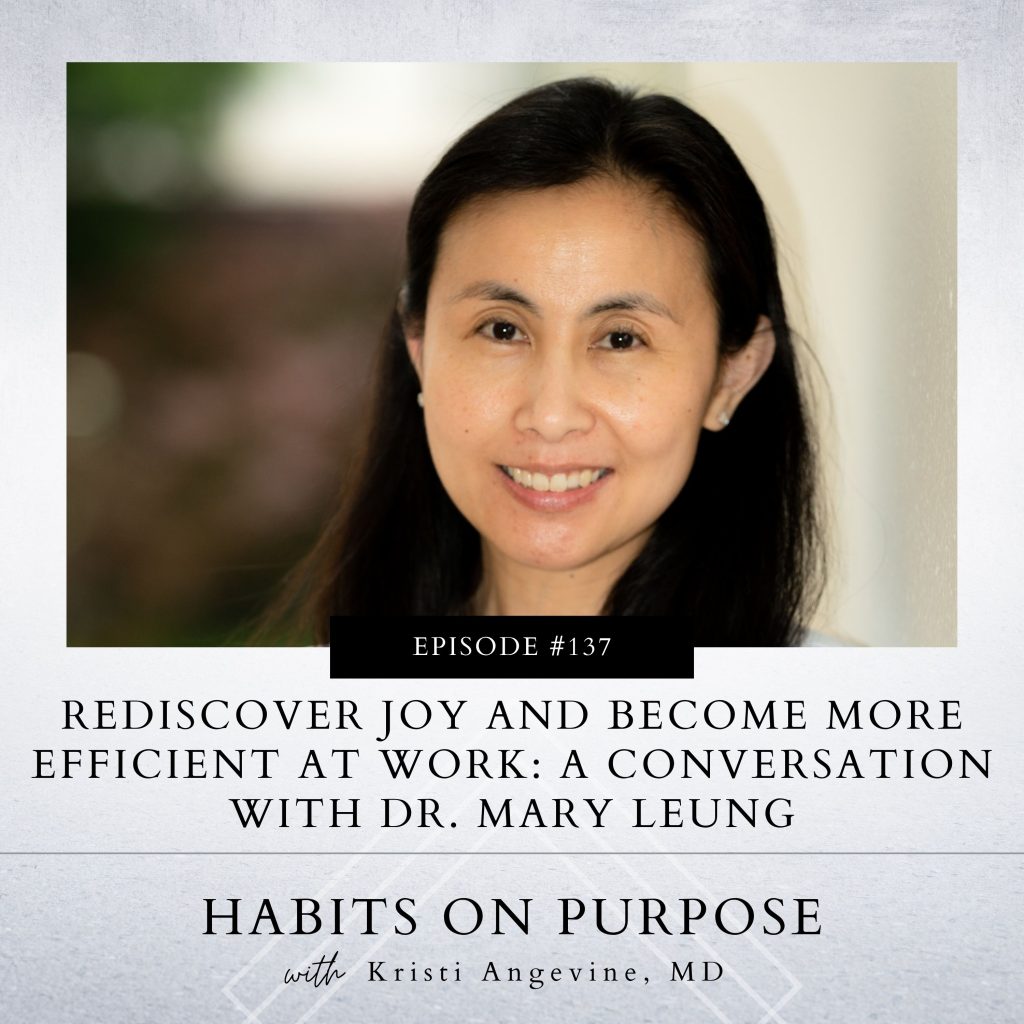
Joining me today is Dr. Mary Leung, a full-time medical oncology and hematology physician, as well as a certified life coach. She’s here to share a bit about her journey of becoming a coach and how she’s been able to achieve better time management.
Even if you’re not a physician or don’t work in medicine, listen to learn how you can become more efficient at your job so you can attend to, and more importantly, enjoy other parts of your life outside of the office. That includes using mindfulness exercises, improving sleep hygiene, removing tech distractions, and more. Get ready to take notes!
There can be times, especially at work, when we feel like we’re just going through the motions, more machine than mindful human being. When we’re stuck in those states, we pay for it—mentally, physically, and in our relationships. If you’re feeling that way, I promise this episode will provide you with hope.
Joining me today is Dr. Mary Leung, a full-time medical oncology and hematology physician, as well as a certified life coach. She’s here to share a bit about her journey of becoming a coach and how she’s been able to achieve better time management.
Even if you’re not a physician or don’t work in medicine, listen to learn how you can become more efficient at your job so you can attend to, and more importantly, enjoy other parts of your life outside of the office. That includes using mindfulness exercises, improving sleep hygiene, removing tech distractions, and more. Get ready to take notes!
What you'll learn from this episode:
- How to recognize if you’re going through the motions in your job everyday.
- Ways to articulate what your goal is and the motivating “why” behind that goal.
- The importance of getting a quality sleep and being mindful of your morning thoughts.
- How to avoid the distractions of technology while also using it to be more productive.
Listen to the Full Episode:
Powerful Takeaways:
11:49 “Realizing what your goal is and just remembering it throughout the day, that’s a very important foundation of how you get a jumpstart to do the thing.”
15:30 “Remind yourself of your strong ‘why’ throughout the day.”
19:31 “When you wake up in the morning, just be mindful of what you’re thinking.”
26:54 “Gratitude is just a gift that keeps on giving because you know what, it makes you feel good—the person expressing it and the person receiving it.”
36:55 “Just tell yourself that you did great today and that tomorrow, it’s another new day for another new try.”
Featured on the Show:
- Leave a rating and review for the podcast here!
- If you’re interested in connecting with me for private coaching, go to HabitsOnPurpose.com/private.
- Follow me on Instagram!
- Click here to join the mailing list.
- Join the Habits on Purpose Facebook group!
- Click here to send me any questions that you would like addressed on the podcast!
- Dr. Mary Leung: Website | LinkedIn | Email
Related Episodes:
Full Episode Transcript:
She specializes in helping physicians efficiently use their time so they can feel less like a charting machine and more like a regular human. As a coach, she focuses on helping physicians who are stressed out and burned out, have more time outside their clinical work and rediscover the joy in life, as well as in medicine. Let's get started.
Welcome to Habits On Purpose, a podcast for high-achieving women who want to create lifelong habits that give more than they take. You'll get practical strategies for mindset shifts that will help you finally understand the root causes of why you think, feel, and act as you do. And now here's your host, Physician and Master Certified Life Coach Kristi Angevine.
Kristi Angevine: It is so fun to have you on the podcast, Dr. Mary Leung. Can you introduce yourself to the people who don't know you?
Dr. Mary Leung: All right. Thank you so much for having me today. I am Mary, and I am a full-time hematologist oncologist, and I am also a life coach for physicians. I help physicians who are stressed, overwhelmed, and burned out to leave on time, to feel better, so that they get to rediscover joy in life and in medicine.
Kristi: Oh, so good. So good. So I will just say, for the people who are listening, who are nowhere near medicine, who are not clinical, who are… your job is something else… this podcast, I guarantee you, is going to have information in it that is going to be useful to you.
Because there are common human struggles that women physicians have that you'll see in every occupation. So that's what my prediction is. Mary, I'm curious. This is our first time “meeting” by Zoom, and I'm not actually sure where in the world that you're located. Can you tell me where you are? And then, maybe, if you're comfortable with it, it looks like you're in a room with natural light. What can you see outside of one of your closest windows?
Mary: Yeah. So I'm currently on Leung Island, New York, and that's where I live right now. I actually have the curtains closed... I mean, it's blinds... and so I can't really see outside. I think they're actually cutting trees right now. I think this morning was in the 50’s, and we're going up to the 70’s.
Kristi: Oh, nice. Sounds really great. One of the things that I think is always really nice to give is a context for the conversation that we're about to have. Tell people a little bit how a full-time hematologist physician found the likes of life coaching and then decided to actually bring it in and specifically add into your already busy life coaching and helping other physicians. How did you find coaching?
Mary: Yeah, that was actually almost like an accident. Or I would just say that, well, I'm very grateful for it happening to me. So what happened just before that? I discovered life coaching during the pandemic. And before that, I was just working my full-time job, seeing patients, working long hours.
I think a lot of doctors have this similar experience, that we're seeing the patients and afterwards there's a lot of paperwork. I mean, it's computer work, but it's a lot of charting to do, a lot of administrative duties, and a lot of calling back patients.
And that adds up to probably four or more hours extra of work a day. A lot of times I had to bring work home at nights and then the weekends. And I just kind of accepted it, even though I did not like it, because I just thought that I did not sign up to do this, to be a doctor and to be a charting machine; to be just doing all these other things. It was just not living, to me.
I wanted to spend time with my family, with my two kids. And I thought that was terrible. Looking back, I was really burned out. Because I did not really fully enjoy the patient interaction as much as I wanted. And that's what brought me into medicine, besides wanting to help people, was to really have meaningful connections with the patients.
So not being able to do that, and not really able to be present, fully present, with my family. I was just going through the motions day in and day out. That was really exhausting to me.
Then the pandemic came, and I had a chance of going home on time, or even earlier than on time, with all my work done. That was amazing. And of course, I had time to explore different things. I was just browsing on the internet and discovered there's this virtual summit that was about doctors doing things outside of medicine. That was where I discovered life coaching.
It was a physician, actually Sunny Smith; I think a lot of people know her. So that was how I discovered there's this thing called “life coaching”, because I thought coaching was just for sports. At that time, I just wanted to feel better.
I was thinking when I went back to full time, to seeing the same number of patients as I did before the pandemic, if I didn't do something different, I would still go back to the same place where I was. And so I just wanted to try something different, to feel better; just a simple request.
And so I decided to join the life coaching program. It was given by a physician, two physicians. I didn't think that anything could go wrong, and so I did it. I really enjoyed it because it was something simple. But I never really thought about how we think about things really affects how we feel and how we act, and we can choose how to think about things.
I think in the past, I would just think, “That's how I think,” like that's the only way. If I have 30 patients to see in a day, that's considered to be a lot, and that gets me annoyed because that's at least five more patients than I wanted to see. But then I could actually look at it a different way.
And so I decided to even go deeper, to join a certification program of life coaching myself. At that time it was only because I wanted to know more about things in general. Because a lot of us doctors like to just get to the bottom of things and learn everything about one subject. So that's what I did, and I really enjoyed it.
So I kind of overlapped those together, being a coach and learning how to coach. At that same time, in my coaching program, my coach was helping me out to be more efficient, how to really think things differently to kind of change the way that I feel and behave.
And so, the long story short is, within about three months I was back to seeing the same number of patients, a full load of patients that I was doing before the pandemic, and I was able to go home by 5:30 with all my work done. As opposed to in the past, I would go home past 7:00 and still have charts to do. So I thought that was really wonderful.
I was consistently doing this by 5:30. And now I'm actually going home before 5:00, or 5:00 at the latest, with the same number of patients. And so at that time, I was thinking, “What if I could help other doctors do the same?”
Because a lot of physicians have the same problem. They enjoy helping people, enjoy seeing the patient; not so much with the charting and with other things that they have to follow up on. And what if we can make it more pleasant, more efficient, so they get to do things outside of work. And just not thinking too much, other than having that privilege of doctor-patient relationship that we get to enjoy so much.
So that's how I started my coaching company, to help physicians on the time management, efficiency, and/or whatever life coaching subjects that they want to talk about.
Kristi: Well, I love that. I think so many of us have this overlap on how we discovered life coaching. Where there is a bunch of unfamiliarity, we sort of serendipitously happen to fall across it, even though we knew nothing about it, found something really practical and beneficial in it, and then realized it was so helpful why not just use it to help others.
I'm thinking, as you're painting this picture of being faced with being as you call it a “charting machine” and having some of the joy sort of seeping out of what you really wanted to have; joy with interacting and actually connecting with your patients.
I'm picturing somebody listening to this thinking, “Okay, I want that. I feel like I do is chart, and I'm behind, and I'm running doing all these things,” that they feel like they're in opposition to what they really want to be doing. And I'm picturing somebody saying, “Okay, well, that's really nice, Mary, that you were able to do this. Number one, I want to know how. And number two, maybe you don't know my situation, you don't know how dysfunctional my particular workplace is.”
By the way, isn't there a systemic system-wide cultural dysfunction in medicine these days? So first off, we'll just address the elephant in the room and say yeah, we both recognize there are problems, that are beyond the individual, that exists in the culture of medicine today. And those are things that we all wish would change yesterday.
And given that that's the situation that we're in, the question becomes, what can we do about that? How can we show up in ways that make our experience of that as easy as possible?
So to the first question of, how do I do that? What would you say to somebody who's grappling with this, and they want to be as efficient as it sounds like you are?
Mary: The first thing is to really go back a step and ask yourself, what is your goal? Say your goal is you want to go home on time. Ask yourself, why? Why do you want that? For me, for example, I want to go home on time so that I can spend more time with my family. I think just realizing what the goal is and just remembering it throughout the day, that's a very important foundation of how you get jumpstart to do the thing.
Because without that, I think that reason behind it, if it's not a strong enough reason, then you probably don't really want to do it or you would think, “Oh, maybe that's not something that I can do.” So the strong “why” is very important.
And the second thing is the belief. The belief that you can actually do it. Not to say tomorrow, but eventually you can do it. And not to focus on the “how” just yet. Just the simple belief, the practicing of the belief that “I can do it.” And also just visualize or imagine that you have already done it. How does that look, that you get to go home on time, spending time with your family? Or picking up a hobby, or continuing something that you enjoy doing, how does that look? So I think those are really the two very important preparation steps.
Kristi: Those two things about getting clear on what your goal is and your strong “why”, and then also letting go of the “how”, that's such a great sort of baseline. But do you think it deserves a little bit… For somebody who's listening to this and those are really new concepts for, let's maybe sort of unravel a little bit or unpack a little bit.
First of all, what's the importance of letting go of the “how”? Somebody's like, “Listen, I want to get home at 5:00. I'll deal with my ‘why’ later. But I have no clue how I'm going to do that. How is it actually possible with my work? But how? I need to know how.” What would you say to the person who's like, “Why let go of the ‘how’” in favor of looking at their thoughts about the possibility?
Mary: So if you ask the “how”, I think a lot of us, I guess, by how we think about things all these years, without really realizing how we think about things, when we ask “how”, there's a subconscious mind that will kind of just to say that, “Oh, you can't do it. You don't know the how yet, you may never know the how. So you probably can't do it.”
And when you have a subconscious voice in your head to tell you that, then you believe it's not going to stand. So I think it's important to just say that, “Okay, I know I need to know the “how”, but I'll deal with that later. But let's see if it's doable.” And I think whatever helps to make you believe better… or sometimes it just may be that it takes time for you to fully believe it.
And you may say, “It is possible for me to go home on time.” And I think I'll just practice that first. When you ask the “how”, instead of asking it in a ‘I can't do it’ way, I would say in a more light-hearted and curious way; to ask the “how”. After you believe it, it's like, “Okay, how can I do this? I mean, someone else did it, obviously it's possible. How can I do it in my way, in my version?”
So I think the next step is asking “how” to do it in a different attitude, then it's a more constructive way of asking it.
Kristi: Oh, that makes so much sense. And then, why is it useful to deliberately remind yourself of your strong “why” through the day? Like, I want to be with my kids. Are you suggesting to me to just set a little timer that says, “I'm doing this so I can be home with my kids?” Explain a little bit why that's important.
Mary: Okay, well, I don't get to the point of setting the timer, I just do it. I think whenever it comes up to my mind it’s kind of like a little silent chant, you can say. I just do it. Because that's a good reminder of why you're doing what you're doing.
We get a lot of distractions, be doctor or not doctor. And with everyday activities, with people interrupting your conversations, phone calls, all these things. And then if you're busy being busy, you kind of sometimes forget why you're doing what you're doing.
So I think you remembering the “why” is just so important. It's like, okay, I'm doing all these charts that I don't like to do. It's because that's a mandatory thing to do. Because otherwise there's no documentation of what you think and see about the patient. And you can't bill for your services. So that's not good. And also, legally, that's not right.”
The other way, just to sneak back in, to view the charting, to finish charting, as a means for you to go home on time. Because if you do it the right way, then you get it done, get it over with, and then you can just do everything else. So unless you're not in clinical medicine, the charting and the patient documentation, it's a must.
Kristi: Yeah. And I think for people outside of this world, there are things in their job that it's just a “must”. They have to do it, or they'll get fired. I think we bring certain beliefs to that. You sort of highlighted, if we, in the back of our minds think, “There's no way I’m leaving at 5:00. It isn’t possible for somebody like me in this situation.”
And if that's somebody thinking, “I don't even know how I would possibly do this, especially since it's not possible,” that approach is so different than, “I don't like staying here being a charting machine, a documentation machine. And I bet it's possible for there to be change.”
“I've heard Mary Leung say that she now gets home. If it's possible for her, maybe it's possible for me. If it's possible for me, why would I want that? Well, you know what? I want to be more present at home when I'm at home, and present with my patients… Okay, that's important. I wonder how I could inch towards this new reality.”
That's a totally different energetic quality to approach a tricky problem, right? So let's say somebody has a really strong lie, and they're reminding themselves, “I don't really know the how yet, but I do know I can probably figure this out,” What are some next steps to help somebody?
Let's just stick with maybe the charting. What are some things that either you do, or things that you've found that your clients do, that help them at the end of the day be able to walk away at the time they want to walk away?
Mary: Yeah, so actually, both me and my physician clients were doing very similar things, or practicing. We talk about this. Because I just find it so helpful, with whatever system that you're using… and even when you're not a physician, even if you're a stay home mom, and it's just trying to be efficient… to do it, it's so helpful.
So I think the first thing is actually how you start your day. When you wake up in the morning, of course it's very important to get enough sleep, if possible. Or work toward that. Because when you have a restful day, you're physically and mentally more refreshed. So that's important.
When you wake up in the morning, just be mindful of what you're thinking, besides remembering your goal. It's what you're thinking. If you're thinking, “Today is going to be a long and dreadful day,” that's a very different energy that you're giving out, as opposed to, “Today is going to be a good day. Today is going to be a manageable day. Today I am capable, I can do all these hard things.”
So I think it's important to just pick a sentence that you believe in, and that works for you, that helps you to fuel your day in a more pleasant way. I think that's a very important thing.
The second thing is, say just sticking with the physician and the charting part, if you're working in outpatient in the clinic, in the office environment, a lot of times, you're working with staff; you're working with the front desk, the medical assistant, or even sometimes nurse practitioners and all. I think if you can harness teamwork, that's very important, to be able to work together.
And I bring that same energy to my staff. So my sentence is, “Today is going to be a good day, no matter what happens.” Meaning, that there are going to be surprises, good or bad. I don't know what they are. But whatever comes my way, I'm still going to make it a good day.
I talk to my staff in the morning before we see the patients. Just a little quick huddle to say, “Today is going to be a good day.” Sometimes they say it before I say it, which is great. Because it's a good energy, and we work as a team.
In terms of the charting part, whatever you do, it's fine. You may have to experiment a little bit and find the most efficient way to do it. For charting, seeing one patient and doing the chart right away, it's the fastest way and the most efficient way to do it.
Because if you wait till the end of the day to do your charts, there are several problems. One is you may get them mixed up, the patients, little detailed information, or the physical exam. That, most likely, will not affect your clinical judgment and your plan, but it's just little details that get mixed up.
And then when you try to think about those details, that wastes your time. And so you end up using two or three more times the time that you will spend to document in the patient's chart than if you do it right away. And a lot of times, I actually start typing in the room when the patient is telling me what's going on. I just jot it down so I don't have to think about it when I get out of the room.
And then the planning part… depending on… because some patients love to talk a little bit longer… and depending on the situation, I may let them talk, but I'm still typing. So that way, they get to talk, they get someone to listen to them, and I'm doing my work. That's a great way.
Second, let the next patient wait a little bit. One of the problems that I had in the past was that I was piling up charts toward the end of the day, especially for the second half of the day, because my belief was that I needed to keep my patients on time according to the schedule as possible.
So the only way I could do it was to sacrifice my charting time. And not doing it right away, I'd just suffer later on. So challenge yourself when you have a belief like this, is that true? What about if the patient just waits for you three to five minutes longer, say, is that really bad? Think about it.
Also, if you're done with that one patient, patient number one, you're done with the chart, you're done with the plan, you're done with their orders and everything. Then you can focus 100% on the next patient without thinking about, “I forgot to do something on patient number one.” So I think that is really, really helpful to be able to do that.
And of course, I think whatever you do, it's so important to know the system, whatever electronic medical record system or programs that you're using, know it well. Know all the little shortcuts, and whatever you can use to utilize it, so you don't have to spend time over and over saying, “Where's that button? I can't find it.” Because that takes time too. Every second counts. That is the take-home message.
I think how you start your day, because that is the fuel you use with the emotions that come up; if you're energized, if you're focused, if you're determined, all these more pleasant emotions; rather than feeling the dread or the anxiety or the frustration and anger, I think I will choose the former emotions to operate my day. And it's definitely more efficient and more rechargeable with those energies.
So the next thing, besides being able to focus, is minimize the distractions. Simple things that everyone can do is turn off your phone, or put it elsewhere. At least on “silent”. Because every time your phone or your email has a ding or a notification, your brain kind of wonders, “I wonder what that's about?”
And then you're debating in your head to look at it or not. That's also another few seconds. So I think just set times apart, if you really need to check your phone during the day, just set certain times to do it. Email's the same thing. Because if it's really something life-threatening, it would have found a way to contact you.
Also, I think a smooth flow in the office is very important to have. A kind of standardization of the front desk; when it is okay to interrupt you while you're seeing patients, what kind of phone calls. Or is there some way that a nurse can screen all your phone calls so you don't have to worry about it? Then you only get the super important emergency ones. Otherwise, they would just send you a message in the chart or something.
So being able to focus and minimizing the distractions, that works for everything and in any situation. Of course, that is really important too, I think. The last two things kind of go together. Just be grateful. I think be grateful all the time. Even things that you take for granted. Even, “You know what? Today's a beautiful day. I enjoy it. Thank you for your patience, for waiting for me in the room for 30 minutes.”
Gratitude is just a gift that keeps on giving, because you know what? It makes you feel good; the person expressing it and the person receiving it. It's just a wonderful thing.
The last thing is actually, celebrate. We don't have to celebrate just for anniversaries, birthdays, graduations, or anything like that. Celebration is just to acknowledge something. For me, I celebrate every day and all the time. And it's just little things that you can acknowledge to yourself.
For example, if I have 25 patients on my list to see, and after two or three I'm like, “Okay, I saw three patients, there are 22 more to go. That's great. Keep up with the good work.” Be your own cheerleader. And with all these things added together, you'll be surprised how many seconds that you would have saved in a day.
Kristi: Let me see if I can recap this, because I feel like if somebody took these items, and even if they just implemented two or three of them, they would probably notice a really meaningful shift in their experience of their day. But altogether, in total, it seems like they have a beautiful synergy.
So getting a good night's sleep, great foundation. Anything somebody can do to maximize getting their rest so that they can start their day in as optimal of a state as possible. Beautiful.
Then people should pick some sort of deliberate sentence or thought to fuel their day. And it should be believable, it shouldn't be something like, “This is going to be the most amazing day ever. I'm not going to get stressed at all. Let's go.”
But more like, “I bet it's possible to have a really good day.” Or your sentence, “It’s going to be a good day, and I'm going to be able to handle anything that shows up.” So a believable sentence to sort of frame your perspective and to fuel you with the emotions that you want to feel in your day, right?
Then the specifics when you're charting. See a patient, do the chart. See a patient, do the chart. And be willing to allow the next patient, who is waiting those three to five or whatever minutes on you to finish the previous patient's charts. Be willing to do that, so that you can be more present with each one.
Then you need to know your system well, know all the shortcuts and that type of thing, so that you can focus and minimize distractions. I'm thinking of the OBGYNs whose phone is used for post-op patient questions and things like that. This is not what Dr. Leung is talking about.
She's saying, of course you leave your phone on for emergency contact, and your Facebook notifications, your email notification, those things can be silenced, right?
And then if you can have standardization to office flow, particularly for ancillary staff to support you in your focus, do that.
Then add in some gratitude. And add in celebration on purpose. And voilà, we have a recipe. Here we go, we have the Dr. Leung of today.
So you and I both know that if we can deliberately pick a believable thought, it can change how we feel, it can change how we show up. And of course, there are times where we are also, at the same time, going to believe another thought. If we believe it's manageable, another part of us might be like, “Yeah, right, it's not manageable.” We can have this sort of juxtaposition of these different things.
I'm curious, for you, when you were discovering how you could change thinking about things and how that affected things, did you have any struggle with having conflicting thoughts in your mind, in your psyche, as you were trying to find one that worked well for you?
Mary: I would just say that the conflicting thoughts come up all the time, no matter what the situation is. And they still do, because we're human beings. We think about a lot of different things without even realizing that we have those thoughts. I think the important thing is to really notice that they are there.
On one hand you want to believe, “It's going to be a good day.” And on the other hand you're like, “Yeah, right. It's probably going to be a bad day.” And I'll just say that you get to decide to say, “Okay, I'm going to choose that good day side.”
To the not-so-good day, or the opposition side, it’s like, “All right, I know that you're here, but we'll let you sit in the background because you don't make me feel good. I'll let you sit in the chair at the corner there, and turn down your volume. I know that you're there. But I'm just going to focus on what is helping me more, and what is more pleasant.”
So I think that it's a constant practice of choosing what you want to believe. And I think the more you do it, the easier it comes. And also the easier it comes to recognize that there is that kind of not-so-helpful voice out there that is in my head. Like the angel and the devil on your shoulder; kind of like that.
Yes, with life coaching, you still feel all the emotions. It's not like all of a sudden, I'm all happy, delighted. That's not the case, because that's not human beings. Being able to manage how we think about things, we get to spend more time in the more pleasant feelings. And we also allow the unpleasant feelings to exist and not push them away.
Kristi: This is so good. I love how you expressed all that. Because that's a question that I hear come up from my clients. They’ll be like, “But I've decided on purpose this is the way I'm going to think about things. And all those other things keep coming up.” And this just reinforces and normalizes that that's just what happens, and that's okay.
And there's a way to, without strong-arming your own mind, to be like, “No, don't think those ‘bad’ thoughts.” Be like, “For now, you hang out over there. Here's a lollipop and a juice box. I'm going to go with this one for now.”
So I would love to know, do you have any other go-to really sturdy sentences that you like to start your days out with, besides, “This can be a good day, and I'm going to handle anything that comes up?”
Mary: Yeah, I think one is control what you can control. Meaning that there are things that I cannot control, and it's okay. Because those things exist. But I can control how I react to those things, or what to do about how I feel about it, what's my opinion. So I think that without having to argue with the situation, it saves you so much more mental energy.
And that's what I share with my patients too. I'm like, “Alright, so you're anxious about this. Has this happened yet?” Just pointing out to them, “Hey, this is not something that you can control.” Say cancer, it's not something that we can control, you already got the cancer diagnosis, “But we can see what we can do about it. You're not alone in this. You have a whole team backing you up. We're in this together.”
I think that's a more powerful way to deal with things than to focus on, “Why did I get this cancer? It shouldn't have happened.” I mean, yeah, you could think like that, but it has, and you can't change that fact.
Kristi: I want to just shift a little bit away from charting specifically, just to ask you, what else has shifted for you in your own life, from discovering coaching and all these tools, beyond charting and getting home?
Mary: Yeah, I think it's just how I feel in general. My coach used to ask me, “What were your three most common feelings in the past week?” In the beginning, I would say frustration, anger, stressed; those were my three main feelings.
And now it's mostly, not to say 100% just to make that clear, it's just more percentage of the time that I feel content, grateful and joyful. I'm very grateful that I can be more present with my family, with my patients, and I can sneak in some coaching concepts with my patients. I can help physicians in a way that really gives me joy to do. Because I can say, “I've been there. I've gone through this, and you can do it too.”
So I think those are really… I can't go back to where I was. I don't want to go back. I think that I'm in a much better place. Nothing is perfect, but it’s a much better place.
Kristi: That's so great. Well, let me ask you, is there… I mean, I think we could probably talk for another hour or two, especially about some of the more complexities that I'm into; changing time management approaches, etc. Is there anything that you could think of that's kind of a big thing or something maybe we've missed?
Mary: I'll say, be nice to yourself. Be kind to yourself. A lot of us forget to do that. It's easy for us to be kind, to be loving, to give other people grace, but forget to do that to ourselves. And so I think it's important to say, if you didn't hit a goal that you set, say… I know I'm going back to charting a little bit…
Say you wanted to go home by 5:00 but you go home at 7:00; you're already done with your work. As opposed to before when you sort of worked at home. Okay, well, great job. Just tell yourself that you did great today. And tomorrow, it's another new day for another new try.
As opposed to beating yourself up, “Why didn't you do this better today?” I think that's kind of like that with kids sometimes, too. You want to encourage them, to acknowledge their accomplishment, and be loving and say, “Hey, you know what? Actually, no matter what you do, I love you.” I think that's important to say that to yourself, too. It's like, “I love you. No matter what, you're worthy. No matter what you do or not do.”
That’s a very important concept that I have learned too. Because I was really, really mean to myself without realizing it. The way that I thought of myself, I would never talk to someone else like that. So I think that's a very important thing.
Kristi: I absolutely love that you brought that to light and articulated that. Because I think the piece there that really hits me is I did the exact same thing. People can be really harsh and mean and cold and sort of rigid with themselves and not even realize it. And so sometimes just having that realization, and bringing awareness to how you talk to yourself, and all those things, can be so, so helpful.
And for everyone listening, if you notice you're quite mean to yourself, well, you're in good company. There are lots of us that have done that for a long time. There's a good reason we've had that sort of harshness, it served us in some way, at some point in time. But we don't need to continue it.
I do think we can just sort of point out that it's not always easy to change that harsh negative script to a more neutral or a positive one. And it’s okay that it doesn't come naturally to be as kind to yourself as it does. But it's a cultivable skill. So I love that you pointed out that you weren't, but now you are.
I love to give somebody listening something really specific that they can work on during the week. And your ingredient list for how to get out of the office, I think is great. But if somebody just wanted to pick one thing, and it wasn't just going to be ‘finish my note after I saw the patient,’ working on being kind and figuring out what's in the way of making that more regular, I think would be beautiful.
So how can people find you? If people are listening, and they're like, “Oh my goodness. Dr. Leung, I need to know about all the work you're doing. I need to find you. I would like to work with you,” how do they find you?
Mary: You can find out more about me on my website, ShiningWithGratitudeMD.com, because I'm full of gratitude. So that's my company name. The email is ShiningWithGratitudeMD@gmail.com. I do write two blog posts a week, so you can check that out on my website. And I'm also on LinkedIn, Mary Leung MD.
Kristi: For everybody who likes to go to show notes, who likes to read, you can read everything there. Click on all of Mary's links there.
It was so fun to chat with you. I love hearing how you found coaching, how it's transformed your relationship with your charts, and your time and your relationship, it sounds like, with yourself as well. So thank you so much for your time for joining us.
Mary: Thank you so much for having me today.
Like what you're hearing on the podcast? Want help taking these concepts and ideas and actually applying them in your everyday life? That's what coaching with me can help you do.
In my coaching practice, I help high achievers change their habits from ones that take more than they give to ones that are much more empowering. If you're interested in connecting, you can go to HabitsOnPurpose.com and join the email list. I will send out emails that will give you information about private coaching, about upcoming small group coaching opportunities, about webinars and workshops and all the things.
And all of this helps you get to know me a little bit better. Now, if you already know that you are ready to work together, so that you can understand yourself better and be more intentional, we can hop on a call to see if private coaching is a fit for your goals. Go to HabitsOnPurpose.com/private to learn more.
And if you're a woman physician, and you want the community piece of getting to the heart of your struggles alongside other women who really get it, get on the Habits on Purpose for Physicians Small Group Coaching waitlist at HabitsOnPurpose.com/HOPP. The next group will start in October, 2024.
Take care and have a great week.
Thanks for listening to Habits On Purpose. If you want more information on Kristi Angevine or the resources from the podcast, visit HabitsOnPurpose.com. Tune in next week for another episode.
Enjoy the show:

