
The life of a high achiever is filled with transitions. Whether it’s in life, work, relationships, or something else, there’s a seemingly endless number of starts, stops, and new beginnings. It’s tough not to get overwhelmed during these periods, which is why I’ve developed a list of ways to make the transitions easier.
In today’s episode, I’m sharing my eight essentials to implement when you’re experiencing any type of shift. Transitions can often drag us back into our patterns, bringing up old stress, old beliefs, and old dynamics. As a result, it’s crucial to have this plan of action to keep you on track.
From simply taking a moment to pause and reflect to doing something fun and playful, listen in as I outline these eight essential practices that are easy to do and highly effective. I also provide some clues to look out for, which may alert you to feelings of stress during a transition. That way, you can intervene before the emotional intensity builds.
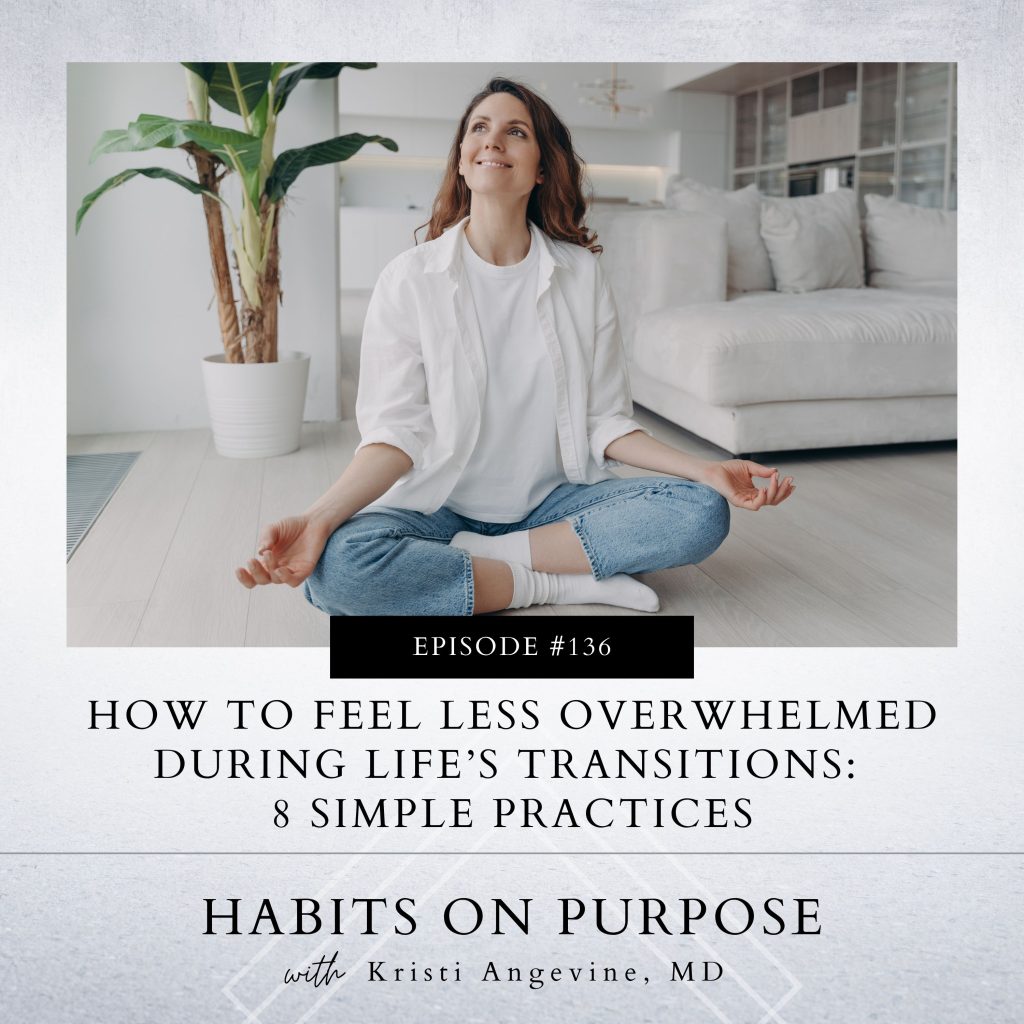
The life of a high achiever is filled with transitions. Whether it’s in life, work, relationships, or something else, there’s a seemingly endless number of starts, stops, and new beginnings. It’s tough not to get overwhelmed during these periods, which is why I’ve developed a list of ways to make the transitions easier.
In today’s episode, I’m sharing my eight essentials to implement when you’re experiencing any type of shift. Transitions can often drag us back into our patterns, bringing up old stress, old beliefs, and old dynamics. As a result, it’s crucial to have this plan of action to keep you on track.
From simply taking a moment to pause and reflect to doing something fun and playful, listen in as I outline these eight essential practices that are easy to do and highly effective. I also provide some clues to look out for, which may alert you to feelings of stress during a transition. That way, you can intervene before the emotional intensity builds.
What you'll learn from this episode:
- Why transitions have the potential to bring your old habits to the surface.
- The many feelings and actions associated with transitional stress.
- Eight essentials to help you go from overwhelmed to ease during life’s transitions.
Listen to the Full Episode:
Powerful Takeaways:
2:20 “When we experience shifts, when we encounter something new, the stage is set for our old patterns to emerge.”
2:35 “Change is situational. Transition, on the other hand, is psychological.”
5:29 “I’m just going to say that pausing is one of the simplest interventions that takes the intensity of any emotional state down a few notches.”
8:54 “Your stress does not mean there’s anything uniquely defective or broken about you.”
14:57 “When you use the language of parts, you remind yourself that whatever you are thinking or feeling or doing, it does not represent the whole of who you are, but it is just one portion of you.”
Featured on the Show:
- Leave a rating and review for the podcast here!
- If you’re interested in connecting with me for private coaching, go to HabitsOnPurpose.com/private.
- Follow me on Instagram!
- Click here to join the mailing list.
- Join the Habits on Purpose Facebook group!
- Click here to send me any questions that you would like addressed on the podcast!
- Pema Chödrön, When Things Fall Apart
- Brené Brown: Website
Related Episodes:
Full Episode Transcript:
Welcome to Habits On Purpose, a podcast for high-achieving women who want to create lifelong habits that give more than they take. You'll get practical strategies for mindset shifts that will help you finally understand the root causes of why you think, feel, and act as you do. And now here's your host, Physician and Master Certified Life Coach Kristi Angevine.
Hello, hello, everybody. I am in a time of transition right now. And for the parents whose kids do traditional school, you will relate to the fact that summer is done. School is back in session.
For us, our kids are headed back into elementary school and starting middle school, which means two different drop-offs, two different playcations, two different times, and starting all sorts of afterschool activities. And it feels like a bunch of change.
For some of you, it might mean that you have kids at college, a slightly emptier nest, kids starting school that have never been at school before. For others of you who are child-free, or maybe you have children you're homeschooling, you might not have a school year per se, imposing any changes or transitions on your life, but you might have transitions related to weather or to the workload or to the end of some projects at work and the beginnings of others.
You might have transitions going on in your existence based on coworkers of yours who have kids, who now have changed availability that impacts your schedule. So if you are like me and a lot of my clients right now, whatever your circumstances are, this particular time right now may feel like a time of transition.
And while transitions are not universally intrinsically difficult, I find that when we experience shifts, when we encounter something new, the stage is set for our old patterns to emerge.
Now, William Bridges says, “It isn't the changes that do you in, it's the transitions. Change is situational. Transition, on the other hand, is psychological.” He goes on to say, “It's not those events, but rather the inner reorientation and self-redefinition you have to go through in order to incorporate any of those changes into your life.”
And with this in mind, I think of transitions as the dog whistle that brings up our old stress, our old habits, old wounds, old beliefs, old dynamics, right up to the surface. In other words, new stuff brings up old stuff. Pema Chödrön from When Things Fall Apart says, “Nothing ever goes away until it has taught us what we need to know.”
So in this time of transition, it might mean that you have more overwhelm, the return of a harsh inner critic, extra frustration that you thought you had solved, taking things personally all over again, making big deals out of small things when previously you'd felt more calm, more grounded. Or you might just have an overall feeling of being frayed.
If this describes how you're feeling, if you find yourself feeling more emotional, snapping at your loved ones more quickly, sighing, letting self-care go, reaching more for things like food or drink or your phone, or maybe busying yourself in work projects or whatever soothing, buffering activity takes the edge off of life for you, if this is you, there's a good reason that you are doing this.
In times of transition, where whatever rhythm and routine you previously had that was working, in transitions, we can fall back into and notice old patterns and old parts come back. This episode is going to give you eight things that you can do to make transitions easier. So if you're in a time of transition, beautiful. If you're not in transition, take notes for when you are.
So if you want to reduce overwhelm, just feel better, feel calmer, more settled, more grounded, this is for you. Now, I know some of you like all the steps and you like to write down all the things and take all the notes, but I want to invite you just to listen.
When I'm going over these items, just take the things that sound like they are very doable, that resonate with you. You do not have to do all of these things to feel a difference. There are enough things on this list that no matter what your reason for feeling off kilter in this transition is, there will be something here that will help you feel better.
But you don't have to memorize the whole list, or do them all in sequence, or do all of them at all.
Essential number one, if you are feeling overwhelmed in a time of transition, is to pause. Now we could spend days discussing the efficacy of pausing, but we're not going to do that today. I'm just going to say that pausing is one of the simplest interventions that takes the intensity of any emotional state down a few notches.
Why does pausing work? Well, pausing requires you to slow down what is naturally flowing along, what is automatically happening. It calls on overthinkers to look up. It takes the tunnel vision blinders and softens them. And it takes the proverbial cyclone of revved-up anxiety and overwhelm, and it stops the swirling like crazy feeling.
And this is because pausing does not come naturally, that's the point. Overwhelm can naturally ramp up. Irritation begets more irritation. Rigidly clinging to a plan naturally intensifies the more things go off track. And pausing gives you the opportunity to interrupt your default ways. It is going against what is natural.
So to stop autopilot stress, pause. What's this look like? Sometimes pausing is simply setting five alarms to go off on your phone throughout the day so that you can check in, in advance of feeling undone. Your alarm goes off, you look at your phone, you check in, you pause.
How am I feeling? What am I thinking? What's going on? A small pause brings in awareness. And you can do it in advance of feeling overwhelmed. Other times, a pause is simply setting the intention at the beginning of your day that you are going to pause, or stop for about one to two minutes, every time you feel a big emotion.
Pausing can look like taking two deep breaths between one patient room and the next, between conversations with different people, between different emails. For you, pausing may look like taking “box breaths”.
Pausing can look like taking a break to stand and stretch when you've been sitting down for too long. It can be simply stopping mid-sentence and assessing, what's going on for me right now, mentally, emotionally, physically, energetically?
You can make pausing your own, but operationalizing it so that it is a regular intervention can help you tons. For me right now, pausing looks like this. When I catch myself getting a bit curt or rushed, or feeling that really familiar tight feeling of tension, pausing is stopping and taking a moment to just acknowledge that that's what is going on for me.
And in doing that, my tension isn't magically gone, but it helps me remember a part of me is tense but I also have other options besides being grumpy and rigid and snippy.
The other tool I love to use for a pause is essentially PNC. It's Pause, Name/Notice, and use Compassion and Curiosity, PNC. You can say PNNCC, but PNC I think is easier.
So you pause, you name and notice what's going on for you, and then you meet yourself with compassion and curiosity. That is number one. Pause, build it in, do it with big feelings, make it physical, make it mental, make it an emotional check-in, make your own, or use PNC.
Now, number two: Remember, it is actually normal to feel off kilter in a transition. It makes sense that part of you feels overwhelmed. Feeling like this is kind of part of the shared human experience, and your stress does not mean there's anything uniquely defective or broken about you.
You are a normal human having a normal human response to a transition. And when I say, “Remember that it is normal to feel this way,” I mean, remind yourself on purpose that it is normal, it makes sense, and this stress does not mean anything bad about you.
Number three: Remind yourself that transitions are not forever. When you look back on this transitional state in one, two, five, 10 years, what seems big now will have turned out okay. You will have learned lots of things. Like seasons or phases that are finite, so are transitions. It's not going to be like this forever.
You're going to get proficient at things that are unfamiliar. You will find a rhythm where there isn't one yet. With practice will come ease. What's intimidating will become manageable. Remember, this is not how it will feel forever.
And notice how you feel when you tell yourself, “Here we go again. It is always so awful. This feels terrible”? You probably feel discouraged and stressed, right? Versus, how does it feel to frame things with thinking, “This isn't forever. It might be hard right now, but it's all going to become manageable with time”? Feels better, right?
All right, number four: Do something fun. Find something to laugh about. Build in play, on purpose, every day. Now, we aren't going to cover the vast evidence of the benefits of play on your wellbeing, on learning, on productivity and on joy, but it is there.
To paraphrase Brené Brown, play is not something that's an option, but it's a human need. Fun and laughter and play are often dismissed as trivial, or even immature and childish. And when you are frazzled and feeling up to your ears in stress, the last thing on your mind is having fun, playing or anything humorous.
It is the opposite of natural to incorporate these things in when you're feeling the weight of a transition, which again is the brilliance in this technique. In times of transition, when you are stressed, consider it mandatory to build these things in.
What this looks like is different for everybody, but you can literally bring up your favorite funny movie, or your favorite comedian, and watch him or her for 15 minutes a day in times of transition. You could build in some activity that is done only for fun. You can find a way to have fun on purpose, to laugh, to play, and do it as much as is realistic in your day.
Because when you do this, it will open the door to things like calm, perspective, connection, and ease, which is exactly what we all need when we feel frazzled.
So let's recap. The first four things to do when you're feeling the stress of a transition is, number one: Pause. Number two: Remind yourself that it is normal to feel as you are, and you're not broken. Number three: Remind yourself that transitions are temporary. And number four: Build in fun, laughter and play.
All right, so now we're to number five. Number five is: Move your body. If you have the ability to move your body, move your body. This could be exercise, riding your bike, walking, running, lifting weights, swaying, dancing, stretching. If you're unable to move in these ways, find a way to move that works for you.
When we are overwhelmed and tense, we are often disembodied, living from the neck up, over thinking, second guessing, hyper focused on challenges or schedules, constantly running a mental to-do list.
When we build in movement, it reconnects us to ourselves. So if you are all up in your head, moving in some way that is pleasurable will help you immensely.
Number six: Get curious and find something that will make things feel slightly easier. Now, if all-or-none thinking is kind of your jam, and it's your area of expertise when things get really tough, what you might find yourself doing is looking for big solutions to your big stress. And when you can't do the grand plan that you've come up with, you end up doing what? You do nothing, but you keep stressing.
But sometimes all we need is a tiny shift, and it gives us a little respite, respite that feels amazing. So getting curious sounds like, what's hard right now? What are two or three options that might make it a little easier? Could somebody else help with carpooling to a sport? Could dinner be leftovers or a frozen pizza?
Getting curious means stepping back from what you think you know, pressing pause on your assumptions, and just allowing yourself to wonder. Asking questions from genuine not knowing. What is working? What is not? What is hard? What could help?
Based on what's going on right now, what can I do, even something tiny, to make things a bit easier? So get curious and find something that will make things a slight bit easier.
Now, number seven harks to my passion about Internal Family Systems. Number seven is: To use the language of “parts” anytime you notice an emotion, a recurrent thought pattern or a recurrent action. This sounds like,
“A part of me is overwhelmed. Part of me is antsy. Part of me is really irritated. A part of me can't help but only see the worst-case scenario here. A part of me is livid right now. Part of me feels stuck and just wants to cry. A part of me doesn't understand why nobody's listening. A part of me feels like nobody cares.”
“A part of me just wants to say eff it and scroll on my phone. Part of me is just putting things in my digital shopping basket that I don't really need. A part of me is being kind of snarky and critical of myself in a way that I would never talk to a friend. A part of me really hates these people.”
“A part of me feels attacked. A part of me feels so unmotivated and does not want to go to the gym. A part of me wants to rush in and ask them an urgent question.”
When you use the language of parts, you remind yourself that whatever you are thinking or feeling or doing, it does not represent the whole of who you are, but it is just one portion of you. When you talk in the language of parts, it can actually help you start tracking common patterns or sequences in yourself.
For example, if you notice in a certain situation where you are being really snippy and curt, when you talk in parts, you might also notice that a part of you feels angry. In addition to that, behind the anger, there's a part that feels unvalued. So you might notice in certain situations a part feels snippy because a part is angry and another part feels unvalued.
This common sequence can help you anticipate a recurrence and tend to it in the future. Using the language of parts helps you create mental and emotional space, which can give you clarity.
Now we are up to our final essential for how to feel better when you are in a transition. Number eight is: Giving yourself a pep talk in the form of reminding yourself that you can do difficult things. Now, this is not the reminder that you can do difficult things to suggest that because you're tough and because you've done hard things in the past, that you should just suck it up and suffer unnecessarily.
Rather, this is the reminder where you take inventory of the challenges you've handled in the past, the tricky situations that you figured out, the uphill battles that you have fought, and you remind yourself of the skillset, the resourcefulness and the scrappiness that you possess, even if right in this moment it feels miles away.
When you remind yourself of your resourcefulness, it is a way to invoke confidence and the gumption that you might need to persist when you feel like you are not cut out for the job, when the transition feels like it's too much.
And it bears repeating to say, for those of you who might distort this little tip, that you should remind yourself that you can do difficult things and that means you should just suck it up, ignore the pain, and kind of soldier on, that is not what this is.
This is reminding yourself of all the things that you've handled in the past. And reminding yourself of the scrappiness and resourcefulness that you already possess. So that you can kindly but fiercely remind yourself how capable you actually are when you might be in a transitional state where you can't see it.
So let's go over all of these different essentials that you can call on when you're feeling the stress of a transition.
You can pause, remind yourself it's normal to feel as you're feeling and that you're not broken. Remind yourself that transitions are temporary. Build in fun, laughter and play on purpose. Move your body. Get curious and find one thing that'll make things a bit easier. Use the language of “parts”, and take stock of other difficult things that you've done in order to remind yourself of your own resourcefulness.
Now, I want you to notice that all of these things help you invoke qualities that you likely feel when you are feeling at your best. Qualities like calm, confidence, curiosity, clear-headedness, perspective, connection, playfulness, compassion, open-heartedness. When you can invoke these qualities on purpose, they will help you surf a transition so much more easily than when you don't.
This is the list of things that are helping me feel grounded and less like I am running around like a crazy lady running on fumes. It keeps me from spiraling in anxiety for too long. It takes my tense, drill sergeant, shoehorning part down a notch. It makes interacting with my family so much easier because they get a less frazzled, more approachable version of me.
So what I'm going to invite you to do is to pick one of these things on this list, just one, and use it. If there are more that resonate with you and they seem easy, great, do more. But I want you to pick at least one and use it this week. And if you're thinking, “Gosh, there are eight things there, I have so much going on in my brain, it is so full, I cannot remember eight things,” I'm going to try to sort of give you an in-the-nutshell version.
It is this: Breathe on purpose, and do PNC. That means take a breath, pause, name and notice what's going on, and meet yourself with compassion and curiosity. So breathe and do PNC.
I had to chuckle a little bit right now, it's kind of funny. I've noticed as I've done this podcast for a couple of years now, and as I've been teaching this work for a while, that I use a lot of letter combinations and little acronyms and things as mnemonics. And I noticed I did that in medical school and in college, and when I would talk to patients about things so they could remember things.
But here it is too, using these little letters as ways to remind myself of things. I think one of the beauties of using something like PNC is that when we are really activated, we need something really simple to grab onto. And if letters like that don't do it for you, come up with something that works well for you.
You might have an image or a color, or you have to write something down, whatever works for you is great. But I noticed having just something really, really simple and short can help me, as something really just tangible to grab onto. So all that to say, use “breathe on purpose and PNC” if you can't remember anything else. Pause, name and notice what's going on, and then meet yourself with compassion and curiosity.
Thank you so much for listening to Episode 136. I hope you found it helpful. If you've got questions, if you want to share your experience with transitions and with using these, please, I'd love to hear from you. Please write. You can join the email list at HabitsOnPurpose.com and just press “Reply” to any email.
Until next week, take care, and I will talk to you soon.
Like what you're hearing on the podcast? Want help taking these concepts and ideas and actually applying them in your everyday life? That's what coaching with me can help you do.
In my coaching practice, I help high achievers change their habits from ones that take more than they give to ones that are much more empowering. If you're interested in connecting, you can go to HabitsOnPurpose.com and join the email list.
I will send out emails that will give you information about private coaching, about upcoming small group coaching opportunities, about webinars and workshops and all the things. And all of this helps you get to know me a little bit better.
Now, if you already know that you are ready to work together so that you can understand yourself better and be more intentional, we can hop on a call to see if private coaching is a fit for your goals. Go to HabitsOnPurpose.com/private to learn more.
And if you're a woman physician, and you want the community piece of getting to the heart of your struggles, alongside other women who really get it, get on the Habits on Purpose for Physicians Small Group Coaching waitlist at HabitsOnPurpose.com/HOPP. The next group will start in October of 2024.
Take care and have a great week.
Thanks for listening to Habits On Purpose. If you want more information on Kristi Angevine or the resources from the podcast, visit HabitsOnPurpose.com. Tune in next week for another episode.
Enjoy the show:

