
Why do I know exactly what to do but still don’t do it? This frustrating disconnect between intellectual understanding and actual behavior isn’t a sign of weakness or laziness. It’s a common human experience that has logical explanations beneath the surface.
In this episode, I explore the knowing-doing gap – that puzzling space where we intellectually understand what would help us, but can’t seem to follow through. Whether it’s saying no when we need to, going to bed earlier, or stepping away from our screens, this gap can feel especially maddening for high achievers who are otherwise so competent in their lives.
I share my personal experiences with this phenomenon, including how I overcame my own resistance to regular exercise despite knowing all the benefits. By examining what’s really happening when we don’t follow through, we can discover the contradictory desires that create this gap. I offer a simple three-part tool to help you bridge this gap with curiosity and compassion rather than judgment and frustration.
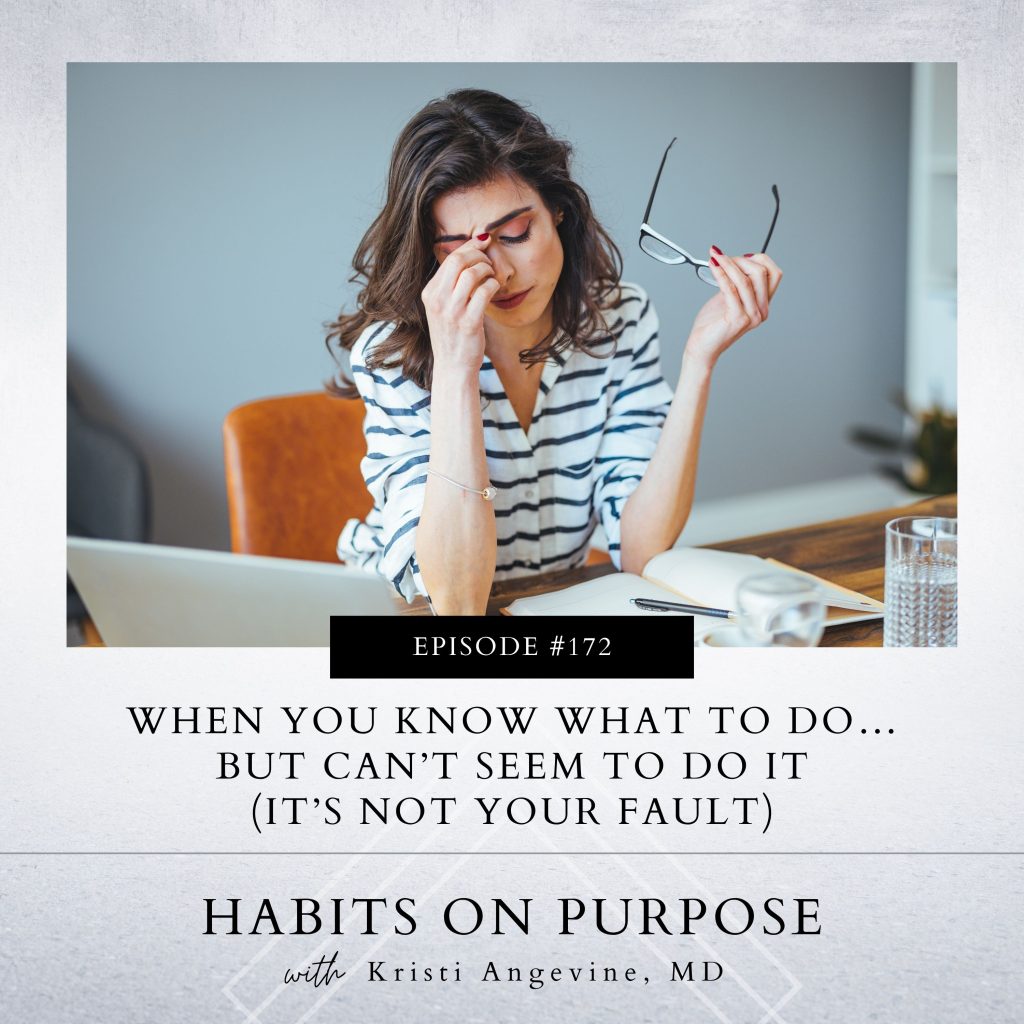
In this episode, I explore the knowing-doing gap – that puzzling space where we intellectually understand what would help us, but can’t seem to follow through. Whether it’s saying no when we need to, going to bed earlier, or stepping away from our screens, this gap can feel especially maddening for high achievers who are otherwise so competent in their lives.
I share my personal experiences with this phenomenon, including how I overcame my own resistance to regular exercise despite knowing all the benefits. By examining what’s really happening when we don’t follow through, we can discover the contradictory desires that create this gap. I offer a simple three-part tool to help you bridge this gap with curiosity and compassion rather than judgment and frustration.
What you'll learn from this episode:
- How to identify when you’re experiencing the gap between knowing and doing.
- Why understanding your resistance is more effective than forcing yourself to change through willpower.
- How contradictory desires within yourself create resistance to change.
- The three-step process to bridge the knowing-doing gap with curiosity and compassion.
- Why assuming positive intent behind your resistance leads to breakthrough insights.
Listen to the Full Episode:
Powerful Takeaways:
7:30 “There is a gap between our understanding and application of that understanding because we often simultaneously want contradictory things.”
9:05 “The part of you that hates rules and wants me time rebels and soothes your stress with cookies, or some reels, or scrolling, before you can even slow down to realize what’s happening.”
10:28 “These desires that go counter to your goals are protective in some way, even if it doesn’t make logical sense at first glance.”
19:32 “If you know what to do but you can’t seem to do it, you are not a failure, you’re not undisciplined, you’re not broken. You just have different intentions happening concurrently.”
Featured on the Show:
- Leave a rating and review for the podcast here!
- If you’re interested in connecting with me for private coaching, go to HabitsOnPurpose.com/private.
- Follow me on Instagram!
- Click here to join the mailing list.
- Join Habits on Purpose for Physicians (HOPP) small group coaching program here!
- Join the Habits on Purpose Facebook group!
- Click here to send me any questions that you would like addressed on the podcast!
- Internal Family Systems
- Learn more about the Befriending Anger course
- Join the interest list for the next Habits on Purpose for Physicians small group coaching program. Enrollment starts June 2025.
- Get more information about the group coaching preview week.
Related Episodes:
Full Episode Transcript:
Enjoy the show:


Welcome to Habits On Purpose, I’m your host, Physician, Master Certified Life Coach, and IFS Practitioner, Kristi Angevine. Let’s get started.
Hello, hello everybody. So, I have some friends who are podcast hosts also, and they have told me that over the years, they have found that their home closet is better acoustically than the fancy podcast studio that they started in. And yet, I have never had the need to record my podcast in a closet, until recently.
So I've been traveling and I ran out of time to record something before I left. So I brought my recording equipment with me, and here I am in an Airbnb closet. And I have a kitchen chair with some pillows on it that is pushed up against the shelf. My microphone is on a box of bubbly water. And it seems like it's going pretty well. My fingers are crossed that any sort of quality change in the acoustics is not too disruptive for you. And if it is, my huge apologies.
So, me from even a few years ago would have had some thoughts about this. Some, perhaps subtle, but some negative thoughts. Like, gosh Kristi, if you didn't run so late, you wouldn't have to do this and you could be more present on your trip. No wonder you always feel so behind. You're really not going to do anything good, are you? And really, how much longer can you keep up this facade until they all see you for who you really are?
So, I am just so pleased to tell you that narrative from that part of me that used to say that stuff, it has stepped down from the full-time position with great overtime pay. And this part of me only makes cameos right now. Now, it's not fully retired, but my relationship to that voice is just so different. This new relationship makes such a difference, and not just intellectually, but in how I feel as I move through the world.
So, instead of packing my bags and feeling discouraged but trying to make out like I'm fine and ending up coming across as really snippy as I'm getting ready for my trip, which, as you can imagine, snippiness understandably elicits really annoyed responses from my kids and my partner, which goes on to make everything feel really tight and tense and contentious all around. Instead of that, I feel more relaxed. I can listen better. I have perspective. I can think more clearly. I can be creative. And this makes me have a totally different experience, and everything just really has a genuinely different feel to it.
So, when I say something to one of my family members and they get upset with me for talking loudly about something they wanted to be private, or they tell me that all I do is nag, nag, nag, or they say, I heard you the third time you said it. Instead of instantly getting angry or instantly feeling guilt, because I'm more steady in the first place, I can do a quick check inside. And I ask myself, are they right? Did I overstep? Am I nagging? Am I over-explaining because I'm tense? Or is it them that has some stress, and I was actually being reasonable? And then when I know the answer, I can respond to my people instead of reacting.
So maybe I apologize. Maybe I own up to my caffeinated inattention. Maybe I respond calmly and tell them that I just don't understand, but maybe we can talk later. Maybe I just say, okay, and let it go. And this is such an easier experience. And it doesn't call on me to have perfection or perfectly great moods all around in order to be okay. And it all starts from me shifting my relationship to some of these like critical narratives. And not being bothered if they show up, but really releasing them quickly, and ultimately just feeling better.
And I share this because this is what it can look like, and for me, what it does look like in just regular old life, when you do this inner work of slowing down and examining what's present, meeting yourself where you are, checking in with your feelings, noticing your thoughts, and having some care and curiosity and compassion. Because once you do that, and especially once you start doing that regularly, it's so much easier to be intentional.
So, live from the closet of an Airbnb, the Habits On Purpose podcast. So, today is about when things don't feel so great and progress feels invisible. So, why might you not be getting traction on something you want to change? Let's explore this together.
So have you ever said something like this? I know I should pause before I nag, but we are running late, and it feels impossible in that moment. Or, I know I need to go to bed earlier. I just don't. Or, I know I shouldn't check email after dinner, but here I am again. Or, I know I need to say no, but I still said yes. It can feel maddening, right? And for high achievers especially, it can feel defeating and discouraging because on paper, you're so competent. So, why can't you follow through on things that are seemingly so simple? This, my friends, is the gap between knowing and doing. The knowing-doing gap. And if you've ever fallen into it, you are not alone. I personally have a master's degree in it, and I almost got my PhD.
So, let's talk about what creates this gap. You know things you could do to make changes in your life. You, let's say you have tools, you know concepts, you may intellectually even see the repeated patterns you fall into, but you just can't seem to get out of them. What makes this even a thing? Well, first off, the conventional advice and tips that we get that sound really reasonable are often more surface-level or vague, or generic. So, take, for example, things like you know, you just need better time management. You're just not disciplined enough. You need more self-discipline. Create a stronger why and revisit that every day. Just read it every day. Or, my favorite, it's just your thoughts. It's just how you're thinking about things. So, let's just find a new way to think about it.
Now, none of these things I mentioned, none of them are intrinsically wrong or bad. None of them are actually unhelpful. They just don't hone in on the deeper issues at play. So when we try them, sometimes they don't work all that great. And then, when things we try don't have the results that we're hoping for, it can be very easy to just stop trying anything.
Next, the other reason there is a gap between our understanding and application of that understanding is because we often simultaneously want contradictory things, but we don't realize it. Now this is very important, so let me say that again. The reason why there can be a gap between our intellectual understanding and our application of that understanding comes down to simultaneously desiring contradictory things but not realizing that. So, this is what it can sound like when different parts of you want different things.
One part of you knows what's helpful. You've listened to all the podcasts, you've read the books, you've made a plan. But when the rubber meets the road and it's time to apply that knowledge, another part of you steps in, almost like another person in a meeting. Say you want to stop saying yes when you really would prefer to say no. This is where a part of you intellectually understands that this requires you to actually say the word no, set a boundary, face other people maybe being disappointed, learn to be with your own feelings when that happens, be brave. But the part of you that's afraid of disappointing people, maybe the part that's wired to people please or afraid of being judged as not being a team player, that part steps in, takes the wheel, and says yes before you can even think it through.
Or let me give you another example. Maybe you want to have less emotional eating, and you intellectually, you know all the things. You make a plan, you anticipate challenges, you watch for urges, you allow them, you do something else to get grounded. But the part of you that hates rules and wants me time, rebels and soothes your stress with cookies or some reels or scrolling before you can even slow down to realize what's happening. Or say you want to stop overextending. And intellectually, you understand that, but viscerally, disappointment in others feels unsafe. There's a knowing-doing gap.
When we intellectually want less junk food and less stress eating, but emotionally feel soothing as this life-or-death imperative, we have a knowing-doing gap. And this is why the knowing doesn't translate into application.
The analogy I often use is, I can read all the cookbooks in the world but not know how to make a meal. I can watch all these YouTube videos about how to jump my mountain bike, but I can still have no jumping skills in real life. This is the same thing that goes on here when you know what you should do, but you don't apply that knowledge.
So, what can we do about having contradictory desires or contradicting parts? First of all, for the parts of you that want to do something counter to your goals, we have to realize they're not trying to sabotage you. You are not trying to sabotage yourself. And contradictory desires, they're not fixed, they're not unchangeable. These desires that go counter to your goals are protective in some way, even if it doesn't make logical sense at first glance.
So this is how we can understand a knowing-doing gap existing simply because there's an unaddressed concern, need, or fear. And once that concern, need, or fear is addressed, and you see how the gap makes better sense, that is when you can stop feeling like you're fighting yourself.
Now, I'll tell you what this looked like for me. I used to exercise, run, ride my bike, go to gym classes as a part of my everyday life. Then, life got pretty crazy. There were lots of changes, and I didn't have movement so easily built in. And I had this season where I kept saying, I need to move my body more. I need to exercise, I need to ride. And I felt better when I walked. I felt better when I moved. I knew the data. I knew I'd sleep better. I knew to start small and create a minimum baseline and to do that until it was easy, until I craved more, etcetera, etcetera. I knew all the things. But when the time came to do something, over and over and over, I would reach for my laptop or I'd go clean something in the kitchen or I would start scrolling or I would do anything other than following through.
Why? Well, intellectually, I honestly couldn't fathom why. Until I started regularly examining what is going on in these moments where I didn't follow through. And what I realized was not something that I could have thought my way to or guessed. I realized a multitude of things. A part of me saw choosing movement as selfish. That I would go off and do exercise, and somebody would need me, and I would be unavailable, and that would then burden them. Another part of me was just exhausted and wanted an easier way to get a hit of dopamine. Another part believed that unless I had forty-five minutes or an hour, moving just wasn't even worth it. Why bother if you can't do the whole thing?
And this last part surprised me. When I would go exercise, I would get great perspective, lots of clarity, and all sorts of creative ideas would come to me, which sounds pretty great, right? You'd think that would motivate me like a carrot. But a part of me worried that when I executed on those ideas, I would therefore be vulnerable to judgment. And that was so bad that it was preferable to avoid moving.
So, once I paused all my judgment and I got curious about what was blocking me, and got curious about these contradictions, that resistance to movement just softened. And movement became something I wanted to do, not this chore I kept skipping and not doing for reasons that I couldn't understand. And then when I caught myself not wanting to move, I would know there's some part of me here with one of those unacknowledged concerns. So I didn't need a better plan or more willpower or to find an accountability buddy. I needed to understand what exactly was in the way. And intellectually, I would not have thought of all the things that I was able to discover when I got really curious.
So, consider this. Where do you have a gap between what you, quote, know you should do and what you actually do? And what I'm going to do next is walk you through a tool that's going to help you bridge that gap between what you know and real-life application.
So, if you've been listening to this podcast for a long time, you know I like to keep things really practical. If we can't take a good idea and bring it into real life, it's just going to go stale on the shelf. So, this is a three-part tool. It's very simple. All you have to do is be willing to do it. And I keep it very short so that you can remember it.
So number one, pause and name the gap between knowing and doing. You just notice that you're in a pattern, and you say, I know what I want to do, and I'm not doing it right now. And that alone is really powerful because it puts you into an observer mode. It shifts you out of any judgment. It interrupts your autopilot default. So you just say, I know what I want to do, or I know what I should do, or I know what I could do. And then you say, but I'm not doing it right now.
Number two, ask, what's actually in the way? What's really going on here? What part of me is here that makes this feel so hard? Maybe it's perfectionism talking, saying, if you can't do it perfectly, don't bother. Maybe it's a fear where you're worrying that if you get it wrong, you'll be judged. Maybe you're exhausted and a part of you just wants to rest.
Number three, assume there's positive intent behind your desire to do something else, and bring in compassion and curiosity. The way this looks is you ask, what is the hidden benefit of what I want to do? Or conversely, what am I afraid would happen if I did the thing that I intellectually know to do?
So, what am I afraid would happen if I didn't do it perfectly? Oh gosh, that would mean I would lower my standards forever. Or, what's the hidden benefit of not acting? Hmm. Oh my gosh, I don't want to get it wrong. I don't want to be rejected. That means if I don't act, I'm going to reduce the risk of judgment and rejection. And that's powerful, right? Say you simultaneously know you should exercise, but also prefer to rest. So you would ask, what's the hidden benefit of this low effort, this rest? Oh, okay. It would prevent any further depletion, and I'm exhausted. All right, that's good to know.
So this last part of assuming positive intention requires you to look at what you really want to do with a totally different perspective. So instead of going, what is my problem for not exercising? Why do I keep doing X Y Z? You assume there's a positive intention baked into what you truly want to do that stands in your way, that's in opposition to what you know to do.
And you get compassionate and curious about it. Like, how come this would make sense? And you just listen or journal, and you will be surprised at what you find. And for me, this is how I found the real block for my movement, being a fear of acting on creative ideas and a hidden benefit of avoiding failure and avoiding rejection, which are really powerful things.
So when you do these three steps, sometimes just recognizing that there's more than meets the eye is more than enough to get some traction. And sometimes with this extra layer of understanding, you can realize a micro step isn't actually as dangerous as it seems. So perhaps instead of meditating for twenty whole minutes, you breathe for two minutes. Instead of perfect food prep, you grab what's on hand, and you slow down a bit while you eat. Instead of scrolling for hours, you set a twenty-minute timer, and you stop scrolling when it goes off.
So, let's talk briefly why interrupting the cycle of knowing something but not acting on it really matters. When we don't understand why we have a gap between what we intellectually understand and what we do, we stay in this weird suspended animation, this Groundhog Day existence on a hamster wheel, never making changes. And then, it is so easy to make our inaction and our lack of change mean something terrible about ourselves. And we can conclude things like, I must just be lazy. I'm just not cut out for this. Other people can change, but not me. And then we can see the worst possible outcome of ten, twenty years of not making change, and feel just so deeply defeated.
But when you realize that it's just different parts of your system, almost like different people on different committees with different agendas in a company, that are pulling you in different directions, you have a workable problem. You can recognize the core issues, you can negotiate, you can make a collaborative plan, you can get to the real reason behind your resistance, and then you can take action. This is such important work that it is a key component to what we do every week in Habits on Purpose for Physicians small group coaching, which, PS, you can join now, enrollment is open. And if you want a preview of the group, you can preview it for free, and you'll get that info at the end of this episode.
But we do this work regularly to bridge the gap between intellectual understanding and application. And we do this using Internal Family Systems and a variety of other really practical tools to get to the root causes of habits, to understand precisely why you do what you do, and build a deeper, much more compassionate relationship with yourself.
So let's just review. If you know what to do but you can't seem to do it, you are not a failure, you're not undisciplined, you're not broken. You just have different intentions happening concurrently. You have parts of your system that are pulling you in opposite directions, contradictory agendas that just haven't yet been identified. And the solution is not more willpower, it's not a better planner, it's not a habit tracker, and it's definitely not more information. The solution is a deeper understanding. And this deeper understanding comes from slowing down, interrupting your autopilot default, and bringing in curiosity and compassion on purpose.
So this week, my invitation to you is to try this. First, in real time, when you notice yourself doing something that's in opposition to what you know to do, pause and name the gap between intellectual understanding and application. Number two, ask, what's actually in the way? What's really going on here? Who's here that's making this feel hard for me? Number three, assume positive intent and bring compassion and curiosity by asking, what's the hidden benefit here? Or conversely asking, what am I afraid would happen?
I would love to hear how this idea and this tool lands with you. So let's connect. Join the Habits on Purpose email list at habitsonpurpose.com and press reply to any message. I read and appreciate every single one. Thank you so much for listening and I will talk to you next time.
If you're a woman physician and you want to go deeper with this kind of work and create changes in your everyday life, come join us in the next round of Habits on Purpose for Physicians small group coaching. Enrollment is open now and spots are limited. Learn more at habitsonpurpose.com/hopp. And if you're listening to this in live time and you want to start this kind of work even sooner than our program starts, there are two options.
The Befriending Anger course starts soon, and you can still join us. It's a two-week course designed to help you understand this complex and very often misunderstood emotion. And the Habits on Purpose for Physicians preview week is a free week that gives you a sense of what being in HOPP small group coaching is like. Check them both out in the show notes, or you can go to habitsonpurpose.com/anger for the anger course or /preview for the preview. I hope you have a really good week, and I'm so grateful you tuned in.
Thanks for listening to Habits On Purpose. If you want more information on Kristi Angevine or the resources from the podcast, visit HabitsOnPurpose.com. Tune in next week for another episode.