
An integral part of maintaining a high-achieving lifestyle is a loving, fulfilling relationship with your partner. If that’s lacking, it’s only a matter of time before you suffer a setback. Luckily, by making a few minor mindset shifts, you can bring more love and connection into your marriage.
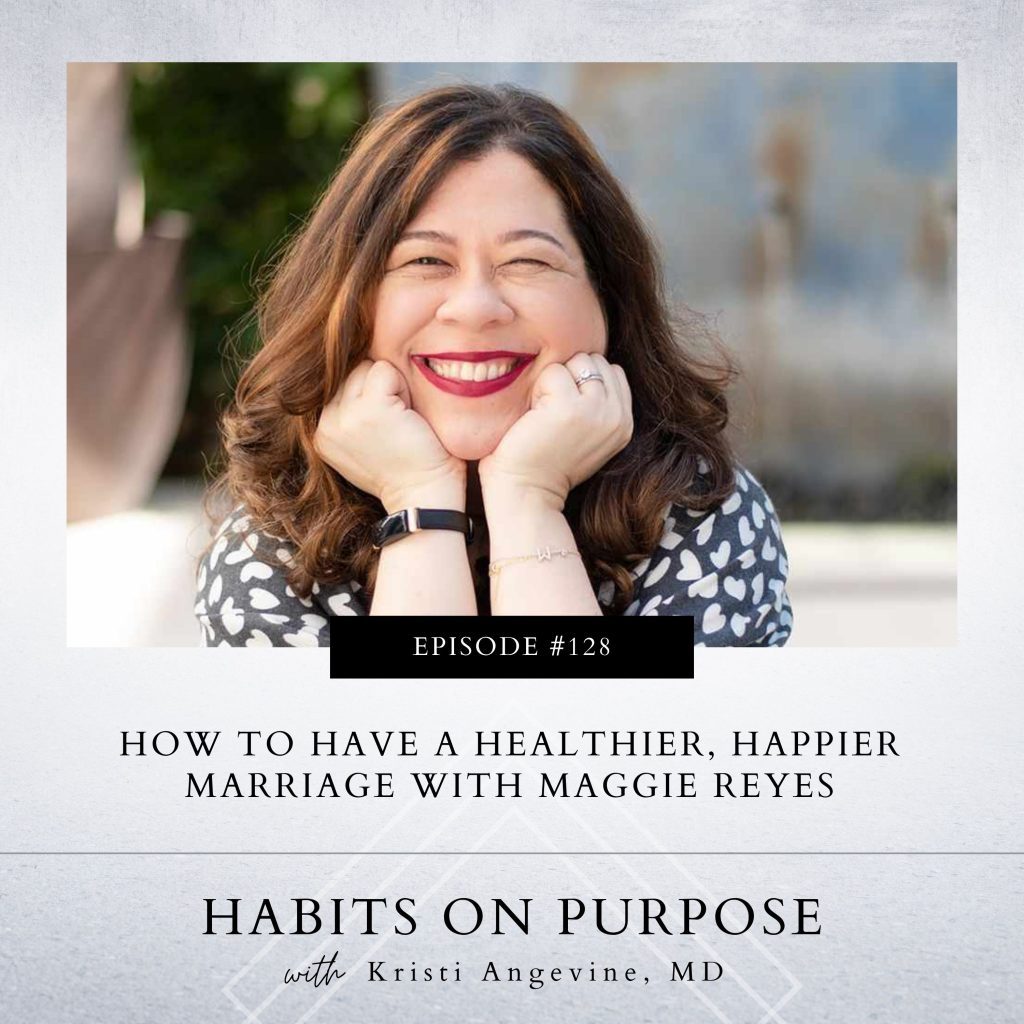
Maggie Reyes is a modern marriage coach, interpersonal communication expert, and author of Questions for Couples Journal. She helps Type-A women like you have better marriages without adding more work to your already overloaded schedule.
Listen in as Maggie shares her path to coaching and the complexities of interpersonal communication. She’ll also outline her signature tool for optimizing communication and understanding stress responses in yourself and your partner. You won’t want to miss this.
An integral part of maintaining a high-achieving lifestyle is a loving, fulfilling relationship with your partner. If that’s lacking, it’s only a matter of time before you suffer a setback. Luckily, by making a few minor mindset shifts, you can bring more love and connection into your marriage.
Maggie Reyes is a modern marriage coach, interpersonal communication expert, and author of Questions for Couples Journal. She helps Type-A women like you have better marriages without adding more work to your already overloaded schedule.
Listen in as Maggie shares her path to coaching and the complexities of interpersonal communication. She’ll also outline her signature tool for optimizing communication and understanding stress responses in yourself and your partner. You won’t want to miss this.
What you'll learn from this episode:
- A cognitive behavioral approach to having better relationships.
- Maggie’s signature “soul-centered communication”—a solution-focused framework.
- The misconception of compassion and listening/communicating with intention.
- Ways to recognize stress responses and cues from yourself and your partner.
- How to stop “solving for the symptoms” and treat the actual problems in your marriage.
Listen to the Full Episode:
Powerful Takeaways:
16:22 “I would ask people, what’s the biggest issue in your relationship? And probably 98% of them said communication.”
26:16 “Loving intention is also the most liberatory intention because it’s really a place where we practice equality.”
28:56 “[Compassion] is a soft, fuzzy blanket. And it can also be simultaneously filled with so much clarity and fierceness.”
29:44 “If we are emotionally activated, if our nervous system is perceiving some kind of danger…it is not the most productive time to negotiate.”
35:54 “The way an argument starts is the way it ends. So if it starts harsh, it ends harsh. If it starts with softness, it ends with softness.”
Featured on the Show:
- Leave a rating and review for the podcast here!
- Follow me on Instagram!
- Click here to join the mailing list.
- Join the Habits on Purpose Facebook group!
- Click here to send me any questions that you would like addressed on the podcast!
- Maggie Reyes: Website | Book | Podcast | Instagram
- The Gottman Institute
- Layla Martin, This Tantric Life podcast
- Michele Weiner-Davis, Divorce Busting
- Dave Eagleman, Neuroscientist
Related Episodes:
Full Episode Transcript:
Welcome to Habits On Purpose, a podcast for high-achieving women who want to create lifelong habits that give more than they take. You'll get practical strategies for mindset shifts that will help you finally understand the root causes of why you think, feel, and act as you do. And now here's your host, Physician and Master Certified Life Coach Kristi Angevine.
Hello, hello everyone. It is with so much delight that I introduced to you Maggie Reyes. Maggie is the author of the Questions for Couples Journal. If you don't already have it, you should order it. She's a marriage coach and interpersonal communication expert. Maggie helps Type-A women who want to know how to feel better in their marriages.
And today, we discuss Maggie's path to coaching and some of the complexities of interpersonal communication. She shares with us her signature tool for optimizing communication and understanding stress responses in yourself and your partner. Enjoy.
Kristi Angevine: Alright, Maggie Reyes, welcome to the podcast. I am so happy we get to connect and have a conversation on this podcast together.
Maggie Reyes: I am so excited, I cannot tell you. Habits On Purpose, I'm so excited.
Kristi: Many people listening to this already know you, because, I mean, they’ve already listened to your podcast, they might have heard you teach in a variety of places because you're in all the places, they may have heard you speak at a recent conference for physicians that a lot of us were at. For the people who don't yet know you, just introduce yourself.
Maggie: Oh, my gosh, I'm still thinking that people don’t know me, like, “Wow, they do.” My name is Maggie Reyes. I am a marriage coach. I help Type-A women have better relationships. I take a cognitive behavioral approach; which we're probably going to talk about at some point. I love to infuse humor and lightness into sometimes heavy topics. And I host The Marriage Life Coach Podcast, where I talk about all kinds of different marriage situations. I like to make it super practical and applicable. I'm the author of the Questions for Couples Journal. People interview me all the time and I forget I wrote a book. It's a good book, everyone should get it. So, there you go. That's my introduction.
Kristi: If you could see us here, I would grab my book and hold it up; it's over a shelf. I think it’s the third shelf on the right. I love Maggie's book. It's great. So, we will link her book in the show notes so you can find her book. Buy her book. One of the things I loved about it is that it's questions, and for me, questions can be a way to tap into curiosity and connection. Or they can come from curiosity and connection, either one. But I just love it. It's such a good thing.
I remember how we first met, but I'm curious, do you have a notion, a vague inkling? Do you remember? This is not a pop quiz.
Maggie: I want to know how we first met. I want to hear it.
Kristi: The way I met you and your work, before we actually met, was my coach Lindsay Dotzlaf. Lindsay had mentioned you and so I thought, “Who's this Maggie Reyes person?” Something like that. And I think I listened to maybe one podcast episode, maybe about 10 minutes in, and I was sold. She mentioned…. I was like, “Oh, this lady. She's done training with the Gottman Institute. She is clearly passionate about interpersonal communication.”
She is taking this approach to the most tricky of relationships that some of us have. That is so holistic… You mentioned humor, I'm so glad you brought that in. There is humor, there's lightness, there is a lot of you sharing yourself, and I was just hooked. I thought this was great. And then, I wanted more.
And so, I remember you had a coaching program, The Marriage MBA, and I remember thinking, “You know what? I don't feel like there's a problem in my marriage. But I feel like there are things where I could communicate better. Where there's recurrent friction events that happen, that are like the same old thing over and over. I don't think there's anything wrong with us. But I think there's something I could optimize. There's so much I could learn.”
Nobody sat me down and talked to me about some of the things I heard you talking about on the podcast. I thought, “Yeah, okay, I should do this.” And so, I was able to be one of your clients. Then I think we ended up roaming in similar circles with working on business and things like that. Then we ultimately did master coach training together and ended up in the same small group. Which sort of began this whole other era.
Maggie: This whole other era. A little, fun trivia fact for anybody who likes to collect those, you were my final coaching that I got evaluated on to become a master coach. Isn't that amazing? I think that's so cool.
Kristi: Just reflecting back, yeah, the first time I met you we were on a Zoom call. Because that's how you did it back then in making sure people were a good fit for your program. And I remember thinking, “Oh, my intuition told me instantly, this is great. I hope she lets me pay her.” It's so great.
And then, like I mentioned, I've gotten to hear you speak in a variety of venues. Most recently, you were speaking at a money conference that was wellness and money, and all physicians. I just was kind of noodling on... I thought in my mind that I had you on the podcast like 10 times, but since I hadn't and I realized I needed to, I was just so happy that you were available and that you could.
Maggie: Oh, my gosh, I'm so excited. Yeah, totally.
Kristi: So, I want to know… I know a little bit of your background, your old life with your work and all the things that you've done in the past, can you tell people a little bit about what your work used to be, and how you ended up choosing, focusing on marriage as part of your vocation today?
Maggie: Oh, how fun. So, I worked in HR for many years before I became a coach. I actually started out, when I was 21 or 22, as a receptionist at a law firm. I worked my way up over a nine and a half year period, from receptionist to training director. I used to train lawyers, which I always think is like herding cats, that would be the equivalent. And that's really how I got into HR, as I came into training.
Then I went into the cruise industry and I did recruiting. And then, I did a mix of recruiting and training. So, I've always worked with people and mentoring. How do you enjoy your job? How do we get more done? I had all these different things around productivity and life, and all those things.
And then I met my husband. And it was wonderful and terrible at the same time. It was wonderful because I do believe he's the love of my life. It's my favorite thought about him. I think about it often. But it was terrible because I felt something with him I hadn't really felt before, which was this incredible sense of rightness.
Some people might feel that with their kids. Some people might feel that with a hobby or a passion, like if you're a painter, or if you're a writer, if you like singing or something like that. Where you're just in the flow, you're doing something you love, you're in the moment, and it just feels like everything is right. You're in the right place, the right time, doing the right thing. You feel the sense of rightness.
And I felt it very vividly with him, which was great. But then I also saw every place in my life that didn't feel that way, and that was not great. That was not fun. And that really is how I ended up becoming a coach. Because I was like, “What do I want to be when I grow up?” I took aptitude tests, and went to retreats and workshops, and they did the StrengthsFinder, all these different things.
At some point throughout that journey I discovered life coaching. And I was like, “Oh, I think I want to do that. Let's see.” And here we are, many, many, many years later, and it's working out.
Kristi: And your people are so lucky to have you. So, you alluded to training with a cognitive behavioral approach to coaching. I do think that undersells a lot of the things that you've also trained in. Because knowing you for a long time, I know that you have done so many things beyond that. But at the same time, that's sort of where we had some overlap.
Also, I know that both of us have a passion for things that sort of expand out from the cognitive world and more of the somatic and systems-based emotional stuff. For me, it's Internal Family Systems. For you, it's… I don't know what the word is for it. But I know that there's a lot of that there. I'm wondering if you could talk to some of the reasons why you incorporate so many different approaches to your approach to coaching people on marriage?
Maggie: Yeah, one of the things we do right fundamentally, we question our thoughts and our thinking, and we see if that’s producing the results that we want. But that isn't always… I used to work in hospitality. So, imagine a galley, imagine a kitchen, and you're going to make breakfast, lunch and dinner in that kitchen. You couldn't just do that with a knife. Right? You would need some spoons and forks and mixers and tools. You would need all different… a toaster. You need all these different things.
And that's really how I think about coaching. It's like, I love my knives. My knives are great. I need them to cut things. Yes, super valuable. But I also need a refrigerator. There are other things that I need. And so, when I first graduated from coaching training, my first thought… interestingly, I wasn't working with doctors then.
But in the cruise line I used to work with the medical director, because I used to hire the doctors and nurses that worked on the ships. And so, I just was sort of tangentially close to medicine for several years. And when I first became a coach, one of my primary thoughts was, “First, do no harm.” And honestly, I was like, “I don't think I know enough to not do harm.”
So, the original impetus, the original inspiration to really study other things and find out different modalities, and all these different things, was what is it that would help me support a person who's struggling in their marriage? And that then led me down the path of the Gottman Institute, where they do evidence-based interventions based on research. Which I really love.
That led me to sex, love and relationship coaching training, that has a somatic and tantric approach, with one of my favorite teachers. Her name is Layla Martin. She's amazing. And that led me to continuing education in a variety of different ways. I did a feminist coach training to learn feminist principles, to infuse my coaching with that.
One of my favorite things I did was I went for a week to Boulder to study with one of my heroes. For everyone listening, if you ever have the opportunity, if your hero is still alive and you get to spend time with them, please do it. So, there's an amazing psychologist named Michelle Weiner-Davis. She was on the team that helped develop Solution-Focused Brief Therapy. I totally have an intellectual crush on her. She's amazing.
She did a whole week of training helping therapists and coaches who work with marriages, teaching her concepts and her solution-based approach, and all these things. And that was as powerful as some of the year-long, multiple hundreds of hours of things that I did; just to be immersed with her for a week. So, when I did those StrengthsFinder, when I was on my quest of ‘what do I want to be when I grew up?’, one of my top themes was mentor, and the other one was learner. So, here I am learning and mentoring.
Kristi: Oh, that's so good. I love the analogy of the knife and the refrigerator. And couldn't agree more. I do think I probably walked around with a plastic butter knife for a while, wondering why it wasn't as helpful as I thought it might have been.
So, when it comes to marriage, and when it comes to just any intimate partnership where people are together sort of navigating what could be ups and downs, what I'm wondering is, by the time somebody comes to you, what are the things that the clients, that want your help with marriage, what are the things that they bring to you, that they think are the problems they need to address?
Maggie: That's interesting. I think I will answer that through the lens of feelings. The problems have different sorts of names and faces and shapes and sizes, but the feelings are very common. So, they come with feelings of overwhelm or frustration, or even grief or upsetness, and a variety of flavors.
So, they come to me with these feelings, and they also have the feeling of love and affection for their partner. I call it this low-grade resentment that just never fully goes away. It's not enough to… you don't want to divorce or anything. But you're just like, “This doesn't feel any good.”
So, many people are in the situation that you described, where it's like, “I love my partner. I don't really think it's a huge thing we need to… We don't need to overhaul this whole situation. But there's some stuff that I think could be better.” So, I have that.
And then I have people that need to decide if they're going to stay or they're going to go. They need to give it their all and determine, “Really, is this a viable relationship or not?” So, I deal with a wide variety of situations. But what's interesting you asking that question, is if I zero it down to the feelings, it's very common with the feelings.
Kristi: Okay, that makes so much sense. I love how you answered that. Because I can imagine some people coming in and saying, “I've got to figure out how to make my partner act differently. And so, I need to get advice and tips from you on how to do that. I need you to tell me how we can make our communication better. Because if you fix that, then…”
I could picture people coming in, pointing outside to different things, but really behind that being these emotions. “These are the common things that I'm coming to Maggie for.” That makes so much sense.
So, when I think back to a lot of the things I've learned from you, those were not things that I learned in medical school, were not things that I got taught in residency… Even though we got taught a lot of things about the nuance of communicating, and establishing rapport with a patient who's in the middle of either a life threatening emergency, or something that's more chronic, we get taught a lot about that. We didn't get taught anything about some of the communication things that you teach.
I look back and I think, “These things are just vastly missing. It’s this huge hole,” in a lot of the things that were taught. And I’m thinking we could go back to elementary school… What stuck out for me, that you teach, is your tool and concept of Soul Centered Communication. I would love for you to share a little bit with the listeners about what that is. And maybe the importance of having a framework to communicate with anybody, but particularly with your intimate partner.
Maggie: Oh, my gosh, it's so important. I absolutely would love to share it. It's a very simple tool. We're going to just walk everyone through it. They can just listen to this podcast and experiment with it, once they’ve finished listening. A little bit of the backstory, for about three years or so, I used to host a free Facebook group.
I would ask people, “What's the biggest issue in your relationship?” And probably 98% of them said communication. The other 2% was like money, children, different things, a variety of different things. But most of the people said communication. So, I would ask them, “Where do you get stuck? Is it in the talking or is it in the listening? What's going on?” I would very innocently ask them to tell me more.
And over about a three year period, I just collected all of these different scenarios of where people got stuck communicating. And then, one day I sat down and I was like, “If I was going to develop a tool that was flexible enough to apply in a variety of situations, but clear enough that you can implement it without having your partner do it, what would that tool look like?”
That's literally how Soul Centered Communication was born. The whole idea, the premise of the work that I do, is based on Systems Theory and psychology. Which is that when one element in a system changes, the other elements in that system respond to that change.
So, that's why a person could come to me for marriage coaching, they're in the session with me, we're working through their issues, they go home, they are presenting differently to their partner, and their partner is reacting to the way that person is now presenting. And then, they're off to a new situation.
Just to give some of the logic of why this tool works, the way that it works, and why that approach is one of my parameters that I gave myself, like a puzzle, was what if you practiced it and it doesn't require your partner to know what you're doing? It doesn't require your partner to do the tool with you. You don't need a long checklist of things to do with it, you just learn the four things I'm about to say, and then you're off to the races.
So, that's kind of the mindset behind it. And feel free to just ask me. I get really excited in the process.
Kristi: I love this. No, this is great. I mean, I also get excited and you have to remind me that I talk really fast, too. I could just sit here, thinking as a preface here, if anybody listens to you go over this… and this is the five minute version of something that’s quite rich. It's got all sorts of interesting applications… and they want more about it, we will link back to your podcast where I know you've done a few episodes. We’ll link back to more resources for people who want more.
Maggie: I have a podcast episode where I go through it too. And what happens, I use different examples and explain it differently, and all that, so you kind of hear it a bunch of different ways. And yeah, we're going to do the 20-minute version of something that usually is like a two-hour workshop. So, it's the CliffsNotes. You'll see, everyone, when you hear it.
I'm going to start with the first part, which is the soul part. Which is solution focused, open-hearted, uncomplicated, and loving. That's the soul part. I'm going to go through each one.
The center part we’ll do next, which is where I talk about stress cycles and your nervous system, and how your stress cycles impact how you communicate. So, that's what you were saying, I mix the cognitive with the body, and mix how the nervous system is reacting with how we're thinking and feeling. And this tool is sort of all compressed into one spot.
Solution-Focused, right? As I mentioned, one of my heroes, Solution-Focused Brief Therapy. It was a seminal moment in the history of psychology to not just look at your problems and find out where they came from, but to ask, “What do you want moving forward?” It was a sea-change moment. I always think of Solution-Focused Brief Therapy as the godmother of coaching. It's coaching in the form in which I practice it and many of my colleagues practice it.
We’re moving towards a goal. We're moving towards what we want in our next chapter. We're moving towards desire. I really believe that there's a godmother. So, when I went to create my tool, I'm like, “Okay, let's start with this. What do I want out of this conversation? Let's be solution focused. Let's orient towards what we want.”
The first step is, so many of us, including me, will just show up to conversations with not any clear anchor, not any clear direction. And especially if it's a difficult, loaded conversation, where there's emotional things going on; whether it's with your partner, whether it's with your boss, whether it's with your kids.
All these different scenarios that we go through, if it's a delicate conversation, that's when it's the most important to identify “what do I want out of it?” Kristi and I, what we want when we meet is to be together and be in loving presence with each other. But even then, we're very clear, we love being in loving presence with each other. And then, once we're done, we did what we wanted to do. Right? So, what do we want? That’s the solution-focused part, step one.
For each of these steps, each of these ones, you can just do one of them and it will just shift the trajectory of how you're communicating. You don't even have to do all of them. Sometimes they all come into play, but you can just do one at a time. So, first, what do I want out of the conversation? What does resolution look like here? It’s one of my favorite ways to present the question.
Open-hearted: Open-hearted is directly inspired by the Gottman Institute. They've done some amazing research, and amongst the research that they have found, couples who thrive are open to each other's influence. So, what that means is, not that you're going to do everything your partner says. What that means is that you are open to considering their point of view before you decide.
And so, open-hearted is the spot where we say, “Am I really willing to consider what this person is saying?” Now, I like to joke around. I’m Cuban, I'm a Leo and stubborn is my middle name. And sometimes I am not willing to consider what this person has to say. Sometimes I am convinced that my point of view is the one. The one, and there is no other. Right?
So, it's a moment to ask yourself, “Am I really willing to consider what this person is saying? And if I'm not, should I even have the conversation? Should I take another approach? What would I need in order to consider their point of view?” That's where open-heartedness comes in. We want to just check in, “Am I willing?”
Okay, uncomplicated: So, uncomplicated is one thing at a time, one thing only. And then, the next thing. And it's kind of funny, because when I came up with S.O.U.L. Centered Communication, I wrote down, “Hold on a sec. I think it's going to be soul. Oh, yeah, Solution-focused, I knew that was it. Open-hearted I just knew that was it.” It pours out of you kind of thing. And then I came up with loving, which was what the L is for.
And I was like, “What’s going to be the U. What's the U? I don't know.” And I just sort of left it to later. And then I was like, “Oh, Uncomplicated. That's the U.” But one thing at a time; one thing only. And then, the next thing. What does that mean?
All of us know that person that when you sit down to talk about something, they're like, “Remember that time in 1987 when you hurt my feelings? And then there was the other time in 2020 where you forgot my birthday?” All the things, right? We all know that person. Sometimes we are that person.
So, uncomplicated means when you see the conversation veering off into the other worlds that are not pertinent to the first thing, which is ‘what does resolution look like here?’, then you bring it back. “Great, we definitely need to discuss 1987. We'll do that right after we decide this thing,” or whatever.
And interestingly, uncomplicated is the thing I get the most feedback about when my clients go out into the world and they test it. They come back, and they're like, “My meetings have been cut in half. My conversations are shorter and more productive.” Only because we stick to the topic at hand. It's that simple.
Kristi: That's incredible. Because it seems so counterintuitive. Uncomplicated, seems pretty clear, just take one thing at a time, one thing, and then the next. That's probably not the natural tendency for many of us when we come to a conversation, especially one that might be charged.
Maggie: Yeah, exactly. So, that's uncomplicated. Then Loving. Loving yourself and the other person. And that was really put into this communication model because so many of my clients are really good at prioritizing everybody else. They're really, really good at helping everyone; people they know, and people they don't know, notice that they're really good at that.
And they weren't as good at including themselves in a conversation as if they were important and they mattered equally to the other person. So, even if you're in a power differential with someone, maybe you're talking with your boss, maybe you're talking with your landlord, someone like that, right?
Are you holding yourself equally as important as the other person? And if you were, what would you ask for? What would you say? What would your approach be? What would you bring to the conversation? What would you suggest?
Like, “If my ideas are equally as valuable as the CEO’s ideas, or the department head’s ideas, or my partner, my husband or my wife's ideas, am I including myself in that?” And so, it was really the place to say, “Let's consider you're equally as important to the other person, and then what happens?” And we also want to be loving to the other person.
We also want to have a fundamental respect for your human. I'm a human. We're both here because we have some commonality, we have something that we want together, to accomplish together, right? As I kept teaching it, and then when I went through my feminist coaching training, I found that that loving intention is also the most liberatory intention.
Because it's really a place where we practice equality, where we practice collaboration. If it appeals to anyone listening to us to smash the patriarchy, the way we smash it is by giving ourselves equal value in situations where we weren't given equal value before.
Kristi: I love that you put that to words, because I think when many people hear “loving”, they think, “Well, how can I show up loving kindness toward the other person?” I think it's very easy to miss that. That’s very specific. If I did see myself on equal footing, yes, I would then show up. Which I think is woefully not acknowledged by many of us. It's amazing that you put that in there.
Maggie: And I also want to make the distinction, as a person who's a marriage coach and talks about love all the time, that when we think about love, we think about it as this mushy, soft thing. Very often, it’s our first inclination. But loving is fierce and powerful, and full of strength. So, when I say ‘loving yourself in the other person’, it doesn't mean that sort of fictitious niceness.
Sometimes the most loving thing you can do, the kindest thing that you can do, is say something that person may not even want to hear. But it is, in fact, a very loving thing to do. My husband is an amazing, amazing human. And he's a caretaker, he loves to help people. And he recently was doing something where he was overworking.
And I was like, “The most loving thing I can do right now is to point out to him that that's not a good idea.” And it wasn't necessarily fun, right? It wasn't necessarily nice, even. I probably was a little crispy about it, a little spicy, but it was definitely the most loving thing. It was like, “Wait, you don't see it the way I see it. I see how many hours you're working. I see, hey, let's take a beat. Let's check in. Is this sustainable over time if you keep doing the way that you're doing?”
So, I just wanted to point that out. That loving doesn't mean there's no friction, or that there isn't who knows what. Loving is powerful, is the point of that.
Kristi: I’m so glad you pointed that out. Because I think that is such a common misconception. That compassion is soft, that love is mushy, that it’s accommodating. It's a soft, fuzzy blanket. Yes, and it can also be simultaneously filled with so much clarity and fierceness and sturdiness.
Maggie: Yes. So, those are the first four sections; solution focused, open-hearted, uncomplicated, and loving. You just take that into your next conversation. You think about resolution, what would it look like? You consider if you're open-hearted. What does uncomplicated look like? And you include yourself in the priority list for whatever you're talking about.
Then, the second premise of Soul Centered Communication, is that it does not happen inside of a stress cycle. So, what is the stress cycle? Fight-flight, freeze, appease. If we are emotionally activated, if our nervous system is perceiving some kind of danger and we're having a reaction, it is not the most productive time to negotiate anything; to have an intense conversation or whatever it is.
So, what do we do? There are two sides to that. First, we start creating awareness around our nervous system reactions, and our partner’s or whoever it is that we're talking to.
We look for the visible signs of: Are they agitated? Are they flying away? Are they changing the topic? Which is what “flight” looks like in a conversation. Are we talking in circles? Which is what “freeze” looks like in a conversation. Am I agreeing to things that I am a no for? Or is the person saying yes to things that you normally don't want to do? This is what “appease” looks like in a conversation.
So, we start just increasing our awareness of even noticing that that's a thing. And then, when we have the ability to notice that it's a thing, we reschedule, reassess, and reorient the conversation in some way. Sometimes we literally step away, get a glass of water, take a moment, take a breath, be with our body, come back; depending on what's going on. So, that's the centered part of it.
And then, part of the centered part… Which we won't get into too much detail today. But just to give everybody a little snippet… is we only have these stress cycle responses when there's a perceived danger. And the way I like to describe it is: When I think I have something to lose, then it's like an emotional danger. I have something to lose, aargh, stress response kicks in.
So, the way that we have less of those, we mitigate, or how do we contribute to the psychological safety of the conversation? There are a bunch of different things that we can do. I'll just give you two very simple examples. The purpose of trying to contribute to psychological safety is to lower the emotional risk, to soften the nervous system responses, to soften, mitigate them, and dissipate them in some way. So that we don't have one, right?
I'm talking here with Kristi. She's told me what we're going to talk about, she gave me the heads up, and I feel very relaxed. Why? Because she framed the conversation. So, that is one of the ways that we help people not go into a nervous system response, we just frame the conversation.
“Hey, everyone, you're going to listen to us talk about communication, talk about cognitive behavioral psychology, and somatic psychology in the body. We're not going to talk about complex math equations, or chemistry, or organic chemistry equations. We're only going to talk about this.” And so framing the conversation, “hey, I'd love to talk to you about this,” that's the framing.
The other part is asking for consent. Such as, “When is a good time?” ‘When is a good time’ is such a simple thing to do that most of us don't do. How many of us… Somebody walks through the door, whether it's at work or at home, they walk through it and they’re like, “Hey, this thing happened you need to know…,” we just dive right into it with no consent. And then we expect to get a good answer.
Which is always fascinating to me, because I do it, too. I do it. I teach it for a living. I'm sure that I will do it in the future. But it's good to try as often as possible to ask, “When is a good time?” And Kristi knows this because when I teach it… I always mention this, but I think this is a fun little aside...
There is a neuroscientist named David Eagleman. I have an intellectual crush on this man. Should I ever have the opportunity to meet him, I definitely will. If anybody knows him, you know where to find me. Anyway, he is doing a multiyear study on sentencing in the judiciary system. And what the study is looking at is, are sentences more strict or less strict before lunch or after lunch?
So, before lunch, when judges are hungry, they are more strict in their sentencing. And after lunch, when they're not hungry… Listen to the body, right? How the body influences the reactions and judgments that we make. What an example, since we're talking about incorporating the body, this is such an example of when the judges have eaten and their body is full, the sentencing that they issue is more lenient.
Kristi: I think that really drives home the idea that we are not just top-down creatures, right? We’re not just our thoughts. And that's not the only thing that influences our experience. What a concrete way, right?
Maggie: What a concrete way. Anyway, his name was David Eagleman, if you guys want to look that up. It's fascinating to me. So, that's one of the many projects that he's working on in neuroscience. And so, when we ask, “When is a good time? What do we want? Do we want a stricter answer? Do we want the no or do we want the yes? We need to check with every person, it's different. When is there a good time?
How can we set ourselves up for success? This is one of the ways that we can do it. And this is one of the ways that… It's like if you asked me at midnight, after I've taught all day or something... Even if you're asking me something nice and fun… I'm going to be like, no, right? And if you ask me first thing in the morning, maybe I've just had breakfast, the day is young, I haven't had all the stressors attack me from all the other directions, I'm more likely to say yes. Depending on what's going on.
So, ‘when is a good time?’ framing the conversation. So powerful. And then, the other example I like to give for how we can contribute to psychological safety is, the approach determines the landing. So, this is another piece that is inspired by the research from Gottman. They have found that the way an argument starts is the way it ends. So, if it starts harshly, it ends harshly. If it starts with softness, it ends with softness.
If I'm like, “Hey, I would really appreciate it if you put the cup away after you use it. It would mean so much to me. It was my grandmother's cup, and every time you see it, it makes me happy,” and whatever, right? And I just start with, “This is what it means to me, and I'm vulnerable about it.” And I'm really loving about it, as opposed to, “The next time I see that cup on the counter I'm going to smack you.” Let's nobody do that. So, the approach determines the landing.
So, how do we want to start? And are we ready to start that way? Kristi and I are both coaches, and sometimes when we coach people, we're like, “You're not ready to have that conversation. We need to do some things before you're even ready to talk about it at all. Let's do those things in coaching. And then, let's see when you're ready to have that conversation.” There you go. That's the summary. That's the 20-minute version.
Kristi: Okay, so I want everybody to rewind this, take notes, and then rewind it again to listen and just soak it in. I feel like this is such a nice distilled version of this very rich tool, that I'll just put the shout out to everybody there.
I've heard Soul Centered Communication for a couple of years now. It's still something that I'm working on. And it is something that I will forget. And then, I'll remember, and I'll remember one aspect, forget all the rest. It's a work in progress. And it's not something that you snap your fingers and just happens. But it's such a great framework. And it's so, so rich.
As I listened this time, the things that I'm noticing come up for me are, how can I take some of these same concepts and use them internally in my system? Because as I look at my own patterns, and what struck me was, “When you start harsh, you end harshly. Start soft, you end soft.” I see that in myself when I am so upset with myself for doing something.
And my habit of being really critical of myself, when I start there, unless I recalibrate, reorient, and I get more centered and then start again, when I start there, I usually end somewhere that is the same version of that. Like, “Look at all the ways that I'm terrible, internally.”
And then, when I start softer, with, “Ah, I wonder why this is stirring this up?” For me, I wonder, “What's going on that this must be so hard?” When I start there, I usually end in a place that is so much more pleasant. I have much more insight. Anyway, so I can see how we can take this and use this internally as well as externally.
The other thing that crosses my mind, while we’re here on soul communication, I think, “Man, this is exactly how I talk about habits on purpose, habits with intention and looking at our default patterns.” This sounds like marriage on purpose. Communication on purpose. It flies in the face of the idea that you and I sort of had a bit ago. In the cognitive approach to coaching there's a bit of the indoctrination of, “It's all your thoughts. If you can just change your thoughts, everything will change.”
And to a certain degree, if you change some of your thoughts, you can change the lens through which you view the world. And also, there are physiologic, there are emotional, there are interpersonal forces at play that I think if we own it, we see things like looking at the world through a straw.
Maggie: Yeah, that sentence, “It's all your thoughts,” there's all-or-nothing thinking baked into that sentence. Which is a cognitive distortion. So, for everyone listening, we have brain glitches that are so common that psychologists have studied them and made a list of them. And one of them is all-or-nothing thinking.
And so, I do think your thoughts are incredibly powerful and super useful, but I go back to my example of the kitchen. I love my mixer. And I also love my very sharp steak knife. I need both of those things. That's why, when I hear something like that, I think, “It is important. It does matter. We do need it in the kitchen, but we also need all the other pieces.
Kristi: Exactly. For sure. Baked in is that premise of all or none. It’s just this, and only this, and this is the only thing that explains it. So, you mentioned something that you did very quickly. And I would love it if you have just a couple minutes to elaborate on something. I think it would be really helpful for people.
You were talking about noticing in yourself stress responses and noticing somebody else's stress response. Where they think there's something to lose, and picking up on ‘what are my partner's cues that they are having a stress response?’ And also, what are my cues? What am I doing or feeling that might indicate I am not centered? And noticing either one of those could be a reason to delay the conversation to later. To take a deep breath, drink some water, or something.
And the thing that I found fascinating… that I think some people are going to rewind and go, “Wait, what did she just say?”… were your specific examples of what it can really look like for fight/flight/freeze/appease. Because then we think of the biology book. We're like, “Oh, there's the possum laying there.”
Then there's fawning when you're in a trauma response, as an example. And then there's you fight, or you're literally yelling and screaming, throwing things in the operating room. And then there's flight where you just flee. You gave really concrete examples. Somebody's looking agitated, somebody changing the topic, somebody is going in circles about the same thing. And then, what was it? Saying yes to things that you know you ordinarily wouldn't?
Can you just give some more real life examples of fight/flight/freeze/appease?
Maggie : Oh, totally. So, here's the thing. Because I teach communication, I think of the stress cycle as it happens in a conversation, which is what most of us never do. Most of us, like you said, we think about the lions and the tigers and the bears. And we think about what it looks like in this other context. But we don't experience it in that context, we've experienced it in this context.
So, “fight” in a conversation, obviously, could be aggression. But it could also be someone who refuses to agree. It could be that it's active, aggressive, but it also could be passive aggressive, right? That's still a fight response. It's the inclination to go for disconnection versus connection. And so, sometimes you just have to slow down and see what's happening with that. Which bucket do I want to put that in?
So, the flight response to the conversation often is very obvious, but sometimes it can be subtle. Flight is any type of leaving. It could be… Have you ever had a conversation with someone where they just got up in the middle of conversation, they get water, do something, but no context? No explanation? No, “Hold that thought.” They just got up. That's happened to me? That is flight.
Something is uncomfortable there for that person, whether they're aware of it or not; they may not be. But it is. Flight is also when you change the topic. When you're here to talk about this thing, and then you talk about everything else, except that. That is a flight in a conversation.
Freeze: Definitely the way that I think about it the most is when you're going in circles, and you feel like you haven't accomplished anything in the conversation. The conversation is frozen, right? What does it tell you? You're like, yes, I've seen that happen, right? Anything where it feels like it's frozen, it's not moving forward, anything like that. Even in meetings.
I used to work in HR, we used to have meetings all the time. You'd go to go third meeting on the same topic, and we still haven't decided the things that we're doing. That would be freeze; it's frozen. And usually it's because of a perceived emotional danger. In an HR situation, when you're at work or something, and somebody's not making a decision, they are afraid to make the wrong decision.
They're afraid to get in trouble with their boss, with the board, with whoever's involved, clients, the patients, whatever it is. And so it's like, “Oh, that's why we're frozen. Nobody's making a decision because nobody wants to be responsible for the outcome.” Just knowing that can then help you strategize; depending on what role you're in or what needs to happen.
I used to be, not the person in the highest authority, but I was often the person who's just willing to say, “If anybody has a problem with this decision, just tell them that I made it. Oh, let's get it done.” Imagine that it was okay to do. I would just be very willing to do that, and my bosses would let me. So, I just said, “I'll take responsibility for it, but let's not stay stuck.” So that's freeze.
And then appease. Appeasement is tricky. With appeasement you really have to try your best to attune to the other person. And I'm going to give you an example with husbands and wives that I see; a dynamic that I have coached on many, many times very specifically.
I’m remembering one of my clients. I think she was engaged. But anyway, she wanted something and her partner said yes, and then didn't do it. This happened more than once, multiple times, to the point that she hired a coach.
Anyway, she wanted something in partnership and it didn't happen. And then she was very disappointed with his “lack of follow through.” That was a very big deal for them. So, I've coached a lot on ‘lack of follow through’ in a variety of scenarios. And what I've come to believe is whenever that's a problem, it's almost…
Because we're talking with doctors, and we're talking about… Think about a symptom. The symptom, when we solve for the symptom, we don't always solve the actual problem, right? Sometimes we do need to do something about that symptom because it's in the way, and we have to do something about it.
But the actual root cause problem is very often not the thing that, when we solve for the symptom, gets solved. We need to do some other kind of intervention for that. So, this ‘lack of follow through’ is a similar situation. It is a symptom, but it isn't the actual problem. This is my hypothesis, for everyone who's listening. And this is what happened with that particular client.
I said to her, “So, he wants to please you and he's saying yes. But there's perceived emotional danger; he thinks he has something to lose. So, he will say yes to anything you say to get out of that conversation. He will absolutely say yes. He is not lying to you when he says yes. He believes himself when he says yes, But the minute that conversation is over, and that threat response is gone, he goes about his day and then doesn't do the thing that he said yes to.
And so, my question, and our coaching work was, how can you create enough psychological safety, create the environment where it's possible? Psychological safety is something that we can influence but we can't control. And so, we contribute to it as best as we can. We see if we can increase it, but we can control, obviously, the reactions of the other person.
But I was like, “How can we contribute as much as possible to create a situation where it's more likely that he’s just going to tell you the truth, or he's not going to be activated? And that goes into that response.” That was her coaching, right? She was like, “Hey, it's okay if you'd say yes or no. This is my plan. If you say yes, we'll do this. But if you say no, we’ll do that.”
She was just trying to create the opportunity for him to feel comfortable enough to just say how he really felt. And two things happened. One, she just started noticing whenever he would say yes really quickly, she was like, “Oh, when he does, it's too fast. It's usually not the real answer.” So, it helped her slow her roll a little and get curious. And then, communicate more deeply, with more connection, with more intimacy, because she was looking for the signs in him.
It also very greatly diminished her disappointment. Because she was able to access compassion instead of anger. She's like, “Oh, he feels threatened, this is why he's saying yes. Now I can be in compassion for him instead of being disappointed by him.” The magic of coaching.
Kristi: That's empowerment right there. To have almost like a different pair of glasses that lets you see something that before you interpreted it as one thing, but now you're like, “Oh, this symptom I'm seeing is related to a stress response. Okay, okay.”
I can picture too, people having maybe a tense argument that normally would just go nowhere, and with one partner being armed with this information going, “Oh, this kind of snarky tone from my sweet pea, that ordinarily I don't get, the sarcasm, the ‘going to get water in the middle of my sentence’, where I thought I was being soft and being listened to, okay, maybe I don't have to take that personally so much. Oh, they're perceiving a threat. This is just how that comes up uniquely for them. Ah, okay.”
I just love that as a way to cultivate a new approach to your relationship, a new habit of not taking things so personally. They actually have a context in which you can interpret them differently. And I would say, more accurately, based on what you've just taught.
Now, people are going to listen to this and want to find you, and learn more from you and buy your book and listen to your podcast and go binge all the things you know, Maggie Reyes. Where can people find you?
Maggie: The best place to go is my website. It's my name. It's MaggieReyes.com. You can go there and you'll see everything that I'm up to. You can also subscribe, if you love podcasts, to The Marriage Life Coach Podcast. It's anywhere that you listen to it; it’s on all platforms. That's the best way.
And if you have a question, or you want to ask me anything, come to Instagram. I’m hanging out there @themaggiereyes. DM me, and I'm happy to help you.
Kristi: Before we wrap up, is there anything that you can think of, that in covering this, we missed? That I didn't ask you about? What is important to pass on?
Maggie: I’ll only say this because the show is Habits On Purpose. My favorite thing about habits is that habits can be broken. It is my ultimate, number one, favorite thing. If you have a great habit, you can do it on purpose, right? And if you have a habit that isn't serving you, that isn't bringing you the results you want in your life, or the closeness you want in your relationship, everything we talked about today is really tools to help you create a different habit of communication, right? To communicate differently. And if you're habitually solution-focused, if you're habitually uncomplicated, if you're habitually looking for stress cycle responses, and then adjusting your approach depending on what you find, when you create that habit, you become unstoppable.
Kristi: You can unlearn habits that seem deeply ingrained, and then redesign a new one in such a beautiful way. I love that. Thank you so much for your time. It's just been so much fun. Such a delight.
Maggie: My pleasure. Thank you for having me. Thank you, everyone.
Whether you're a new listener, or you've been around for a while, if you find the ideas on this podcast useful, if they've helped in any way, it would mean more than you know if you could leave the podcast an honest review; even a phrase or a sentence is just so helpful to grow the podcast.
The more the podcast grows, the more people learn ideas that help them feel more in control of their habits, and more in control of their lives. Thank you so much for listening, and talk to you next week.
Thanks for listening to Habits On Purpose. If you want more information on Kristi Angevine or the resources from the podcast, visit HabitsOnPurpose.com. Tune in next week for another episode.
Enjoy the show:

