
What if being undone, feeling big emotions, or even feeling overwhelmed is actually what healing looks like? Most of us have been taught that doing well means feeling calm, composed, and in control, but I want to make the case that falling apart might be a sign of your greatest emotional strength and a marker that you’re at a meaningful growth edge.
In this episode, I explore why emotional capacity, strength, resilience, and progress sometimes look messy. Drawing from neuroscience and my work with clients, I examine how our brains learn to mute and suppress overwhelming emotions, and what becomes possible when our system starts to feel safe. As the prefrontal cortex comes back online and the limbic system begins to reprocess stored emotional memories, what was once tucked away can finally surface.
You’ll discover why feeling big feelings isn’t failure; it’s often a sign of recovery. You’ll learn how a regulated nervous system isn’t defined by calm, but by responsiveness. And you’ll understand why emotional intensity may mean your system is no longer in survival mode, but is expanding its capacity to hold more of your lived experience.
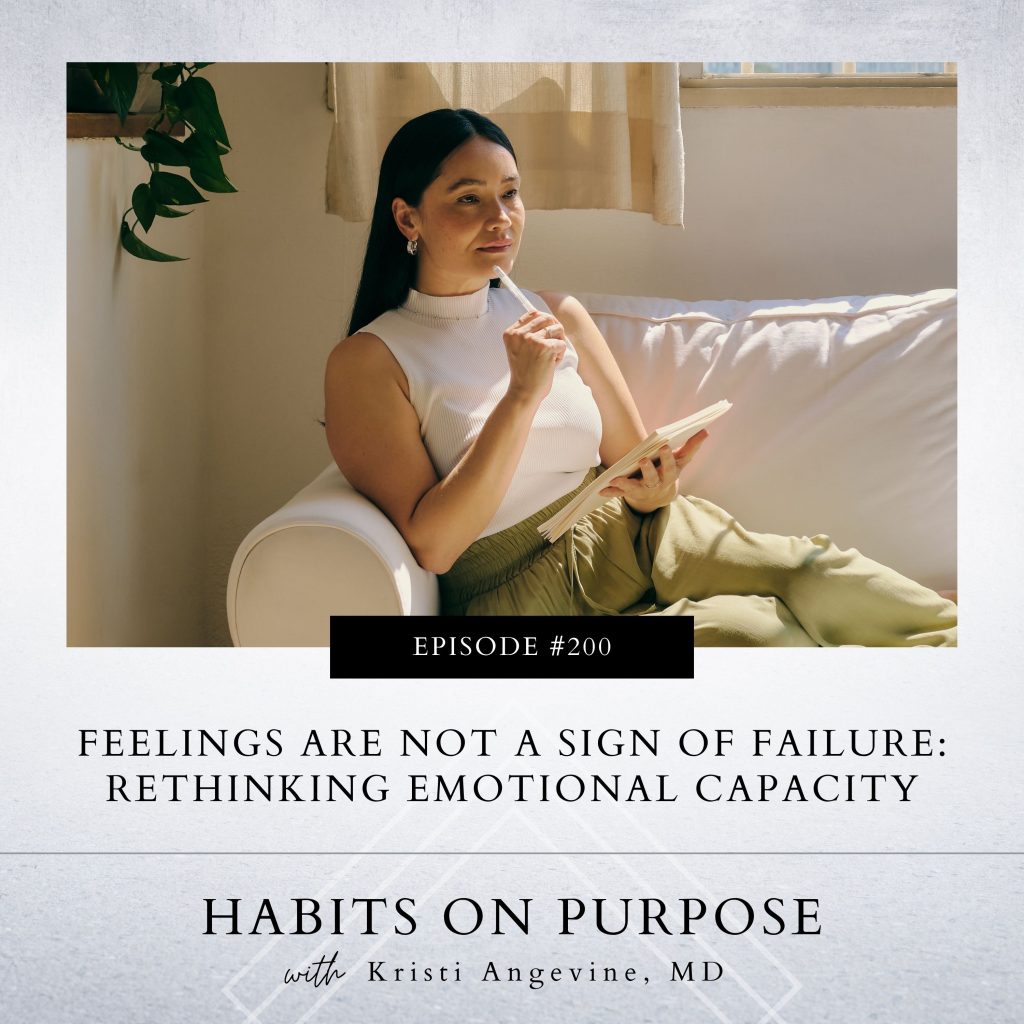
In this episode, I explore why emotional capacity, strength, resilience, and progress sometimes look messy. Drawing from neuroscience and my work with clients, I examine how our brains learn to mute and suppress overwhelming emotions, and what becomes possible when our system starts to feel safe. As the prefrontal cortex comes back online and the limbic system begins to reprocess stored emotional memories, what was once tucked away can finally surface.
You’ll discover why feeling big feelings isn’t failure; it’s often a sign of recovery. You’ll learn how a regulated nervous system isn’t defined by calm, but by responsiveness. And you’ll understand why emotional intensity may mean your system is no longer in survival mode, but is expanding its capacity to hold more of your lived experience.
What you'll learn from this episode:
- Why calm isn’t always the indicator of wellness we assume it is.
- How big feelings can reflect a shift away from suppression and toward self-trust.
- What happens in your brain as you move from survival mode to safety.
- The neuroscience behind why stored emotional memories come forward when we feel safe enough to feel them.
- Why a regulated nervous system is a responsive one, not necessarily a calm one.
Listen to the Full Episode:
Powerful Takeaways:
4:12 “Feeling big feelings is progress. It’s just not packaged to meet the cultural stereotype of wellness as calm.”
7:11 “Wellness is not necessarily tidy, calm, or composed.”
8:44 “A regulated nervous system is not a calm nervous system. It’s a responsive one.”
11:52 “Let’s just retire that myth that being ‘regulated’ means being emotionally flatlined.”
Featured on the Show:
- Leave a rating and review for the podcast here!
- If you’re interested in connecting with me for private coaching, go to HabitsOnPurpose.com/private.
- Follow me on Instagram!
- Click here to join the mailing list.
- Join Habits on Purpose for Physicians (HOPP) small group coaching program here!
- Join the Habits on Purpose Facebook group!
- Click here to send me any questions that you would like addressed on the podcast!
- Join us in the next Habits on Purpose for Physicians small group coaching program or join the waitlist.
- Click here to join the Habits on Purpose newsletter for extra tools, prompts, and stories between episodes.
- Sah D’Simone
- Gabor Maté
Episodes Related to feelings & emotional capacity:
Full Episode Transcript:
Enjoy the show:


Welcome to Habits On Purpose, I'm Kristi Angevine, a physician, Master Certified Coach, Internal Family Systems informed practitioner, and host of this podcast, where we explore the deeper psychology behind why we do what we do.
Hello, hello everybody. Welcome to episode 200. It is so surreal to say that. 200 episodes of the Habits On Purpose podcast. And whether this is your first time listening or you've been with me since the very beginning, thank you for being here. Truly, this podcast began as a space to explore habits and how to change them, how to be deliberate, how to be intentional, and to do all of this by examining the deeper roots of our patterns. But over time, it's become so much more. It's a place for self-compassion. It's become a home that welcomes complexity and contradictions and nuance. And it's a space to rethink and rewire the way we see ourselves and relate to ourselves. And that's exactly what we're going to do today.
So I want to start with a simple question: What if doing well doesn't look the way we've been taught it looks? What if emotional capacity, strength, growth, progress, resilience, flexibility, what if it sometimes looks really messy? And what if it feels like having big feelings and lots of them? What if wellness means crying, feeling rage, trembling, feeling really undone?
For so many of us, there's a deeply ingrained belief that being well means being calm. It means being composed, logical, and at all times, under control and in the driver's seat with a map. But what if that's not actually true?
So see if you can relate to this. I see this all the time in my clients, and when I'm honest, I have experienced this so many times myself. Here's the pattern. Someone will say, "I've been feeling so much lately, all these big feelings. It must mean I'm falling apart. I used to be able to handle things. I used to stay calm. Now I'm angry, I'm sad, overwhelmed. I just don't feel like myself. What is my problem that I can't keep it together? It's embarrassing." And they will think that their struggle means that their window of tolerance is shrinking, that their capacity and their resilience are just dwindling.
But here's the reality. Sometimes when you're feeling all sorts of big emotions, it's not because you're failing. It's not because you're falling apart. It's just because you've gotten to the point where you finally trust yourself enough and trust that you can handle all the feelings instead of having to squash them down, minimize them, dismiss them, suppress them.
What if your big feelings and your big struggles right now mean you've stopped buying stock in the, what I call, the "suck it up buttercup and move on" industry? And what if you're finally feeling safe enough to feel? What if you've grown your self-trust such that all the big feelings that are usually on ice, like a proverbial iceberg, hidden away, are now allowed to surface as your self-trust has essentially thawed your system and you've moved from survival mode and suppression to full trust and full feelings?
Sometimes what feels like dysregulation is actually your body and brain saying, "You are strong enough to feel this now. You are capable of holding this now." The very presence of big feelings, things like grief and fear, agitation, anger, tenderness, they're all likely indicators that something is shifting inside of you. And usually are indicators that your window of tolerance is in fact growing and not shrinking. Feeling big feelings, it's not failure. Feeling big feelings is progress. It's just not packaged to meet the cultural stereotype of wellness as calm.
Now I want to bring in a small piece of neuroscience here because it really helps anchor this idea. So let's zoom in for a moment on what's happening physiologically when we begin to feel more.
When we have experienced things like trauma, chronic stress, perhaps invalidation, whether it was when we were young or when we were in our current job, our brains learn to protect ourselves by muting and suppressing overwhelming emotional responses. The amygdala, our brain's emotion center, so to speak, might stay on high alert. But our prefrontal cortex, which helps us reflect and plan, and regulate, often becomes underactive.
And when this happens, we might have a bit of a tendency to shut down emotions. And over time, we might not feel much at all. Or we might only feel in a very narrow range of acceptable emotions.
But when our system as a whole starts feeling increased safety, whether that's through community, through a sense of belonging, through therapy, through coaching, through inner work that you do on your own, through meditation, through mindful exercise, the prefrontal cortex area of the brain comes back online. The limbic system begins to reprocess stored emotional memories, and what once stayed locked away can now begin to safely surface. And sometimes this surfaces as waves of anger, grief, fear, and even joy. This is not regression, it's reintegration of what's always been there.
So the very intensity of emotion that you feel is often a sign that your brain, your whole system, is no longer in survival mode. Rather, it's in a process of recovery. So big emotions, they don't indicate a problem. It's just the result of your system recalibrating and releasing what's always been there, and it's your body saying, "Now it's safe enough. Now we can feel."
And this is why feeling is not a failure. So let me say that again. Feeling is not failure. It's not a sign that something's wrong. It's often the clearest sign that something is really right.
Now there's a beautiful quote that I'm going to be paraphrasing some of this, but this is from Sah D'Simone. Real wellness does not ask you to be calm. It asks you to stay with yourself, to feel what is true, not what is acceptable, to stop performing, and to start listening. Wellness is not about controlling your emotions, it's about being intimate with your own experience. A nervous system that trembles or cries or contracts or roars is not broken. It is honest. It is adaptive. It is alive.
Now, this quote speaks to a deeper truth. Wellness is not necessarily tidy, calm, or composed. Real resilience isn't about pretending to be calm, it's about allowing what's actually real.
Now, most of us, especially in the West, have inherited a cultural script from our family, from our training, from our culture at large that says strong means stoic, quiet, steady, controlled, unemotional. We should be unbothered and above all else, calm, cool, collected. I almost wish I had created a list of all the movies where the protagonist or whoever was seen as the one who had it all together, that was the most intelligent and had the most agency, was the one who was portrayed as being calm, cool, and collected. Because there are so many of these such that we kind of just absorb as a truth that's what is desirable, and that's what's best.
But sometimes the strongest thing you can do is actually not aim for so much control or calm. Sometimes the most regulated response looks like the purest expression of what is present. And this can be shaking or sobbing or yelling into a pillow or shrieking while you're driving your car or being still and maybe a little numb. Because, to quote Sah D'Simone again, a regulated nervous system is not a calm nervous system; it's a responsive one. So I'm going to say that again because it's so beautiful. A regulated nervous system is not a calm nervous system. It's a responsive one.
Calm is just one of the ways that we can be. To be responsive means to feel and to allow what is present is to be authentic with your own experience. And when this happens, it's an indicator that you may feel safe enough to be with what is there for you.
And when we start being with what is present and start feeling big feelings, it is very easy, although misguided, to assume that we are coming apart at the seams. Like we're a mess. We're feeling all these feelings. We can't keep it together because we have all these big emotions. We are undone, and we need to ASAP fix the problem. And if you're like me and many of my clients, we need a planner, and we need a sort of seven-point strategy for how we are going to fix things, and we need it yesterday.
But the truth is, oftentimes we can thrive and find more peace when we stop trying so hard to be calm, and we just let ourselves be how we are. I think this quote from Gabor Maté puts it perfectly. Quote, "The attempt to escape from pain is what creates more pain," end quote. In other words, trying not to feel is what keeps us feeling stuck.
So many habits that we develop, perfectionism, people pleasing, numbing, avoidance, saying yes when we want to say no, second-guessing, they're all strategies that we have used in order to not have to feel things that are really destabilizing. And they are brilliant and resourceful and creative until we don't need them for pure survival. And then we start noticing that there's an underbelly.
So what if your next phase, your next growth edge isn't to be calm, cool, and collected, but is simply to learn to let yourself feel the very things that you used to run from?
So here's what I want to leave you with today, especially on this 200th episode. If you are in a season of life where you are feeling more, if you are crying more, yelling more, feeling like you need more, if you feel like you need more support, more venting text to your best friend, if seemingly small things are really difficult, if what used to seem like a manageable amount of challenge in your life is now just more than you can handle, if you are moved to tears or overwhelmed by something that did not used to phase you, if you are leaning hard on self-soothing in a way that you didn't in the past, don't assume you're failing. Don't assume you're broken. You are not doing anything wrong.
Let me say that again. You are not doing anything wrong. Instead, consider you are on your way toward a new way of experiencing yourself and your emotions. Assume you've developed enough inner safety and self-trust and a sturdy belief that you can handle whatever surfaces, such that you're now opening the door to new insights, new wisdom, and potentially to healing.
Assume that your emotional capacity is actually growing, not shrinking. Let's just retire that myth that being 'regulated' means being emotionally flatlined. Let's replace it with something more real and more true. Being regulated means being responsive, which means being alive and vibrant and having lots of big feelings. It means not abandoning yourself when things get big.
So maybe, just maybe, when you feel like you're falling apart, it's not actually the opposite of strength or resilience. Maybe it's just part of the process of how you come home to yourself and reclaim a sense of ownership and welcoming of all of your feelings. In your effort to be intentional, don't mistake your struggle for a deficit. It just might be that your system is thawing out enough and your window of tolerance is expanding such that you're now feeling what's previously been tucked away until your capacity could handle it.
Thank you again for being here for 200 episodes. Here's to undoing the myths that keep us going in circles with counterproductive things when we want to focus on what truly matters. And here's to creating space for the full, honest, alive version of who you are. Until next time, stay curious and be kind to your whole self. And remember, feelings are not a sign of failure.
Thanks for listening to Habits On Purpose. If you want more information on Kristi Angevine or the resources from the podcast, visit HabitsOnPurpose.com. Tune in next week for another episode.