
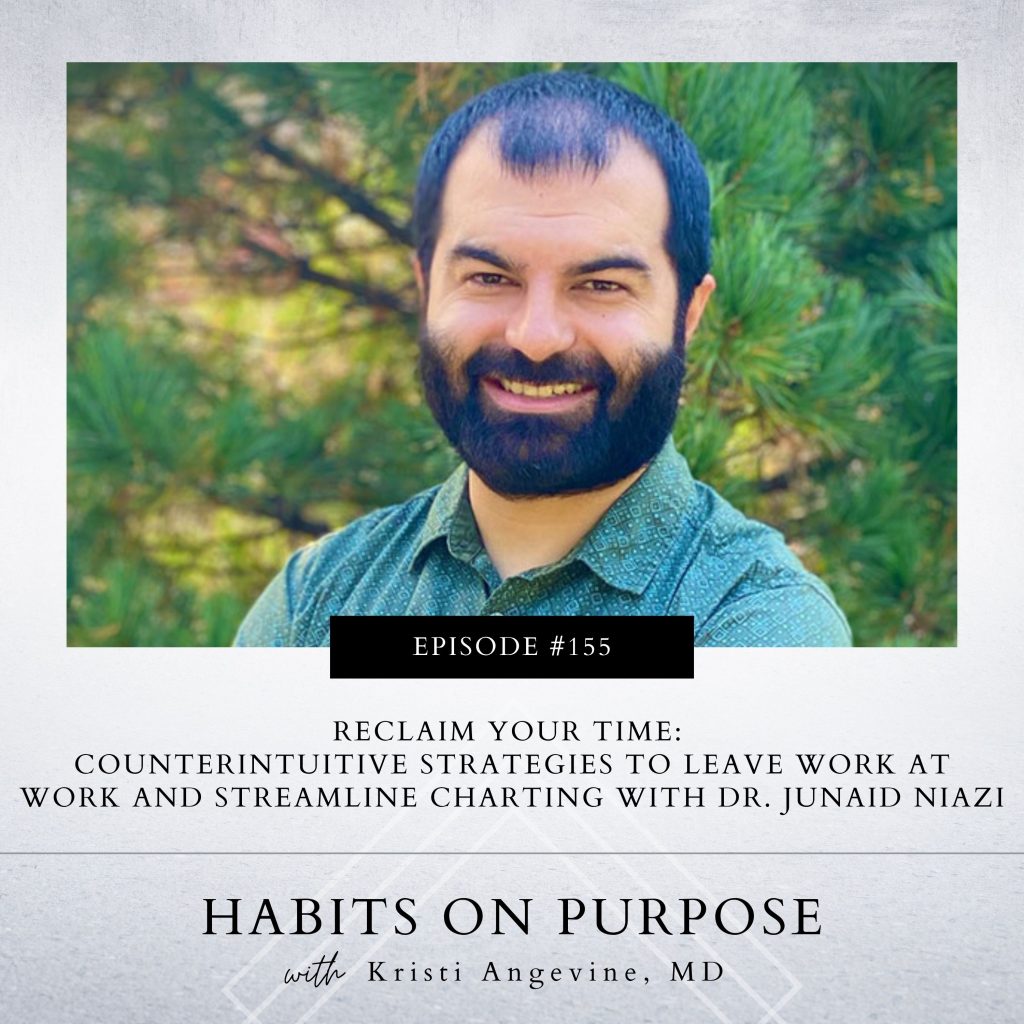
Do you ever feel like your charting and documentation are taking over your life? You’re not alone. Many healthcare providers struggle with the burden of administrative tasks, feeling like they’re constantly playing catch-up and sacrificing their personal time. But what if there was a way to reclaim your time and finish your work at work?
What you'll learn from this episode:
- Why recognizing that charting is a problem is the first step to solving it.
- How to overcome perfectionism and procrastination that keep you stuck in inefficient charting habits.
- The counterintuitive strategy of making patients wait that can actually improve patient care.
- How to set boundaries with your team and patients to streamline your workflow.
- The power of group coaching for normalizing struggles and crowdsourcing solutions.
- Practical tips for typing during visits and using templates effectively.
- Why working in extra patients due to people-pleasing tendencies leads to more charting headaches.
Listen to the Full Episode:
Powerful Takeaways:
9:00 “I think we have to pause and recognize, despite the state of our healthcare system, we still have a say in our micro environment.”
12:00 “People see their colleagues leaving work and assume, ‘Oh, they must have finished all their work,’ not realizing they’re rushing home to feed their kids, get them to activities, and then staying up all night working.”
20:30 “Even if you’re doing something that’s a little bit exceptional compared to the culture of your office, you could be setting a new standard and blazing the trail that might change things for the better.”
32:00 “If you can’t do it right or in one go, then don’t start. And that’s why I think a lot of physicians procrastinate—because they wait until the discomfort of having 20 notes hovering over them, instead of just two, becomes overwhelming.”
Featured on the Show:
- Leave a rating and review for the podcast here!
- If you’re interested in connecting with me for private coaching, go to HabitsOnPurpose.com/private.
- Follow me on Instagram!
- Click here to join the mailing list.
- Join HOPP small group coaching program here!
- Join the Habits on Purpose Facebook group!
- Click here to send me any questions that you would like addressed on the podcast!
- Leave Your Work at Work Free Masterclass
- Dr. Junaid Niazi
Related Episodes:
Full Episode Transcript:
Now, even if charting is easy for you, the challenges and the solutions surrounding productivity extend to so many other areas. So let's get to it.
Welcome to Habits On Purpose, a podcast for high-achieving women who want to create lifelong habits that give more than they take. You'll get practical strategies for mindset shifts that will help you finally understand the root causes of why you think, feel, and act as you do. And now, here's your host, Physician and Master Certified Life Coach, Kristi Angevine.
Hello, hello, everybody. I am so excited to bring you this episode. Junaid and I first met as speakers at an Institute for Physician Wellness Conference. I believe I was talking about numbing habits and he was talking about charting. And for anybody who works in healthcare, documentation can be the bane of your existence.
And yet, not only is it a critical piece for communication for the other people who are taking care of your patient, and for thorough record keeping so that you have a cohesive narrative for someone's care, it's also a body of work that can be pulled into the courtroom, and it's a body of work that needs to explain and sometimes justify clinical decision-making or document the presence or absence of certain interventions.
And if that's not complex enough, additionally, with electronic medical records, there are all sorts of extra documentation requirements and time that has to be spent making sure things are complete that really didn't exist back when people just used pen and paper. Therefore, it is no surprise this particular aspect of people's jobs can bring a bunch of stress.
Well, this conversation and the work that Dr. Niazi does can help you so much. And as you're going to hear, Junaid is a problem solver, and he has developed an approach to productivity and charting that, in my opinion, basically liberates people from habits and mindsets that keep them feeling miserable and disenchanted with a job they used to love.
Part of Junaid's mission is for his clients to finish their work at work and reclaim their home time for themselves. And just think about this, this makes more physicians happier so that more physicians stay in medicine.
Now, you don't have to be in health care or in a clinical role to appreciate this conversation. All of us have tasks in our day-to-day life that feel like they take more than they give. You might not have a documentation challenge, but guaranteed, you have an equivalent. Writing up assessments about students, turning in annual reviews, meal planning, grocery shopping, making lunches, keeping the house clean, keeping up with vehicular maintenance, keeping track of finances or paying your taxes, organizing travel or kiddo activities or doctor's appointments. The list goes on. Tedious things that don't intrinsically give you joy, but are required for the results you want.
So if this is you, as you listen, consider how some of these seemingly healthcare or charting specific ideas that we discussed, extend to your particular challenges. And then for those of you who are in health care, if you want to learn more and you want to get support with your charting habits, go to the show notes and you can access a link for a free Zoom training on Thursday, January 30th that Junaid's doing.
And in the Zoom training, you will learn how the training and culture of medicine keep you stuck charting, practical tips for efficiency so that you can complete your work at work, and you'll also learn his four-step framework to build your own system to finish charting before you go home. So definitely check that out if you're interested. And let's dive in.
I am so excited to have on the podcast a guest who I ran into when I was speaking, Junaid Niazi. I think I said that right. Junaid, welcome to the podcast.
Junaid Niazi: Hi, Kristi. Thanks for having me.
Kristi Angevine: Of course. So some people who are listening to this, they already know who you are. They have either done your program, they've gone to your website, or they follow you on Instagram. But some listeners don't know you. So can you introduce yourself to those who don't yet know you?
Junaid: Yeah, I'm Dr. Junaid Niazi. I'm a MedPeds primary care doc in the Twin Cities, Minnesota. I'm also a physician coach and have been since late 2020. And since early 2021, I've been running a program to help physicians and APPs get their work done at work, get their charting done at work, and reclaim their time for themselves.
Kristi: Okay, so everybody listening, if you are feeling like you want to reclaim your time for yourselves, this is going to be chock full of not just ideas to help you, but things that are going to help you understand why things are hard when it comes to this. So right now I'm trying to see what your room is like. I think I see a window and I'm looking around like, what can you see from where you are right now?
Junaid: It's a basement window so I mostly see brown leaves. It lets some light in.
Kristi: Yeah, because it looks a little bit like a basement, but it also looks quite bright and cheery. So I'm like, all right, very good. Can you tell me a little bit about your origin story and how you found yourself doing this work in addition to clinical work?
Junaid: Yeah, like a lot of physicians, I think, discovered coaching kind of around the onset of COVID, no different. And as I started to really dive deeper into coaching and mindset work. I decided myself to go get trained so I'd have better skills for dealing with myself, dealing with myself especially sort of vis-a-vis work as well as kids, family, you know, relationships, everything. And I really was doing pretty well.
You know, let's go back to May of 2020. We just had our second kid. George Floyd was murdered about 10 blocks away from where I live. There was ash floating into my yard from all the fires, from all the protests and everything. I had to carry a paper that said, if I'm pulled over by police, I'm an essential worker. So, I'm allowed to be on the road during the National Guard shutting things down. And obviously, COVID was happening. My wife had just, you know, we're three months into COVID. My wife had been furloughed from her physician job. And I was like, hey, things are okay. Which was like a complete surprise for anybody that knew me at that time.
And so I was like, man, I would love to share this with other physicians as well. And so, you know, originally I was thinking I was gonna do more kind of financial coaching for physicians, but as I started talking with other physicians, as I started being a guest coach in other physician coaching programs, they always noticed, not I didn't notice, they always noticed I would be the one to pipe up about clinic workflows and to try these things.
And so one of them challenged me and said, “hey, can you just put on a one hour class for my clients?” And I said, “oh yeah, sure.” And really that was kind of the impetus for me recognizing like, hey, I've actually been pretty intentional with charting over the years from when I got out of residency. And I was sort of like, this is another fire hydrant in the face moment for me, like medical school was the first one probably. And then graduating from residency thinking, Oh yes, this will be, I got this. I just spent four years in med peds training for this.
And then like, no, knew nothing, nothing about workflows managing like, you know, MAs and nurses in the clinic, navigating partners, being on call, all those types of things. So I was really intentional. Before we had kids saying like, “Hey, we're spending all of our time at work. And then when we get home, we're just working more.” So it took several people recognizing that they noticed I was doing these things. And so they said, Hey, you should do some sort of charting. And so that's, that sort of lit the fire under me.
Kristi: Love that you were able to have other people observe you're doing things that perhaps you didn't even notice that you're gravitating towards. Right. I want to ask you, since you got coaching and became a coach, I'm always curious about what people's impressions were, or their connotations of coaching prior to experiencing it or becoming a coach. Do you remember what you thought about it?
Junaid: I do. I was a pretty big skeptic. You know, people will make the analogy to athletes having coaches and I didn't view mindset coaching really like that. I think in my mind, it was all sort of Tony Robbins walk across, you know, burning stones type thing.
And I remember telling my brother that I was going to train to be a coach and he just assumed I would be a consultant for things. And so, he kept asking me questions. I'm like, oh, he's not understanding me. I was like, this is kind of like Tony Robbins and he was just silent. And I was like, I mean, it's a little more grounded maybe. It's a little different, not bashing Tony Robbins.
But I mean, I felt that way about Tony Robbins before too. And now I have a different view, even if I don't necessarily buy into his style or his whole approach to coaching fully, I definitely appreciate what he's done and how he helps other people. But yeah, no, I thought coaching was sort of a woo-woo way of transferring money from one person's pocket to your own.
Kristi Angevine: Yes, you said it perfectly. I had very, very similar feelings. And I know what you're saying about there being almost like a caricature of a life coach that's larger than life and very rah, rah, rah and chanting and coals and you know, Tony Robbins gets lumped into that caricature, right? Even though there can be some brilliance, right? So I'm curious, like, what made you have any interest in it at all such that you would actually do it.
And then I understand why you do it and you see the benefit and then you go on to become trained like that makes perfect sense. But what helped you have any interest in it and not just look at it sideways?
Junaid: I think a lot of just increasing the amount of exposure. So more physicians I knew were experiencing it, and were going through other people's programs. More physicians on summits and other online venues and things were mentioning it. And it got to the point where I just said, you know, I, there are things about the way I'm living my life that aren't what I thought they would be, or they don't seem necessarily aligned with my values or how I wanted my life to be. I've tried to do things by myself.
Why don't I just see what this is about to see if it can help. So like, this might be another tool. Let me just learn about it. Now. Now curiosity has peaked.
Let's investigate a little bit.
Kristi: So I think I heard you say this when you were speaking because we first met each other. We were both speakers at a conference and that's where I first learned about you. And I have this vague recollection, you may have said this in your talk, but then later on, I've seen it on Instagram and things like that. And I thought it was really brilliant. So I would like to get you to speak to me.
You've said that the first step to solving a problem is realizing it exists. And I think people listening, they're like, yeah, of course, you always have to know which problem exists. It's very straightforward and simple, but I think there's a sort of deep wisdom there. And I'm wondering if you can talk to what that means for you and clinic flow.
Junaid: Yeah, great question. So I think so many physicians, we're so used to just always working very hard that whatever way we do things, we just kind of keep doing things that way without ever questioning. A lot of our mentors and educators also just had one way of doing things. And so they kept doing it that way. And they don't necessarily recognize that charting is a huge problem for them.
And then conversely, another important point I should make is that people think they're the only ones who have this problem, which is sort of can we just do a big public service announcement and dispel that.
Junaid: So that they are not the only ones. It's not that there's something wrong with them. But they have this problem.
Kristi: But yeah, could you give your take on that? If we can, you know, bring the mic up and have the world know that these people are not alone, how would you phrase it?
Junaid: It is so ubiquitous, but people are so ashamed about it, or they see their colleagues leaving work and assuming, oh, they must have finished all their work, not that they're going home rushing to feed their kids, get their kids to activities, and then they're staying up all night working. But you've probably seen some of your colleagues' timestamps on their medical messages to patients that you're seeing or when they're covering. And you're like, why did they send that at 3am? That seems a little absurd. But backtracking to the...
You have to recognize that there's a problem first. I think, again, we are on such a path from high school onwards if you're a traditional student, there's one step after another along your journey and you just hit the milestone, you'd move to the next step. And then when you're in attending, I mean, I think so many folks have a lot of different varieties of arrival fallacy, but it's just kind of like, oh, wait, I'm here now.
I mean, I remember personally, I, you know, med peds every three months, I'd switch between adults and kids and I change rotations every month, like most people in residency. And so after I did two months in a row in clinic after I first came out, I'm like, this is weird. Like, what is this doing two months of the same thing? Now, eight years later and enjoying it.
But I think we have to pause and recognize, despite the state of our healthcare system, we still have a say in our micro environment. And if you don't have a say in your micro environment and where issues are, I mean, that might be the reason to look elsewhere or to reflect on what you really want.
Kristi: I think that's a really wise point that I think sometimes is overlooked for people. They think they should have a say and that maybe there's something maybe they're not recognizing that they do. And that is the case sometimes where they actually do have a say, but they don't know how to influence or even speak up. And then there's other times where you just don't have a say and that's something to be curious about.
I want to touch on something you just mentioned. You mentioned that a lot of your clients, a lot of physicians in general, have some shame around, sounds like, the pace at which they take care of all of their charting and how long it takes, etc. And it just makes me think, so if there's shame, there's usually a sense of like, there's something specifically or uniquely problematic about me. I'm bad. I'm not good. I've done something wrong, but other people are fine.
And I'm wondering if, you know, since we're talking about being able to identify the problem, I'm wondering, like, what are the people who come to you for help with this? What do they think the problem is?
Junaid: They think there's something deficient with themselves, sort of like you alluded to at the beginning. Why can't I get my charting done if my colleague is seeing 50% more patients than me and going golfing in the afternoon to play on an old physician trope. And I'm stuck working all hours of the night. So there must be something wrong with me. There's something I'm doing wrong, but I feel like I'm trying to be a good physician.
I feel like I'm taking care of my patients and being there for them. So why does it feel this way? There's this big disconnect between part of their lives that is being a physician and taking care of other people and then the rest of their life.
I think times are changing. People used to, I mean, generationally, I mean, just look, my father's an orthopedist. He's a surgeon. That's what he is. There's other stuff sprinkled in there that he does at times, but that's not the way I look at it, right? Like, a doctor is not the only part of my identity. And so, there's other parts that I also want to prioritize at different times, including family, kids, you know, school events, I want to be able to pick my kids up.
I can't remember if my father ever picked me up from school. He might have dropped me off when I had early basketball practice in middle school and he was heading to the office at 6am or whatever.
I think our priorities have shifted but the system was created a certain way by a certain style. And it's successful in extracting money and doing what it needs to do, so it's very hard to change that system. But there's so much friction now as those of us who don't want to only be labeled as a physician or tie up our entire identity into being a physician.
Kristi: So, it seems like based on what you just said, the system is set up a certain way and it's very advantageous for certain features, that it can be difficult to be in that system, and even though it's more common, but be in that system and not be embodying maybe the same values as your dad, and be somebody who's like, well, yeah, but I actually do wanna drop my kid off at school. That can be a little bit tricky.
I would love for you to talk about when I think about charting. I was thinking about misconceptions and like what we you know, what we think are the problems and sort of the myths that go along with how we can do it and how we should do it. And I'm wondering, since this is from your area of expertise, like what are some of the myths that you see people holding on to that you kind of have to help them unpack?
Junaid: Yeah. The first one is probably that, oh, I just need more time. And then we can dive into that a little bit more.
Kristi: More time for charting, more time with patients? What do you... More time in life in general?
Junaid: If I had an extra half hour added on if there was, you know, 27 hours in my day.
Kristi: Yeah.
Junaid: And then the other one, which I think finally is shifting is there is this weird dependence on like a note template. Like I just don't have a good note template.
Kristi: Okay.
Junaid: And people seem to think the more robust a note pulls in, like the better and the easier it'll be for them and it'll save them time. And it's actually the complete opposite. You want a very skimpy note that you can peruse very quickly, that is not pulling in all the other stuff. And especially if you have concerns about counting items for billing purposes.
So prior to 2021, you'd have to hit, you know, so many review systems and all this stuff and that's gone by the wayside. But it's been very, it's like turning a ship very slowly that physicians are shifting to then being like, oh, I don't need all that stuff. I just need what's actually germane to this visit.
But with that, a lot of people, you know, people always ask me like, Oh, well, can I just have your note template or something? And I'm like, you would hate my note template because I do like modular notes. So I have a very basic SOAP note, little sections, and then I just pull in little other parts as I need them.
And so that was probably the last thing I added to my program actually was a section on templates and scripts for people to use. And I literally just state like, you're probably not going to like this, but this is how you can be faster. It's not the note. It's not the template.
Kristi: Yeah. Okay. That deserves an emphasis right there because I don't, this is not my area of expertise. I do hear this a lot from people. I'm learning a new system and I just need to get some, you know, you know, a better template.
And I'm just going to work on this and that, almost like putting it on a pedestal that like, once I have that thing, that will help. Right. And I think what you just said is going to be super validating. I'm picturing some of my clients right now who worry that their notes are too streamlined. And they think that like the comprehensive dissertation notes, like those are, you know, they've been sort of lauded as like the standard.
And there's a time and a place for something being comprehensive, right? I'm not trying to say anything bad about anybody's comprehensive notes. And yet there can be beauty and efficiency and honestly, potentially better communication when a note is what you're describing. Distilled, skimpy, basic.
Junaid: I mean, what are our goals with communication? Usually it's not to like, well, maybe it is for some people. It's not the blood in the other person with so much stuff that they can't make heads or tails out of what's going on, right? The people that are lauded as the best orators, for example, it's because they can convey a message simply using simple language powerfully and that draws on their expertise, right? So, one thing that I see a lot is especially with perfectionism in charting is people will sometimes use the note to validate themselves in a couple of ways.
One is writing a beautiful note, you know, in iambic pentameter that the muses would sing high praise of. And the other is putting in every potential thing on a differential and then every possible outcome of every investigation they're doing and where that might take them. And that's not actually useful. Like I'm coming to you as the expert or I'm referring a patient to you as an expert. I don't need the full 30 things.
I want you to tell me what are the top three or four that you actually think it is because I trust that you have the expertise to sort through those 30 things and figure out which ones you think it most likely is.
Kristi: Let's stay there for just a second because I think there's something interesting here. If there's a really elaborate note that has like these 30 differentials, that could be somebody trying to make themselves feel better by writing like a lot of things. Can you elaborate on that?
Junaid: Yeah, when I was on my internal medicine rotation in medical school, I was at the VA for one month and I would use my notes to learn, right? So I would overwrite stuff in the assessment and plan. So if they had the time it was CKD now it's chronic kidney injury. And I just write this voluminous thing that then I saw other people copying it like the specialists were copying and pasting my thing and I'm like, what are you doing? I'm trying to prove to my attending that I like reading this stuff and that I know it, you don't need to do that.
Like it doesn't actually make you look smarter to have this giant thing when you're like infectious disease. You don't, no one needs that. And so, I think there's this idea that more is better, maybe more shows that I care more, I put more effort into it. I am gaining my self-worth even potentially and demonstrating my value as a physician through my note. It's the only tangible piece of evidence that I even had a visit with a patient oftentimes.
And I think a lot of us struggle with that.
Kristi: I could totally see that it almost seems like a bit of residue from a different era, where, you know, for learning sake, for proving yourself sake, that worked. And if it follows you to a place where perhaps you don't even need that, like you really know what the top three things are. But that habit of like, I still want to make sure that like nobody thinks I forgot, you know, like the five other things that could be or whatever it is that makes that tendency to either copy-paste somebody else's thing and just drag it over because it seems like the right thing to do or to add in your own.
It's interesting just for people to think about what could be behind such a voluminous note? And again, not to like rain on anybody's parade if they really love their voluminous notes. Totally fine. If it's coming from a clean place, right? Probably not a problem.
I love that you pointed out too that like there, we can hold these sort of ideas that we just maybe have even haven't just questioned that more is better, more demonstrates that I care more. Like, you know, if I have a note that's one sentence long, I'll probably only spend, you know, one second thinking about the patient who really cares if you don't actually document the care.
Am I remembering correctly that I think, no, I think this was you that said like, it's actually good patient care to make people wait. Like this idea that like we have, I'm thinking about other ideas we have in our mind, but like making patients wait, like if I'm finishing a note is really bad. But I think you've said like, it's actually really good care to make people wait. And that just comes up as I'm thinking about voluminous notes and time. So that might break some people's brains here.
So can you sort of like talk about that idea?
Junaid: Yeah. So the most valuable thing you can give a patient is your time and attention for when you're with them. And the best way I found that I can do that for my patients is by not having to even remotely worry about all the patients I've seen previous to the patient I'm currently seeing. And if my note is done and all my orders are in, there's not all these loose threads that I'm having to keep in my active working memory to, you know, which leg was that rash on? Where was I supposed to send that other script?
She wanted, you know, she wanted it at a different pharmacy. Where was that? Which medication was it? If you're not juggling all those things, and you might think, oh, well, I barely noticed those things. But if it's siphoning off 5%, 10% of your mental bandwidth, that's 5% to 10% of your mental bandwidth you are not giving to the patient in front of you.
And in my view, that's doing them a disservice and it's doing yourself a disservice. So you can sort of look at it like the most loving thing you can do to show the patient you truly value them is by making them wait that extra two to three minutes while you finish your last patient's note. So then you can sort of flush your mind clear of everything that came before and show up 100% for them.
Kristi Angevine: This makes me think about a common phenomenon. I'm sure, I'm guessing you've experienced this too, but I mostly work with women. And one of the things I hear a lot is that they leave work, they come home, and it's their time where they want to be with their partner, be with their kids, be with whoever is there, their dogs. And it's the time that's the most challenging to be present because they have loose ends following them. Charts might be done, but they're doing all this.
And it almost sounds like the same thing. Like, wow, what if there was a way to reset and cleanse and sort of close that chapter of work, even if it meant you came home an extra 30 minutes late so that when you were there, you actually were really there.
Junaid: Yeah. I mean, it boils down to the quality versus quantity argument. Would you rather have two hours with your kids where you're frazzled and snapping at them maybe? Or would you rather have an hour 45 minutes with them but you are not burdened by things that happened earlier in the day? I would choose the latter every day.
Kristi: Can we get into some of the like, we've sort of talked about the problem that you're helping people with. Let's talk about some of the biggest game changers that you have experienced when you're being intentional with your charting, and that you advise other people to try to sort of reclaim their time.
Junaidi: Yeah, so we've touched upon one, which is finishing everything about a patient encounter either with the patient still there or right after they've left before you move on to your next patient. I like to take that a step further and this sometimes is controversial depending on the client or the person with whom I'm chatting. I tried not to type in front of patients when I first started. And that lasted like three months before I was like, I have no idea what's going on with the... I just stare at blank notes at the end of the day.
And I was like, Maybe I can piece this together. And I completely have 180'd on that. And now I type as I go. And I've gotten to the point where I can ask a different question than what I'm typing.
Kristi: That's an advanced move right there.
Junaid: I still mess up. I still laugh when I read some old notes and or the prior note and I'm like, what? Okay, clearly I just put two sentences there together that don't belong together, but that's okay. And even if you can't do that, I think just typing in the room as much as you can. That way I can even capture what the patient's actually saying and put it in quotes. And I've had patients even reply back and like, "I can't believe you wrote stuff that I said during the visit. Like how are you doing that? Like that's really cool." And you know, I'm like, that's what I that's what I try to do. So that's one thing.
There are people that are not really good at typing, unfortunately, it is sort of a life skill in this day and age. If you can get by with dictating after a visit, There's some people that have really efficient workflows where they don't like typing and they can dictate right after a visit. Beautiful, but just do it right after the visit.
So notes are one aspect I use the term charting maybe differently than other people. I use charting to mean everything like in the basket, the visit itself, the note, orders. Some people think charting just means a note, but for things like in basket, a tendency I used to have that I recognized was, I would, if I had a no show or had like five minutes, I would just like click on everything in my in basket to like mentally triage it and not actually accomplish anything. Since I've clicked on 30 things, I have no idea what water I actually considered high priority, right? And then five minutes have gone by and I've literally done no work. And I'm like, Oh, well, that that's not good. Like, am I going to look at this further and deal with it? Or is this look more complex? I don't have time right now. I'll defer it for later.
So try to do a one touch method like that and deal with things. A lot of my clients have said that's really helped them a lot because they would just sort of punt things down. They'd keep clicking on something and then retriaging because in their mind and it makes sense, right?
That intuition when you have 30 or 100 or whatever things in your in basket, what a normal thought to have, I should figure out which one's the most important. The issue is you can't keep a hundred things in your head you know, with a relative weight of how important they are compared to the other 99 things. So, until our systems get better at doing some of that for us best to just pick an item and try to knock it out.
I do it also by folder like there's certain folders in my in basket that if I don't address sooner are going to lead to more inputs coming back to me, and maybe more distraction. So refill requests, patient calls, things like that are more important than going to co-sign order best, you know, list and then clicking on all these little orders. Although that makes you feel good sometimes just checking some stuff off your, you know, dunning some items in your in basket.
Kristi: Typing in front of patients is something that initially you had sort of like a block on but now you do. And it sounds like for the people who are like, there's no way I could do that. It seems like all I'm doing is being a transcriptionist. I'm not actually connecting with a patient. Your experience is that you're actually connecting with a patient.
Patients feel heard. It's not the barrier you thought it was.
Junaid: I mean, there's a way to do it, right? If you're good at touch typing, I can spend most of the visit actually looking at the patient and chatting while I'm going through typing the note. And also if I have a note pulled up and I'm referencing it while I'm talking to them, I can also be way more organized and efficient in my questioning. So if you do happen to use a note template for something easy, think of an upper respiratory infection and you're like, oh, I forgot to ask about fever and here's my little thing in my template. Oh, yeah, by the way, any fever?
Okay, great. And then you can navigate pretty adeptly and quickly through most EMRs now. Not true for all of them, but most. And so, I think with how accustomed we've become to screens in our lives, I have patients that are on their phone the entire time I'm talking to them. Somebody being on the computer is actually, I like looking at them more than they're looking at me because they just have their phone in front of them.
Right. So, again, I think it's one of the things that has changed for better or worse. It's just one of the things that's changed.
Kristi: So typing from the patient, when you have a no show, picking something and completing it and prioritizing something that's perhaps higher yield than lower yield. Other things that are really useful?
Junaid: There are. I mean, a lot of strategies kind of will depend on a person's sort of specific situation and scenario and clinic setup. I would say, after the things we've already talked about, boundary setting in various ways is huge. A lot of that is boundary setting yourself, boundary setting your patients, boundary setting with your team, and getting your team to enforce your boundaries. So for example, you know, when I first started, I was trying to be all really, really good at not prescribing antibiotics over the phone for things.
And if someone had said, hey, I think I have a sinus infection. I was like, well, I can't tell unless I talk to you and do a little bit of an exam. And my nurse just got so annoyed with having to tell patients and getting yelled at before the patient even said, no, no, I don't want to. She's just like, hey, no, no, you just got to come in. He's not going to do it.
So she was upholding the boundary for me to limit her discomfort of then being the go between, you know, then I wasn't the bad guy with the patient. That's sort of an example of boundaries. With patients, with staff, if somebody doesn't, we've all worked with staff that'll just route something to you without, maybe they looked at it in a cursory way, but haven't done anything meaningful. And they really can do a lot more. A lot of us will just, it's just faster if I do it myself.
Right? And then they do it. But if I route it back to the person, and I'm like, Hey, can you tee up that order for me? Now they're like, Oh, I gotta spend more time on this. I keep doing that until they just recognize, hey, I should just be teeing this up for him.
Because that's actually now become the fastest way I can get this out from in front of me, and onto his plate.
Kristi: So supposed to you just take care of the order and it disappears like hot potato resolved, you're like, thanks for the hot potato back to you. Right. I can see that that's a really a very smooth way to set a boundary without maybe being that explicit about it. You're just like, and here you go, thank you. Especially if perhaps, and I do hear this a lot, well, my coworker, she does all that stuff or he does all that stuff.
So I look like the bad guy when I say, here, could you tee that order up for me? Because I'm upholding a boundary that I think will be better for my dynamic, but nobody else does. And so I think sometimes just recognizing that, yeah, you might be, you might have to have some courage, especially if perhaps all your other coworkers do it differently or do something that may not be as effective.
Junaid: Another thought, and I saw this play out in my clinic, is what if your coworkers see you doing that and then they also adopt it? And so, you know, we had a lot of old internists working at my clinic and, you know, when I came on a couple of them were able to retire. And in their day, right, like you had, every patient had like three benzodiazepines, like one for anxiety, one for sleep and one for something else. And it was getting really tough getting some of these patients off of them. And I'm not throwing shade at these old internists.
That was, you know, in our day and age, it's like the opioids, right? Like it's not one thing, it's the other. But three or four of us that were taking new patients all sort of realized, hey, that person just upheld the boundary about not being willing to prescribe it unless you're willing to meet with a pharmacist or figure out a way to wean safely or this and that. And if patients didn't like it, they went somewhere else. And you might say, well, that's burdening somebody else, but that's if they don't have that same boundary.
But if the patient hears it repeatedly, they start to say, well, this is the normal practice. Maybe I shouldn't be on this or maybe I should be doing this differently.
Kristi: Just that idea. I love that you said, like, even if you're doing something that's a little bit exceptional compared to the culture of your office, you could be setting a new standard and sort of blazing the trail that might change things for the better.
There is something you mentioned a minute ago I wanted to circle back to because I think it touches on some of these perfectionistic tendencies that many of us have. And you said, oh, so I'm typing and I'll look back at some of my notes and I'll see, oh, these two sentences just don't belong together. And you said something like, these two sentences don't belong.
Oh, that's okay. That to me is almost a microcosm of perfectionistic tendencies unraveled and not so strong. And I'm wondering where you see perfectionism show up for your clients when it comes to workflow and when it comes to charting.
Junaid Niazi: It is so rampant in medicine. It is, once you start looking for it, you will find it everywhere. And I like to say that we are honed to be perfectionists all through our training, okay? Like how do people assess our knowledge and our capabilities? Through testing.
Well, what is that gonna do? Well, you get a number, you get a score, and then they compare it to other people. Oh, were you valedictorian? Were you alpha, omega, alpha in med school? Were you this?
Were you like that? So, that's what we've been rewarded for. That's what has propelled us along our path the entire time. So, how can we not have perfectionistic tendencies? How can we show up to this and not have these neuroses almost about so many aspects of our job?
You know, in training, again, our mentors and educators reinforce these. Like if you want something done right, you do it yourself. So if somebody sends you something and it's not correct, you don't send it back to them like I just said. You tee up the order yourself and you send it in. And if they tried once and they didn't get it, well then again, I want it done right.
So I should just forever now move forward, I'm going to take on this role and this task of doing this one thing. I mean, that's one way that it shows up. I have clients that double or triple check their work.
Kristi: Yes, I hear this a lot. I think I did that a lot for ages. Yeah.
Junaid: Also, people will wait for if they put orders in, they'll wait for imaging or labs to come back before they close the encounter. And so you've just got this thing sort of nagging at the back of your mind that I have this open encounter, Whereas I just sign it and then I add later. Like when the result pops out, I'm like, Oh, okay, yeah, let me go back and look at that.
Some people go back and rewrite their note because now a result has come back that is completely changed where they thought that, you know, what was on the differential and they don't want to look dumb or silly or whatever. So I better change my note to make it look like, oh, yeah, I totally was thinking that the whole time.
We talked about using your note to show your value as a physician. Indirectly, though, perfectionism and clinic charting workflows shows up in working in extra patients, right? So people pleasing, because you don't want to look like the one doc again, to your example of people not setting boundaries, you don't want to look like the one doc that's not working in their patients, or that's burdening somebody else by having them see their their patients when their schedule is already chock full.
Of course, working extra patients into more charting and more bureaucratic stuff on the back end, right? If you're worried about medical legal stuff, I think I will make a joke in some blog post somewhere about, you know, a patient comes in for a stubbed toe, and the differential is like this insane, like thing, including being struck by Orca, some random ICD 10 code. Like, is that a good way to practice? Probably not, because worrying about medical legal stuff all the time, again, it's siphoning off part of your bandwidth. And so maybe you actually miss the stub toe that they're actually there for or whatever it might be.
And then it shows up as procrastination. And this is in other areas of my life, I still struggle with this a lot. And historically, growing up, I did as well. But like, if you can't do it right, or in one go, then like, don't start.
And that's why I think a lot of physicians procrastinate, because until that discomfort I've got now 20 notes, hovering over me instead of two. Now that discomfort is overwhelming. Like, I don't need to be perfect, or just get started on it. But until that happens, which again, you're trading one very uncomfortable thing for another very uncomfortable thing. Are you showing up as your best self and doing that? Are you producing your best work? Probably not.
Kristi: I think it's really useful to almost use that umbrella of perfectionism and underneath that to include procrastination, include people pleasing, include difficulty with boundaries, include working in other patients. Because I think some people, perfectionists, don't procrastinate. They do everything perfectly. It's like, well, actually, people who procrastinate can do that because they have this idea that perfection is the only standard and it's always better to be better. And if I can't do it in one go, well, then I'm going to put it off till later.
But I'm not a perfectionist because I wouldn't have procrastinated if I wouldn't. It's a loop of sort of like blinders that you don't see when you're like, oh, well, actually, it would just be perfectionism. This is a primary focus for your work with physicians to help them reclaim their time and you help people if you have a program and I'm wondering if I mean, I think you have one coming up and people can learn more. And I'm wondering if you could just sort of talk about how you help people and how they can learn more about what you do if they want your help.
Junaid: Yeah. So the program I offer is called Charting Conquered and it consists of an online course, some modules that folks can go through combined with group coaching. And that's the part that usually scares people away. But a big part of, again, what I've said is there's, and we've alluded to this, there's a lot of isolation in medicine thinking that there's something wrong with me or I'm the only one that has this problem. Without a doubt on every first cohort call, people are like, oh my gosh, it's so nice that there's other people that struggle with this and are willing to talk about it.
So just that opening up, being vulnerable, seeing our shared experiences from people in Hawaii all the way to Maine, private practice to employ people working in academics or a federally qualified health center, you're like, oh, these are similarities when most of the time we're always focusing on our differences, right? And so that's a really powerful thing to experience as a client, but it's great for me to be able to witness that every time as a reminder.
And you get individual coaching if you come on a group coaching call and I'm coaching you like you and I are chatting right now. But I will try to extrapolate just like you do on this podcast, right? What are the themes? What are things that might apply to other people? I can also get other people's ideas. So I haven't experienced everything under the sun. I've been at one job since I graduated residency. And it's changed. And there's some cool other aspects of it coming up now and in different ways. We're the largest private sector physician union now in the country. So that's like, that's a cool thing. And it's fun to explore that.
But I haven't done private practice. I haven't done these other things, right? So everyone else will weigh in with their ideas. And one thing that's really cool is when you're stuck in a problem, it's a lot harder for you to come up with a solution sometimes than if you're one degree separated from it. So when you're one degree separated, especially as a physician, your like physician brain kicks in and you're like, I'm going to solve this problem for Kristi.
And then I'm like, well, Kristi, why don't you just do X? And then I'll be like, but I have that problem. Why don't I just do X? Then all of a sudden you're like, oh, yeah, I could just do X. As a fellow coach, I'm sure you see this all the time too, where people come up with, I mean, we try to get people to come up with their own solutions, right? Give them the container in which to explore and express those and maybe get some feedback if that's what they want. But that to me is sort of the funnest part of the program.
So, you know, the next cohort will be going live in February. And leading into that, just to give people a flavor for who I am and how I teach and all of that, I'll be hosting a free sort of online masterclass called Leave Your Work at Work. And folks want to register for that. It's www.leaveyourworkatwork.com. And we'll make sure that you have that link to include in your show notes.
Kristi: Yeah, no, that is perfect. So yeah, so like Junaid said, we'll have all of this in the show notes and I encourage everybody to go to that webinar to learn because I mean, I just get the sense that some of the things that are now really intuitive to you are probably counterintuitive to a lot of people who haven't encountered these ideas. And I want to tell you, thank you for putting to words some of the power of group coaching, because I think that idea that you said of somebody can give some advice and be like, hey, did you ever think about what do you think?
And sometimes not only does that help the person receiving it, but people listen to the replay or people who are there. But then, you know, when you can reflect for yourself, like, wait a second, how could something similar to this work for me?
It just opens the door. And it happens to me all the time when I'm asking something, then I'll later on go, wait a second, this actually ironically applies to me and this thing that I had no clue about, right? Because I'm in my own jar, I can't read the label. And so it is a powerful part. Is there anything that we've missed anything that you want to pass on as we wrap up?
Junaid: If you are struggling with charting, just know that the system in which you are functioning does not support you in lots of ways. And that is just the way it is. But there are things you can try to do. There are ways to alleviate some of that discomfort and some of those challenges and just start seeking those out. If that's following me on Instagram, so be it.
If that's coming to that free masterclass, so be it. But you might've gotten enough just from this conversation to be the impetus for you to make some changes that greatly speed you up in the clinic. So, and that's what I hope.
Kristi: Thank you so much for your time for sharing what you've learned and how you got here and for giving people a way to reach out to you so they can learn more because this work that you're doing it's really important. I think it's my sense that it's going to help people who are in caring professions, whatever profession that is, to really enjoy themselves better, stay in a job that they love, if that's what they like, be able to be more present in other areas of their life. And I think this is just huge. So I'm really grateful that you're out there doing that work and thank you for your time.
Junaid: Thank you, Kristi.
Are you on the Habits on Purpose email list yet? I send community emails with practical information, habit change tips, and announcements about workshops, lectures, and in-person events that I'm going to be attending. I share things that I don't share here on the podcast, and I let you in on what I'm studying, what I'm learning, and what I'm going through in my life.
When you're on the list, you can always press “Reply” and ask me a question. And you'll hear back from me; not from my team, not from AI. You'll hear back from me.
So to connect in your inbox. Go to HabitsOnPurpose.com and join the email list. You can also find me on Instagram and Facebook. And get ready for it, eventually … gasp … you will find me on TikTok once I actually open an account.
Take care, and I look forward to connecting.
Thanks for listening to Habits On Purpose. If you want more information on Kristi Angevine or the resources from the podcast, visit www.habitsonpurpose.com. Tune in next week for another episode.
Enjoy the show:

