
Does anxiety make you feel like there is something wrong with you? It can feel uncomfortable, overpowering, something to manage or medicate away. We’ve been taught to see it as a flaw, a weakness, something broken that needs fixing. But treating anxiety as an adversary might be exactly what’s making it worse.
In this episode, I’m exploring a radically different approach to anxiety—one that sees it not as something wrong with you, but as a sophisticated signal system trying to help. I share how anxiety functions like a check engine light or cybersecurity system, alerting you to threats to your physical, emotional, relational, or financial well-being. When we ignore these signals or try to suppress them, they escalate from gentle pings to full-blown alarms.
Through practical examples and a simple outside-inside approach, you’ll discover how to decode what your anxiety is actually signaling—whether it’s pointing to something unsafe, inauthentic, unacknowledged, or simply needing a plan. By the end, you’ll understand why befriending your anxiety, rather than fighting it, can transform it from a source of spiraling tension into a meaningful guide that enhances your entire experience.
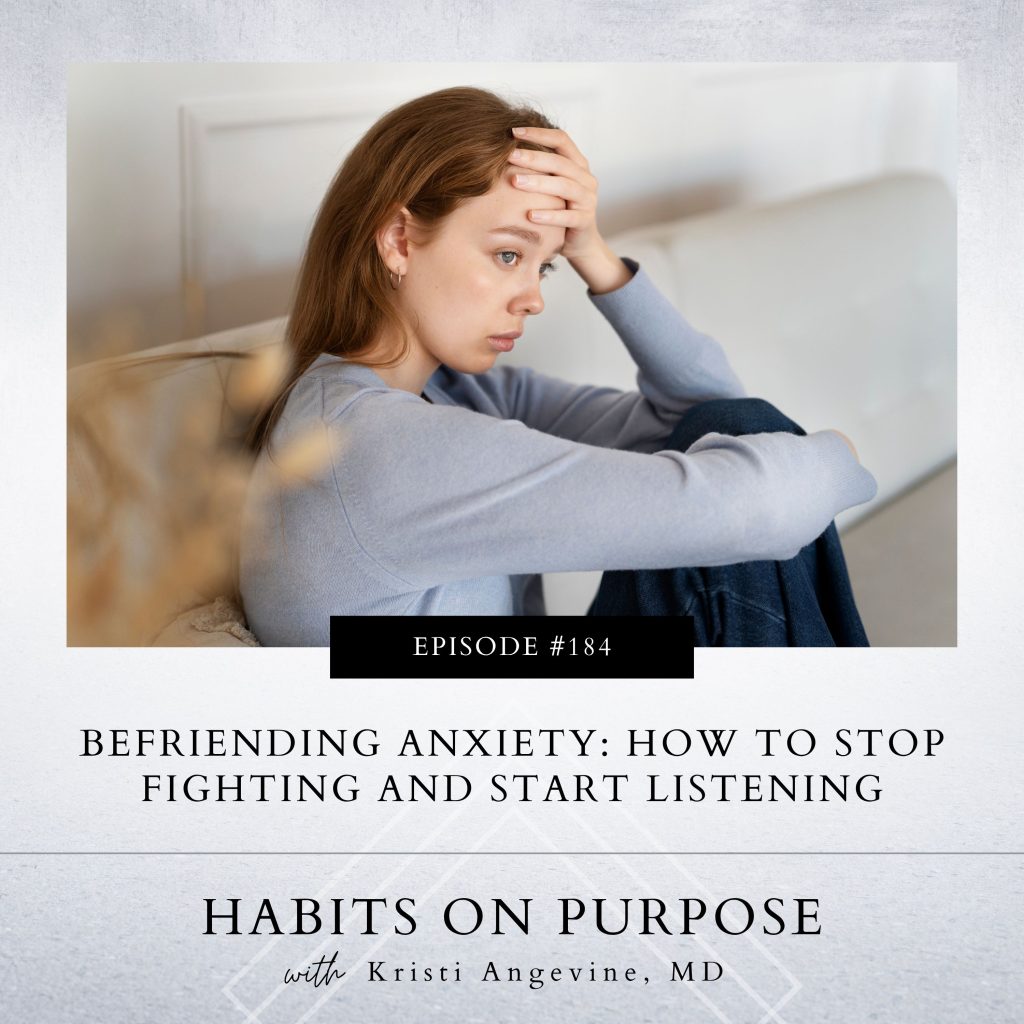
In this episode, I’m exploring a radically different approach to anxiety—one that sees it not as something wrong with you, but as a sophisticated signal system trying to help. I share how anxiety functions like a check engine light or cybersecurity system, alerting you to threats to your physical, emotional, relational, or financial well-being. When we ignore these signals or try to suppress them, they escalate from gentle pings to full-blown alarms.
Through practical examples and a simple outside-inside approach, you’ll discover how to decode what your anxiety is actually signaling—whether it’s pointing to something unsafe, inauthentic, unacknowledged, or simply needing a plan. By the end, you’ll understand why befriending your anxiety, rather than fighting it, can transform it from a source of spiraling tension into a meaningful guide that enhances your entire experience.
What you'll learn from this episode:
- Why anxiety escalates when ignored, like a toddler wanting attention or an alarm system trying harder to get through.
- The four main categories that anxiety signals.
- How to use the “outside-inside approach” to decode your anxiety’s message in real-time.
- Practical ways to respond when anxiety shows up at social events or in daily situations.
- How making a plan can dissolve the spinning “what-if” thoughts that fuel anxious spirals.
Listen to the Full Episode:
Powerful Takeaways:
3:32 “Anxiety is not as straightforward to define as you might think. And this is because it encompasses cognitive, emotional, as well as physical elements.”
8:38 “It’s also really helpful to think of anxiety as analogous to a cybersecurity team. But instead of scanning for internet threats, this team of yours scans for risks to your physical, emotional, relational, and maybe financial well-being.”
11:34 “When your needs, desires, or deeper feelings get repeatedly shoved to the side, anxiety shows up like a concerned friend.”
19:18 “This is how you take anxiety from being this precursor for spiraling and chronic tension to a meaningful cue.”
Featured on the Show:
- Leave a rating and review for the podcast here!
- If you’re interested in connecting with me for private coaching, go to HabitsOnPurpose.com/private.
- Follow me on Instagram!
- Click here to join the mailing list.
- Join Habits on Purpose for Physicians (HOPP) small group coaching program here!
- Join the Habits on Purpose Facebook group!
- Click here to send me any questions that you would like addressed on the podcast!
- Join us in the next Habits on Purpose for Physicians small group coaching program or join the waitlist.
- Britt Frank
Related Episodes:
Full Episode Transcript:
Enjoy the show:


In this episode, we'll talk about why anxiety can be misunderstood, what happens when we try to fight or ignore it, and how to approach it in a way that gives you more clarity, not less. If you've ever felt frustrated with your anxiety, like it hijacks your day or shuts you down, this episode is for you.
Welcome to Habits On Purpose. I'm Kristi Angevine, a physician, master certified coach, Internal Family Systems informed practitioner, and host of this podcast, where we explore the deeper psychology behind why we do what we do. This is Episode 184, Befriending Anxiety: How to Stop Fighting and Start Listening.
Hello, hello everybody. So, I am bringing you one of my favorite topics, and this is the topic of anxiety. The reason why I love talking about anxiety is I experienced anxiety for many years, but did not know that's what the name was for what I was experiencing. I just didn't have that in my lexicon. And I love talking about anxiety and teaching about it because for me, it really deepens my own appreciation and understanding of my own experience, and I love just even thinking about the ideas that I teach here helping someone else who may not know what they're experiencing feel empowered to experience something that can be so disempowering.
So, let me just ask you, if I said for you to rank your love of anxiety on a scale of 1 to 10, where 1 is you don't like it at all, it is terrible, it is awful, and 10 is it's your favorite thing ever, you really are fine with it, you feel comfortable with it, you in fact invite and welcome your anxiety, where would you be on a scale of 1 to 10? What would you say?
So, to put this in a context, let's start with the cultural default. We hear mostly that anxiety is a problem. It is a flaw. It is a disorder. Anxiety is something to be medicated, minimized, or pushed away. So most of us would say that our love for anxiety is more like a 1 than a 10.
Now, on that note, this episode is not intended as a way to diagnose anxiety or to suggest a treatment for anxiety. This is definitely not a substitute for medical care, for therapy, or medication. And on that note, there's something to be said about an official medical diagnosis and pharmacologic treatments. These can be game-changers, they can bring so much relief, and they can very much help keep you safe. So if you're having difficulty with anxiety or with panic, this podcast should not be your only resource. And if you're having thoughts of self-harm or suicide, reach out to your local suicide hotline, which in most areas is 988.
So, where I want to start is, let's get on the same page about what anxiety actually is. Anxiety is not as straightforward to define as you might think. And this is because it encompasses cognitive, emotional, as well as physical elements. So it can include feelings of insecurity, apprehension, worry, and uneasiness related to anticipating danger, threats, or misfortune. It can include fear and doubt, and it can be accompanied by physical sensations of tightness, restlessness, a racing heart, sweating, a knot in your stomach. And depending on who you talk to, anxiety can be classified as an emotion, a feeling, a state, or an overall mood.
Now, the anxiety that I'm talking about in today's episode, it's not the variant that has you riddled with extreme worry and unable to do daily living tasks. The anxiety I'm talking about here is ordinary, everyday anxiety that you feel, but you can live with.
Now, so often, too often, we treat this type of anxiety not just as something to support, but as something to fight and fix. It's something adversarial. It's even something shameful. And it can become something that we feel like we have to hide. Sometimes we have to suppress it. Maybe we have to really wait it out with bated breath, hoping that it will go away if we just take enough deep breaths and distract ourselves, maybe it will be gone.
And this is where the problem starts. Because every emotion we have is a messenger or carries a message. And if you ignore, suppress, or fight off the messenger, you'll never get what the core message is. In Internal Family Systems, we say there are no bad parts. In the same way, there are no bad emotions. There are no bad feelings. Anxiety might feel uncomfortable, but it's not bad. It's not the enemy. It's actually simply a signal. And when we treat it like a signal, we can start accessing what it's actually trying to show us.
So, before we talk about how we get to understand anxiety differently, let me talk about how we usually think about anxiety. In a nutshell, there are more negative connotations than positives. But by the end of this podcast, hopefully, you'll embrace the idea that anxiety, in its mild to medium forms, is actually a really fascinating part of being human.
So, overall, we usually see anxiety as a problem to fix, a weakness to hide, or something that we've got this adversarial relationship with, like I mentioned. So how is it that it's problematic? Well, anxiety in social situations can make it really difficult to converse and connect. When it comes to your goals, anxiety might have you overthinking or stuck in analysis paralysis, spinning with doubt and forecasting catastrophic outcomes.
Anxiety is usually something we really don't want more of. When we think of emotions we enjoy, anxiety is not usually one that comes to mind. Usually we think of confidence, peace, feeling energized, relaxed, calm, encouraged. No one usually says, "I would really like to operationalize how to feel more anxiety."
Anxiety can also be seen more of a weakness than a superpower. We don't usually lead with it when we're applying for a job or starting a conversation. And when you're in public and you're feeling anxious, it's really common to suppress it, to pretend you're fine, hope it goes away, hope nobody notices. Maybe tell yourself you should just suck it up. Maybe drink your wine a little bit faster.
And how do we fix it? Well, we cope with it by eating or drinking or busying or scrolling or isolating or suppressing. And sometimes, we can conclude that anxiety is an indicator that there's something wrong with us as a human. On some fundamental level, anxiety means you're broken, defective, or you just can't hang.
So it's very understandable that we can see anxiety as a negative, as a problem to fix, as this adversary that we spar with, and as something that we really want to keep under wraps. And when we have this type of relationship with an emotion, we don't usually have much curiosity around it.
But imagine what might shift for you if you thought of your anxiety simply as a signal, a signal to get curious about. Perhaps you thought of your anxiety as an important part of your threat detection system, a system that's very sensitive, sometimes imperfect, but simply provides signals with important information. Brit Frank puts it really nicely and says that anxiety is simply your system's way of giving you a check engine light. It's saying, "Pull over. Check and see if everything is okay. Are all systems a go? Or is there something that we need to address?"
I think it's also really helpful to think of anxiety as analogous to a cybersecurity team. But instead of scanning for internet threats, this team of yours scans for risks to your physical, emotional, relational, and maybe financial well-being, and flags anything that could be unsafe, inauthentic, or unresolved. And this system, it might start gently by pinging you with just a feeling of mild worry, kind of like a quiet system notification.
But if you ignore those pings, if you pretend everything's fine or dismiss the worry or invalidate the fact that your anxiety is there, the system will escalate. You will get multiple emails, then a phone call, then a full-blown alarm. This is analogous to anxiety turning into panic. Not because your system is broken, but just because it needs to try harder to get your attention. That check engine light, if it could have audio to it, would start getting louder and louder and louder.
So here's my invitation. I want you to think of your anxiety not as a problem that you need to push away, but as an invitation to look towards what's going on behind it. And just ask, what might this anxiety be signaling? And it helps me to consider it, anxiety being a signal for four main things, four main categories. Number one, something feels or actually is unsafe. Number two, something feels or is inauthentic. Number three, something important is being ignored or unacknowledged. Number four, something is without a plan.
Now, let's elaborate on all of these. These are things that anxiety can signal for you. Number one, something feels or is unsafe. Remember, we are wired for survival. This means we are constantly, often unconsciously and subconsciously, assessing and scanning for threats to our physical safety and our social belonging. So, if you have anxiety around money, if you are afraid of being judged or rejected, if you're navigating tension in a relationship, anxiety makes sense. Your system is detecting possible danger to survival or connection, and just giving you that signal, that's what you're noticing.
Number two, something feels or is inauthentic. Anxiety can flare when you're doing something that goes against your values, like saying yes when you really mean no, saying you have time when you really don't, saying everything's fine when you're really stressed. When something is inauthentic or you are dismissing something that actually matters to you, anxiety can be your cue.
Now, for the third thing, anxiety is signaling something important is being ignored or not acknowledged. When your needs, desires, or deeper feelings get repeatedly shoved to the side, anxiety shows up like a concerned friend saying, "Hey, hey, I think you're forgetting something back here." It might be that you have a deep need for rest, for play, for creativity. It might be that you are ignoring anger. It might be that there is grief that hasn't had space to be processed. And the longer you delay listening or acknowledging what's actually there, the louder and bigger anxiety tends to get.
Now, the fourth thing that anxiety can be a signal for is that there's just something that doesn't have a plan. Sometimes anger is just your system saying, "Hey, what if this happens and that happens and then this happens and we don't know what we're going to do?" It might be some potential outcome, a worry, or a fear. You just haven't mapped out how you'll address. And when this happens, anxiety can feel like a dust devil. It's spinning and spiraling, and it's just kicking up all this mental and emotional debris. And the usual reflex is to get swept away in that whirlwind of what-ifs, second-guessing, catastrophizing. But if you can address and treat your anxiety as like a little chime that says, "Heads up, something needs a plan," you can step out of that dust devil swirl and just create the plan that you need.
So when we're really anxious and spinning, what's going on is we're thinking, if this happens, I don't know what I'm going to do. I'm worried we're going to leave the house, we're going to forget something, and then that will happen, and then this is going to happen, and then it's going to be terrible. And the feeling that comes with that, that anxiety, is just a request for a plan.
A plan that might sound like, "I'm really worried that we're going to forget something. I notice this anxiety is here. And I'm worried that if we forget something, that we're not going to have it, my family's going to get in a bad mood, the kids are going to have meltdowns. Okay. I'm going to make a plan for that. I'm going to remind myself that we can buy whatever we need later, or we'll live without it. And it's okay if my family's upset. And even if I get activated in response to that, this bad mood, this tricky time, it's going to be temporary."
So when the anxiety signals a need for a plan, we just get to make that plan. And that gives our mind the closure that it's searching for when it's constantly spinning in what if, what if, what if.
So, let's bring all this together and make it concrete with an example. Say you're at a social event or a party and you start feeling anxious. Maybe you're feeling self-conscious or doubting that you have anything to say. You're maybe worrying about your outfit or imagining rejection before it even happens, or imagining what you're going to have to do when conversation dies down and you're standing there by yourself, going between one group of people and another group of people, not knowing how to initiate conversation. And you feel the anxiety build. Your shoulders are tense. Your stomach has a knot in it. You feel a little bit sweaty. It's harder to think.
In this situation, when anxiety is seen as a flaw or a weakness, you might try to take some deep breaths, run over to the hors d'oeuvres and eat them quickly, start seeing worst-case scenarios while you're drinking your wine faster than you ordinarily would, or you might just bail. Just leave. Just get the heck out of there.
Now, none of those things are wrong or bad. But if you see anxiety as a signal, that's when you can pause and ask, “what is this feeling trying to tell me?” That check engine light could be pointing to one of those big four things. Maybe there's something you're not addressing. Maybe you're just exhausted. You need rest. You need some downtime. But you're telling yourself that you should be fine.
A part of you is saying, "I don't want to be here." And another part's saying, "Suck it up. Everybody else looks fine. They're dealing, so you should too." So you're not addressing your need for downtime and rest, and you're concurrently telling yourself that addressing that makes no sense.
Or there's something you're dismissing. Maybe there's like a deeper belief that you don't belong there. And that sense of not belonging is something you're just shrugging off and telling yourself you're just being too dramatic. So you're dismissing this deeper issue to address, and what you feel in the moment is a sense of anxiety. Maybe there's something you're overlooking. Maybe somebody at the party reminds you of somebody who hurt you in the past. And one part of you is sounding an alarm system while another part of you just insists that you're overreacting. So in your head, you have alarm bells going off, and also, you're just telling yourself like, "I'm just being so sensitive. What is my problem? I can't just relax."
Or it might be that you simply don't have a plan for something. Maybe you're worried that you're going to say something awkward, the conversation will die out, and you don't know what you're going to do. And you're starting to have all those what-ifs and second-guessing and self-doubt. So, what you can do that helps is just decide ahead of time. If this thing happens, my plan is I will do X, Y, and Z. I'll ask the other person a question about themselves. I will go get myself a drink of water. I will have a plan. I know what I'm going to do.
So none of this is possible unless you can slow down enough to see what the anxiety is signaling. So, I hope by now you're open to the idea that even the uncomfortable feeling of anxiety can be something that is actually fruitful. It's a signal. It's your threat detection system telling you to pause and look inside, and see what else is going on.
So I want to give you a practical tool that can help you take some of these ideas and really bring them into your ordinary, everyday life. And this tool, you can use anytime you feel garden-variety anxiety.
So, when you feel anxiety this week, instead of defaulting to, how do I make this go away? I want you to try this. Ask yourself, what is this alert pointing me towards? Is there a threat? Is there something inauthentic? Is there something I'm not acknowledging, something that needs a plan?
And when you ask these things, you can do this by starting with looking at the outside world and then moving to the inside. So you can think of this as the outside-inside approach. So start with the outside. You feel anxiety, and then you ask yourself, is something actually unsafe? Am I in a relationship that feels shaky? Is my job misaligned with my values? Are my finances creating stress? Is my body telling me something I've been ignoring? Is there something in the outside world that just needs a plan?
Then check inside. Am I invalidating how stressed I actually am? Am I brushing off some sadness or anger or fatigue? Am I ignoring my instincts? Am I pretending something doesn't matter when it actually does? Am I forecasting catastrophe without coming up with the solution? Is there something going on inside me that I don't have a plan for, that I don't feel like I have a safety net for?
Now, sometimes it's going to be both. There are going to be things in the outside world that need to be addressed. There are going to be things in the inside world that also need to be addressed. But either way, anxiety is your signal pointing you to pay attention. And when you do this, this is how you take anxiety from being this precursor for spiraling and chronic tension to a meaningful cue. And in this way, we get to be more welcoming of the normal human experience of feeling the state or mood or emotion or sensations of anxiety.
So here's a new way to think of your anxiety. Anxiety is not bad. Anxiety is not a weakness. Anxiety is not an adversary. Oftentimes, when it feels terrible, it's because it's being resisted or suppressed or ignored, or judged. And like a toddler who wants your attention, it will start screaming and getting really big. Anxiety is not in need of fixing so much as understanding. And anxiety is your check engine light. It's saying, "Hey, slow down. Pull over. Take a moment and check in." Anxiety is simply your reminder that something inside hasn't been fully addressed. It's your alert saying, "Hey, there could be something that feels unsafe on the inside. And maybe we need a plan for that."
Anxiety is like that person on your team who says, "Hey guys, don't forget about this thing back here. Remember, we need to come up with a plan. We need to acknowledge this thing. We need to make sure we don't keep dismissing this and putting this on the back burner." And when we listen, it can enhance our entire experience. Anxiety can actually show us things we might not have picked up on without it. And so in this way, anxiety can be a positive.
So thank you so much for listening. If you're not yet on the email list, come on over to habitsonpurpose.com, and you can click join the email list. And if you like this episode, if you like talking about different ways to see common emotions and habits and things that we oftentimes really grapple with, I'd be ever so grateful if you gave the podcast a rating and a review. These ratings and reviews really help the podcast get moved higher onto the search list, so people who could benefit from the topics here can find them more easily.
Thanks again for listening. Take care, and talk to you next week.
Thanks for listening to Habits On Purpose. If you want more information on Kristi Angevine or the resources from the podcast, visit HabitsOnPurpose.com. Tune in next week for another episode.