
I have another amazing interview lined up for you this week. Janette Dalgliesh is my coach, and she has a truly unique approach to perfectionism, overworking, and self-criticism, and rewiring your brain to overcome all of it. Working with her has been eye-opening for me, and I know all of you are going to love her blend of neuroscience, astrology, and life coaching.
Janette is an elite life coach who helps women with important work to do in the world to be able to do what they’re called to without ignoring their own needs. She serves an international clientele from her home in Australia, and is a former performer, union organizer, and political aide. Her clients include physicians, politicians, actors, farmers, coaches, and cyber experts.
Tune in this week because Janette Dalgliesh is here to discuss the habits that live below our conscious awareness. We’re diving deep into the influence of socialization on our thought habits, why it’s never too late to rewire your brain, and Janette is sharing a very specific technique for dealing with those big emotions that seem like they occur without any preceding thoughts.
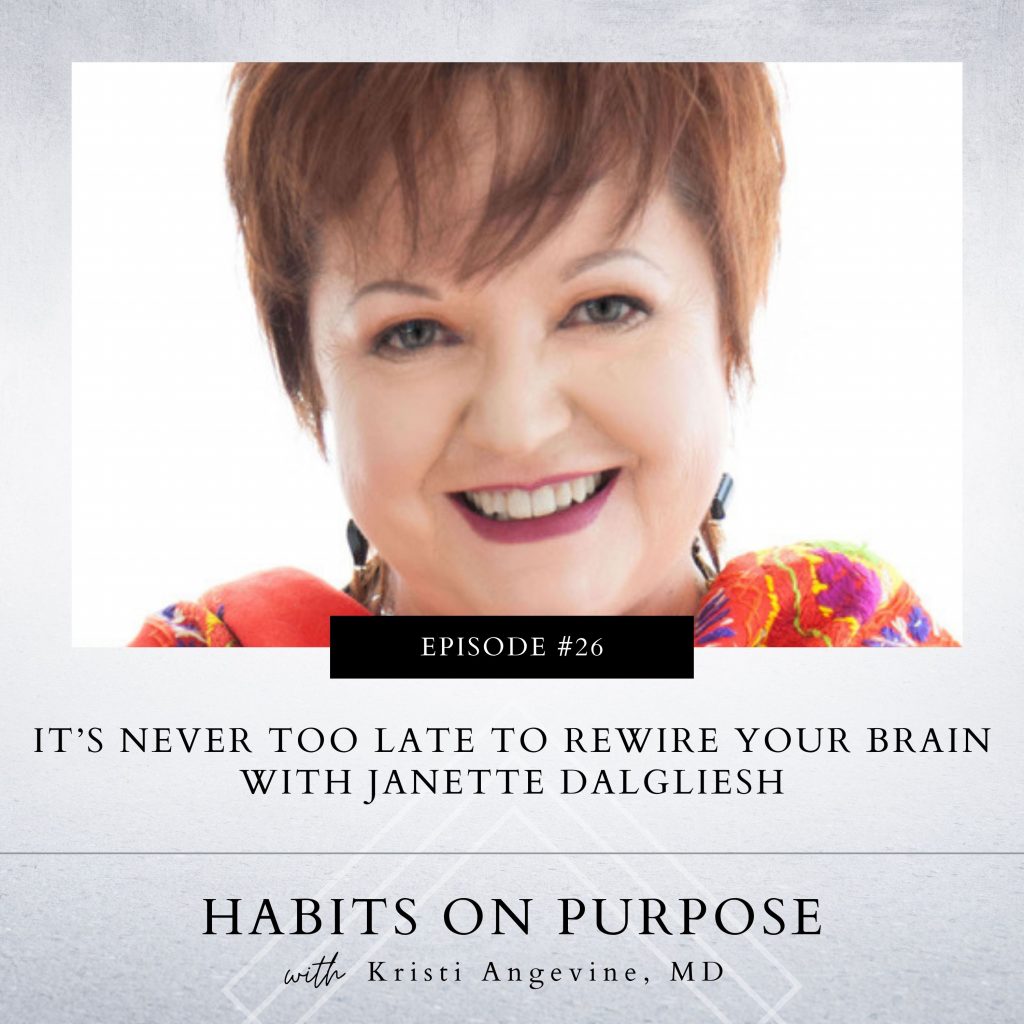
I have another amazing interview lined up for you this week. Janette Dalgliesh is my coach, and she has a truly unique approach to perfectionism, overworking, and self-criticism, and rewiring your brain to overcome all of it. Working with her has been eye-opening for me, and I know all of you are going to love her blend of neuroscience, astrology, and life coaching.
Janette is an elite life coach who helps women with important work to do in the world to be able to do what they’re called to without ignoring their own needs. She serves an international clientele from her home in Australia, and is a former performer, union organizer, and political aide. Her clients include physicians, politicians, actors, farmers, coaches, and cyber experts.
Tune in this week because Janette Dalgliesh is here to discuss the habits that live below our conscious awareness. We’re diving deep into the influence of socialization on our thought habits, why it’s never too late to rewire your brain, and Janette is sharing a very specific technique for dealing with those big emotions that seem like they occur without any preceding thoughts.
Enrollment for the current round of Habits on Purpose for Physicians (HOPP) CME Small Group Coaching Program is closed. If you’re a female physician who wants to better understand your habits and learn to apply pragmatic tools to create new ones, click this link to learn about the program and click here to sign up for the waitlist for the next round.
What you'll learn from this episode:
- Janette’s journey as a coach and how she started integrating neuroscience and astrology into her work.
- The impact that socialization and generational trauma has on the thought habits we form during our formative years.
- How Janette helps her clients to liberate themselves from the thought habits and patterns they have unconsciously picked up throughout their lives.
- Why the planet needs you to drop the conditioning and show up in all of your messy, imperfect human glory.
- How to uncover your unconscious habits and begin to get curious and question them.
- Why it’s so easy to get stuck in black and white thinking when we’re in a stress response, missing out on the nuance of a situation.
- How to understand your stress responses.
- 3 steps to start rewiring your brain to deal with your big emotions.
Listen to the Full Episode:
Featured on the Show:
- Follow me on Instagram!
- Click here to join the mailing list.
- Enrollment for the current round of Habits on Purpose for Physicians (HOPP) CME Small Group Coaching Program is closed. If you’re a female physician who wants to better understand your habits and learn to apply pragmatic tools to create new ones, click this link to learn about the program and click here to sign up for the waitlist for the next round.
- Join the Habits on Purpose Facebook group!
- Click here to send me any questions that you would like addressed on the podcast!
- Janette Dalgliesh: Website | Twitter | Instagram | Facebook | Vibration Rehab
- Get Janette’s free Vibration Rehab PDF
- Brain Lock: Free Yourself from Obsessive-Compulsive Behavior by Dr. Jeffrey
Full Episode Transcript:
Welcome to Episode 26. This is your host, Kristi Angevine, and today is another summer interview. In this episode, I have the privilege of talking with Janette Dalgliesh.
Janette is an elite life coach who helps women with important work to do in the world, to do that work without ignoring their own needs. She serves an international clientele from her home in a small town in southeast Australia. She's a former performer, union organizer and political aide, and her clients include physicians, politicians, actors, farmers, coaches, cyber experts, visionaries, entrepreneurs, and poets.
She and I discussed the influence of socialization on our thought habits. She teaches a very specific technique that's perfect for those big emotions that feel like they happen to us without any preceding thoughts. I hope you enjoy.
Welcome to Habits On Purpose, a podcast for high-achieving women who want to create lifelong habits and feel as good on the inside as they look on paper. You'll get practical strategies for mindset shifts that will help you finally understand the root causes of why you think, feel, and act as you do so you can learn to create habits that give more than they take. And now, here's your host physician and Master Certified Life Coach Kristi Angevine.
Kristi Angevine: Today I'm so excited because my guest is Janette Dalgliesh and I may be butchering her name, but she will happily correct me. So, Janette, welcome to the show.
Janette Dalgliesh: Thank you, Kristi. No, you nailed it. Janette Dalgliesh. Everyone struggles with it unless they live in Edinburgh, which is where it's from.
Kristi: I love it. I know we were talking a little bit, before we started pressing record, but I do just want to emphasize that it is just such a treat to have you here. Not only because your coaching approach is unique; you blend neuroscience with Jungian psychological astrology, which is so outside my wheelhouse, but you're also my coach.
I've had the privilege of getting to know you, and see firsthand your approach to things like perfectionism, and overworking, and self-criticism. It's just been so eye-opening for me to be able to work with you. And, I knew that it would be wonderful to have you on the show so that you could really help my listeners approach some things in some different ways.
Janette: Thank you. That's so sweet. I have to say it's just such a privilege to be here as well, because I've watched the journey of this podcast from the very beginning. And when you first said you were doing a podcast, I was so excited because I knew that what you brought to your listeners would be amazing. And, it turned out to be I was right. I was right all along. So, I'm very thrilled to be here.
Kristi: Well, that is supremely kind of you, and I will work on receiving that compliment. So, thank you. For those listeners who don't follow you like I do and don't know you as well as I do. Can you just introduce yourself?
Janette: Yes. I've been a coach for about ten years. Very early on in my coaching journey I got introduced this concept of neuroplasticity and neuroscience, and the power we have to rewire our own brains. And around the same time or shortly afterwards, I was also introduced to psychological astrology, which we know that Carl Jung was a fan of astrology.
He said that astrology was how the ancients understood human psychology. And so, all of the mythology and the metaphors that are woven into astrology help to give us some deeper understandings. So, as I started with one foot in either camp, kind of going, “I have no idea how to blend these two things,” I suddenly realized they're both different sides of the same coin.
Because we come here to planet Earth, you know, in terms of astrology, the stars don't dictate who you are, they reveal the potential of who you came here to be. So, this notion that we come to planet Earth with preferences, and values, and goals, and things we're passionate about, things that we're naturally drawn to and gifted with, all of those things are longing for self-expression. They're longing to be expressed out in the world.
But then, we get socialized. We have our brains wired with all of the stuff that we learn in our own personal lives, but also things like intergenerational trauma. We know that the trauma that occurred to our ancestors can have a direct impact on our own psychology. And, we all grow up swimming in the waters of all these larger systems.
Systems of oppression like misogyny, and racism, and ableism. Every single one of those things has an impact on the thought habits that we form in our early years. Long before we have the critical ability to question them and say, “Wait a minute, I'm not sure that that's a particular rule for living that I want to follow.”
The basis of my coaching, I guess the core of my coaching, has become this yearning. I have a yearning to help people liberate themselves from all of those different weird thought habits and patterns, many of which are so unconscious to us, so that they can do that glorious work of being their true self on the planet.
Because the planet needs you. The planet needs you in all your glory, in all your messy, imperfect humaneness, without all the learned stuff that we acquire along the way. And I think that, for all of us, is a lifelong journey. But I like to try and hasten it for people if I can.
Kristi: One of the things I adore about just how you've framed all of this is, you've not only sort of given hope to my listeners, who may feel really bogged down in just the way they feel, the way their habits are, how sometimes they feel like they're not malleable. And, you've pointed out that it makes so much sense that many of our habits are below our conscious awareness, that we don't even recognize that they are things that we could question.
And sometimes, as maybe somebody who might speak from a little experience, sometimes it takes repetitively gently nudging to actually be able to see that there is something that is a habit. That we can actually question in a way that doesn't feel like we're beating ourselves up. But that feels like sort of very curious and compassionate exploration.
Janette: Absolutely. And I think the other very nuanced thing… I love human brains, because they are so capable of sophisticated, nuanced thinking, if we give them half a chance. A brain that's in the middle of a kind of fight-or-flight response, or a stress response, will really struggle a little bit to do that.
So, the first thing to do is flow some kindness and compassion, and recognize; if I'm in the middle of a stress response, it's likely not my fault. I can have some kindness for myself. I can say, I'm a creature in pain. I have a nervous system that's just responding in the way that it's been trained to do. It doesn't make me a bad person; it doesn't make me a bad human. I'm allowed to just cry if I need to freak out, if I need to have the emotional response that I need to. So, that I can then soothe and calm myself.
Because, it's once we can get into that state of peace, that we can then start stepping back a little bit from those patterns, in order to free ourselves from them. And you're right, it does take time and repetition very often, not always, but mostly…
With neuroplasticity, which is this phenomenon whereby we can change our own brains, requires two things: One is repetition, and the other is engagement. So, something has to … We can't eat a piece of lettuce after decades of eating junk food and expect our whole biology to change overnight. It's the same thing here. And, the engagement means it has to be sticky, somehow. It has to have an emotional engagement, or a sensory engagement. So, those things are the things that make it possible for our brain to rewire itself.
Kristi: Yeah, and just for my listeners out there, who may have sort of a chronic baseline level of heightened stress, sort of very frequently going in between fight, flight, freeze and back again, I think it's just so easy to be very stuck in that black-and-white thinking that can happen in there, where we can't appreciate the nuance.
So, for those of you who are listening, please go back about 90 seconds and re-listen to the brilliance that Janette just said; that stress responses are not your fault, and they are not the most optimal place from which to investigate and to look at some of these thought habits.
Which brings me to, I'm curious with your clients, what are some of the insidious and very kind of pernicious thought habits that you see? And then can you also speak to a little bit like, why they're so common?
Janette: I think that we live in a patriarchal system, sort of late-stage capitalism, which is very imbued with notions of productivity and perfectionism. But this has been sort of growing since the days of the Industrial Revolution, when really, we saw human labor being commodified.
So, whether your ancestors were kidnapped and enslaved, or whether they were living in Europe and working in the mills in Britain, or any of those much more structured industry arrangements where humans were expected to…
Our previous ancestors had lived a mostly agricultural life, where we followed the seasons. We followed the sun, more or less, with our waking hours. We rested when we were tired. There was a much more rhythmic pattern to life. And then, we found ourselves in a situation where we were working fourteen-hour days. We were expected to show up before the sun rose and keep working after dark.
We were put in a situation where we were required to stop listening to our bodies, as much as we could. And that, over time, has become more and more and more emphasized, so that now we're seeing this incredible pressure on humans, particularly around their working lives. But it's also creeping into everything else.
I know, pretty much every parent will know what I mean when I say there is this intense pressure to be the perfect parent. And, I don't want to turn around and blame social media for all of our ills. But I do think it becomes a bit of a pressure cooker, if we're also trying to manage our own lives, and then kind of make it Instagram™ worthy as well, on top of everything else; it's not surprising.
So, we've got this old, patriarchal construct that has been applying pressure to us and to our ancestors. We've all kind of acquired that at this very deep level. And then, on top of that, we've got our own life experiences. And certainly, for people working in industries like medicine, law, and other high intensity professions, particularly in the United States, Britain, Australia, there is this intense workload, expectations of perfection.
My father was a GP. And I know during his practice, during his lifetime, as in practice, he saw the shift from a gentler way of practicing medicine through to something that had to be managed in a much more intensive way. There was a rise in doctors being sued for negligence, for example, that really wasn't a thing when he started out. It's not the doctors were always perfect, it's just that there wasn't this same mentality of saying; when anything goes wrong, I automatically see the doctor and hope that I might get something.
And so, all of these different elements have woven together to say; in order to earn your way, in order to be worthy of the money that you get in your bank, and the oxygen that you breathe, in order to be worthy of your place on the planet, you have to be a perfect human. And, you have to work twenty-eight hours a day.
That becomes a pressure cooker that we are surrounded by all the time. We see it in movies, there's an almost hero worship of the suffering in order to be as productive as possible. It's almost like we admire the heroic journey of sacrificing your own mental health and your own physical health, for the sake of others.
At the same time, there’s a very weird, rugged individuality that says; I must take care of myself. I can't possibly ask for help. It's up to me. I have to be the one in control of my own life, and everything around me, in order to make it all perfect. If I can't do that, I won't feel safe. So, it's a very toxic combination.
Kristi: Yeah, I think it's so beautiful how articulated that, yeah.
Janette: It's not surprising that so many people… Especially those who work in certain industries, and I think particularly women in those industries. It's certainly people of color in these sorts of industries.
It's just so many messages coming in from outside to say; You don't belong here. You're not doing it right. You're not doing it well enough. You should be doing more hours. What do you mean, you have to take care of your family, your children, your own health? How dare you.
It's a horrible combination of circumstances. And, that's not to say that we are the victims of circumstance and that nothing can be done about it. But it is to say that if your nervous system is having a stress response, it's not really that surprising.
Kristi: I love that really explicit acknowledgement of the context in which our ancestors and the recent generations, maybe two before us and us, have been swimming in. Not to say, okay, there's nothing I can do about it. But to just be eyes wide-open about the ocean in which we are swimming. The pressures that we've inherited. And the messages that we get socialized into, that we many times don't even recognize; like a fish in water, we just don't recognize.
Which is why one of the reasons I think having an outside perspective with a coach, with a therapist, with somebody to guide us, is just precious and just so valuable. Because sometimes it is hard to see on your own; you can, but sometimes it's just easier with outside perspective.
Janette: You can't read the label from inside the jar. And, I think that's such a perfect...
Kristi: I will say, I love that right there. I have passed that on to my clients because it's such a beautiful thing. So, now they get to hear it from the original source. Because it's such a wonderful phrase that we could both use.
Janette: Well, I have to acknowledge Jacqueline Gates, who was the one who said it to me the first time, so I passed it on from her. Kristi: So good. You were about to say something, so go ahead.
Janette: No, I was going to say that one of the things I think is so important to remember, because it can sound… I want to temper what I just said, all of the description of just how horrible and toxic it all is. I want to temper that with some optimism and say, the good news about all of this is that we know from the research that brains are plastic, they are malleable, they can be rewired. And, that is true throughout life.
Anybody over the age of twenty listening to this, has basically grown up in a world where everyone assumed that once the adult brain got to a certain stage, it was fixed. And certainly, assumed that once it was past about thirty, or maybe forty, or even fifty, that it was slower to change, or it was harder to change. The research doesn't bear that out.
The research says that basically, there might be some slowing of the change process in later life, but the brain is still capable of change. And it changes, this is the bit that blows me away still, that the brain changes faster than any other organ in the body, including muscles.
Now, we've probably almost all of us experienced the phenomenon of starting a new workout program, and measuring our biceps. And suddenly over a period of four weeks, we go; I've got an extra centimeter on my bicep. That's amazing. I've grown muscle. How cool is that?
But if you imagine that your brain is capable of change faster than that, I think that's an enormously optimistic piece of research to remember. Because of this phenomenon, where we can't read the label from inside the jar, it's extremely convincing… All of the stress stuff that we have, all of the stories our brain tells us about; how stressful it is, how difficult it is, how much we're struggling over the circumstances, etc., etc. It's very, very convincing.
But all of the perspective we have on our own lives, is a construct inside our own brains. It's an extremely convincing one, but that is literally how the brain presents reality to us, as a construct. We’re never directly perceiving reality anyway. So, in a way, it is all made up; it is all in your head.
I do not say that as a way to gaslight anyone, or to say that, you know, the crappy work colleague or that horrible boss. I'm not saying they're not real. But what I am saying is, that our perception of what those things mean for us, is always open for change.
This is one of the things I get very excited about when I work with my clients. When we work together on helping them to rewire their brain, to reshape their perspective of reality, so many good things flow from that.
Kristi: I mean, this is at the heart of… Many of us have the perspective that habits are not as deeply entrenched as they may seem, even when they feel like that. When we combine what we understand about neuroscience and neuroplasticity, we can really appreciate how even habits, that have been there for 30 or 40 years, are much more malleable.
They are soft clay, not forged metal that will never change. My bias is that it all starts with awareness. Which is so much easier when you have that sort of calm compassion and curiosity, that are usually not available inside a stress response, like you've said. And so, when I think about all this, like the potential for change and the potential for sort of altering our experience and altering, on purpose, our perception of how we're moving through the world or how we see ourselves.
One of the things that I know that my clients grapple with, is what to actually do with the big emotions. Because oftentimes, when they're feeling big emotions; heightened anxiety, lots of disenchantment, defeat, anger, feeling worthless. When the rubber hits the road, and they're in the middle of something like that in their real life, those are the moments that sometimes feel difficult for them to sort of step outside of.
The way that I see them, and the way that I hear my clients describe them, is that they are emotions that sometimes seem like they just come out of the blue. Even the ones that my clients who are really sort of attuned to how their thoughts connect to their emotions, they will feel big emotions without these antecedent thoughts.
Or, they will feel emotions that seem out of proportion to the circumstances. And despite that awareness, they're still there. Or, there'll be emotions that are simply just plain old recurrent. Like a certain set of circumstances happens and every single time, just millisecond away, a huge emotion overcomes them, and they don't really know what to do.
And so, with these big emotions, what I see is that common responses are that, you know, people will resist them and push them away. To try to get them to go away so that they can just focus on getting through the day. Because frankly, they're kind of inconvenient if they're in the middle of driving, or trying to give a talk, or operate in the O.R., or teach a class.
Or, they will try to in some way, to numb them, avoid them, distract themselves from it, go to bed, hope that it won't be there in the morning, and maybe even wait them out. And then with my clients, particularly, and I'm sure some of yours as well, since you know, I am one of your clients, they will add insult to injury, and they will judge themselves for having them.
So anyways, all that’s to say, what I'm thinking of is one of the most like most severely salient and powerful techniques that I've learned from you is, you know, what to do with some of those big emotions. So, would you be comfortable sharing a little bit about what you teach?
Janette: Absolutely. So, the technique that I created for my clients was something I developed about 10 years ago, and I call it Vibration Rehab. I stole that term from Law of Attraction world, where the combination of thought and feeling, where they seem combined together and woven together in a sort of locked way that they don't seem separate, we call that “vibration.” And, it was just handy terminology.
It's ideal for when, or is designed for those moments where it feels like the emotion hits a split second before the thought. So, unlike the sort of classical model, where we know that it's; you have a thought, which gives rise to a feeling, and that dictates our actions, and that creates results. Life doesn't always feel like that. It sometimes feels like the emotion happens.
I wake up at three o'clock in the morning, and I'm in a panic and I don't even know why. And then, I suddenly remember there's an overdue bill.
It doesn't always feel like it's this nice, neat sequential thing. So, I was doing some reading of works by authors like Don Goewey and Joe Dispenza, in particular. And, I realized that there was something a little different going on than just the sort of the thought process way of looking at things.
I have to preface this by saying, I'm not a neuroscientist, and I'm not a physician. So, please don't ask me complicated questions about neuropeptides. But what I did discover when I was doing some reading, was that the way that the brain operates, the communication methods that it uses internally, means that the brain can become chemically addicted to stress.
What actually happens, over a period of time, is that the brain talks to itself. The brain communicates with itself and within the nervous system, through neurotransmitters. And in order for a brain cell to receive a message from a neighboring brain cell, which is how neural networks are formed, it needs to have receptors specifically designed to receive the different kinds of neurotransmitters. This is partly metaphorical.
I explain it this way to my clients, to make it a little easier to understand. Imagine that the neurotransmitter for anger is a different shape from the neurotransmitter for joy. And within that, imagine that the neurotransmitter for the anger of witnessing the Supreme Court doing something crazy, is a different shape from the anger of the cat throwing up in your shoe. We get these very nuanced, very subtle differences.
As a brain cell receives a flood of particular type of neurotransmitter, let's say the stress neurotransmitter, from being in a very busy workplace. As your brain cells receive more and more and more of these neurotransmitters for the stress of: I can't do enough. There's not enough of me to go around. I haven't got enough energy. I'm going to make a mistake if I do this. All of those sorts of circumstances.
The stress of that, creates a larger number of receptors on each brain cell. So, each brain cell is getting flooded with all of these transmitters. And it's going; whoa, I can't handle all of this. I'd better make some more receptors. So, it creates more and more receptors.
Over a period of time, that brain cell effectively becomes desensitized to that transmitter. So, it has to create more and more and more receptors in order to stay able to receive the messaging. Meanwhile, it's hard to get rid of some of the receptors for other things because there simply isn't room.
So, you now have a brand cell that is really set up for that particular neurotransmitter. And if you suddenly remove that… If you suddenly take yourself to a stress-free situation, that brain cell is like a little junkie. It's going; wait a minute, I haven't got that stuff. Where's my stuff? It starts craving, it's like it craves a hit of that stress neurotransmitter. So, it's become chemically addicted to stress.
What you end up with is, you're now living with a brain, you're the owner-operator of your brain, not the victim. But in those moments, it's like living with a brain that has this chemical addiction that it is determined to satisfy. Regardless of what you, the owner-operator, wants to do.
Kristi: You have like such a beautiful description and explanation for why somebody has an amazing vacation planned, or they had two hours of white space just pop into their schedule, and when they're there, it's hard to unplug. It's hard to feel present and their mind is racing, or they feel like disproportionately anxious or stressed in circumstances in which they would expect they would feel differently.
Janette: Absolutely. I think one of the key things I really love about realizing this, or one of the things that I found so valuable when I first learned this, was this is another opportunity for me to say; this is not my fault. I'm not broken. I'm not doing anything wrong. I just happen to have a brain that's become chemically addicted to stress. It's just chemistry. And that, certainly makes it easier to deal with.
At around the same time, as I was learning all of that, I also read Brain Lock by Dr. Jeffery Schwartz, which is a book about his technique for helping people recover from obsessive compulsive disorder, which is a notoriously difficult disorder to treat.
I realized that his technique for that could be adapted. I created it initially for myself, this technique that I want to teach your listeners. I did it initially for myself and discovered that it worked really well. I'd also discovered that, the more I used it on different things, that'll make more sense in a minute, the more effective it became, and the faster my brain learned to trust the technique itself. I hadn't expected that. That was a really unexpected bonus.
So, the way that I used it for myself, and I've now use it with my clients, is if I realize that I'm having a stress response, and then my brain is justifying it with a narrative... Because we know, that's how brains work; they come up with narratives, they come up with stories all the time. So, if my brain is having its little chemical hissy fit, and just craving some adrenaline, or some cortisol or whatever it's craving, some stress neurotransmitter, then it will trigger me to have that response by creating a story.
I get this story in my head that justifies the explosion of stress chemicals. And it's really easy to feel like a victim, in that situation. So, learning to actually kind of use that as a signal to use this technique became really helpful.
I think the very first time I developed it for myself, was around anxiety to do with money. I'd had a long history of money anxiety going through to childhood, even though my dad was a GP. He was a classic English country doctor, who then emigrated to Australia, and he became a country Australian doctor. We lived on the coast. He was frequently paid in buckets of fish, and in kind. So, we were not particularly well off.
I had grown up with money being tight in the household, despite that background. So, money anxiety was a thing. I would frequently have a panic attack and stress out about money, only to then have to remind myself, actually, I had just got paid and there was plenty of money in the bank. So, my brain was giving me this false sense of anxiety around a circumstance that actually wasn't nearly as terrifying as I kept thinking it was.
I started using this technique, and it took probably about two weeks of using this technique to find myself at a point where I could get through my day without having any kind of anxious thoughts about money. I recovered my equilibrium, and I couldn't believe how fast it had been.
Kristi: That’s beautiful. For the listeners who can relate to this, how does this vibration rehab technique work?
Janette: Okay. It's really straightforward. It's very simple. There are three steps; it's going to take me longer to explain it, than it does to do it. So, this is what you do. The moment that you feel that emotional, sudden sense of being dragged off course by the emotion, where it feels like it's welling up; it's got ahold of you, it's pulling you off in a direction you don't want to go, you're having the stress response. Just noticed that it's happening.
That’s the very first step, is to notice that it's happening. If you want to, you can give it a label. Sometimes it's helpful to give it a label like Nervous Nellie, or Freak-out Frank, or whatever. Some people find that too cutesy, and it's like; that's ridiculous and nonsensical. So, if that's you, don't bother.
But notice that it's happening. And, remind yourself that this is chemistry; it's not you, you're not broken, it's just your brain having a chemical moment. That's step one.
Step two, you're going to engage sensory pleasure. So, after I describe the three steps, there's a little preparation work that I'll kind of cover, as well. So, you engage sensory pleasure. That means having something on standby with you all the time, if possible, that elicits that almost swooning feeling of; oh, that's so good. That feels so good. If you can elicit that sensation, then you've nailed it. So that's the second step.
The third step is to deliberately, consciously practice a new replacement of thought, something that makes you feel calm and soothed. I like to stick to something fairly generic. So, it can be something like; right here, right now I am safe. Or, I don't have to worry about that right now. Or, it can be, one of my favorites was the dame Julian of Norwich, quote, “All shall well, and all shall be well, and all manner of things shall be well.” You could use the Universe has my back.
Whatever kind of mantra affirmation, positive thought, feels generic and true, and makes you feel a bit safer. It doesn't have to be a really long, elaborate thing. In fact, the shorter the better. So, you can see how fast you can do that.
My recommended methodology would be kind of notice the emotion, grab the pleasure item, whatever it is. And, as you engage with that pleasure item for about the space of three slow breaths, just keep reciting the replacement thought over and over in your head.
That's actually doing a number of different things. First of all, it's flooding your brain with dopamine, from that sensory pleasure. It's really flooding your brain with a different set of neurotransmitters by using your own senses. You're using your own physiology kind of, to not trick your brain, but to turn its attention to something else.
So, you're flooding it with the pleasure sensations, which helps to reset the chemical balance. Because now, your brain cells are all being asked to create neuroreceptors for pleasure. They're all kind of like; Oh, crap, I better get rid of some of these stress neuroreceptors, because now I've got to be building the ones for pleasure. So, it helps reset the chemical balance.
Nature abhors a vacuum, so does the brain. So, if you haven't replaced whatever narrative your brain was about to come up with, or has already come up with, that is linked to the stress response. If you don't replace it with something different, it'll just try and snap back to that; it's a habit, it's just a thought habit that your brain has.
We're going to do all three of those steps. When you get practiced at this, you can do it so fast. Most people don't even notice that you're doing it. And when it comes to the pleasure… Here's the preparation piece that you need to do.
You don't really need to label or identify that feeling; if you want to, it can help but you don't have to. You do need to have some pleasure items. You need to have things that are relatively portable, that you can have with you at all times. Things that are fairly handy to access and things that you know are reliable.
My preferred pleasure item is a particular essential oil blend that some guy in my local magic supply shop makes. It’s a local shop in my country town that sells incense, and crystals, and what have you. He makes a blend called Stress Relief, and I have no idea what's in it. I couldn't tell you. I must go and ask him one day. But it doesn't matter.
The point is not what particular oils are in it. The point is that when I first opened a bottle to test it, I just knew, I just I loved the smell of it. I bought it for that reason, not because it happens to be labeled Stress Relief, that’s just a coincidence.
You can use hand cream. Massages, that’s another one; so, massaging your own hands. Really feeling that sort of the deliciousness of that flesh moving against flesh. If you use a scented hand cream, you can get the best of both worlds.
Kristi: It sounds like anything that will activate any of the five senses, or combination of, that is unique to each person. That’s portable. Is what you could use.
Janette: As long as it gives you that intense feeling of pleasure, that's all that matters. Anything that just brings this. It's got to be physically delightful, that's the key. So, sensory pleasure.
What it looks like when I do it, because it's my little bottle of essential oil, if something's arisen, some old stress addiction arises, because it very occasionally happens from time to time. In fact, it happened to me a couple of weeks ago, related to some family stuff. I found myself waking up in the middle of the night and suddenly went; oh, my gosh, I'm having one of those stress responses. I've done this enough that I can spot one of these a mile off, now. It's just practice.
I happened to have a different oil blend sitting by the bed, so I fumbled around in the dark, managed to open it without spilling it, and just lay there sniffing it, and having my replacement thought; right here, right now, I'm safe. And immediately, almost immediately straight back to sleep. When I woke up in the morning, it was gone.
That's the speed with which it works for me, now; it’s partly because I've practiced this technique. In the early days, it would take a couple of weeks. But what we know about the brain is using a technique like this, the brain starts to change within about 72 hours.
Kristi: That's what I was going to ask. For somebody who just tried this out for the first couple of tries, right? Since they haven't done this for weeks or years or months, for the first couple of times, what should somebody, who does this today or tomorrow, what should they expect it to be like? Because some people might listen and say, “You know what? I'm going to do this, and I'm just going to feel amazing.” And if they don't just instantly feel perfect, you know, or 100% relief, I would suspect that some people might think they're doing it wrong, or that it won’t work for them.
Janette: One of the things that Jeffrey Schwartz talks about in his work on OCD, is that the technique he developed… It’s similar to this, except that it's a much slower process each time you do it. But it has the same sort of framework for it.
He said one of the things that they discovered, which really surprised them, is that doing the technique didn't make people feel better in the moment, or didn't prevent them doing the compulsive behavior. It was the attempt that counted, not the individual experience in that moment.
If I hadn't learned that from his work, I would not have trusted this approach myself. Because that's certainly what I found in the first few times. It was that sometimes I would feel so much better, and sometimes I would do the thing, and then it would feel like I still felt I was still in that stress response. So, it took willingness to just trust this process.
The other thing I will say, is that in the early days, particularly if you're dealing with a really chemically addicted brain, it's going to keep pushing back. You may find the stress response happens, and you have to use this technique many times in a day. So, it's like, walk down the street…
Kristi: Let’s just emphasize that ‘many times’ just doesn't mean three. It might mean thirty or 100.
Janette: Exactly. Every time you get this stress response imagine it's your little junky brain trying to break out of rehab. And, your job as the owner-operator of your brain is to say; no, we're not doing that. We're doing pleasure and my replacement thought. Pleasure, my replacement thought. Pleasure, my replacement thought.
So, if you're a surgeon, for example, you're not going to be able to leave an operation, grab a bottle of essential oil out of your pocket, open it up and sniff it. That's not going to be a doable thing. You might need some adaptation. It might be something to just do when you know that you've got a two-day window that you can start the process.
Certainly, in the first days of using this technique, it can feel like you're doing it every thirty seconds. But what we do know is that you don't have to do it perfectly. In fact, there will be times where you do this technique, and it feels like nothing's happened. That doesn't matter. You keep doing it. And, it's the cumulative attempts that eventually make the changes in the brain.
The other thing I will say, is that I have had clients come back to me and go, “This was great for the first three days. And now, I feel like my brain is being a complete butthole, and just swamping me with stress. What's going on? Am I doing it wrong?” And I always think; no, that's a sign you're doing it right, and your brain still having a momentary panic, because you're asking it to change.
Kristi: Oh, that's so good. I want to emphasize, you just said that, for those listening who try this: Number one, it takes repetition. Number two, you do not have to do it perfectly for it to work. It is the accumulative effect. And this kind of, I guess, you might call it like a backlash, can occur. Just knowing to anticipate that can take away some of the; oh, no, this has gone wrong, when or if it does occur.
Janette: Yes. It doesn't always happen to everybody, that sort of backlash thing. But it can happen. Your brain has become so habituated to stress, chemically habituated, that it's frightened of not being stressed anymore. So, of course, when you're asking it to change, it's possible to have your brain kind of go; I can't handle this change. I can't handle this new normal, this new concept of reality. I just want to go back to how things work with all stress.
It sounds so weird and so unhealthy to have a brain that's kind of thinking the stress is better, but your brain doesn't know. Your intellect, that's you as the conscious owner-operator of your brain. You're the one here that knows why you're doing this, what you're doing.
You may find some moments where your brain is freaking out. And it's your job to say, “Hey, brain, it's okay. We're making some chemical changes here. I know you feel like it's weird, but it's okay.” So, if you do get that little bit of backlash, it's just your brain having a momentary, you know, jonesing for a hit of the stuff it's used to.
Kristi: That's so good. One of the things that I'm imagining somebody listening to this, who has this experience pretty regularly of having these big emotions that don't seem like there's a preceding thought that creates them, that is a pattern for them, could hear this and say, “It sounds like this is a great self-soothing technique. But it also sounds like it's flirting a little bit with bypassing something that's there.”
Can you speak to a little bit about the difference between self-soothing as a way to move forward and understand yourself better, versus bypassing by smelling something that smells amazing and looking over something?
Janette: Oh, my gosh, absolutely. One of the things, I have to laugh because one of the pleasure items that a client suggested for herself, was a glass of wine. And I was like, “Yes, we may not want to use that,” because I suspected that perhaps there was a bit of bypassing going on here.
I think this is such a critical question. We need to recognize that. If you are in a situation which is stress inducing, then this may not be the tool to use for that situation. You may actually need to find a way to get out.
For example, if the stress is coming from being in an abusive relationship, in a domestic violence situation, I would never be recommending this for my client. I would be talking to them about how we get them out of that situation. It is never our job to make it okay for someone else to abuse us.
Kristi: We’re not trying to tolerate something that is intolerable. This is absolutely, definitely not the message.
Janette: Absolutely. Because what really, in that situation, the stress response is an appropriate response. It is a reasonable response. The fight-or-flight response is the correct response if you are in an abusive and damaging situation.
I think sometimes, as a former union organizer, I have seen situations in workplaces. I used to work looking after academics who also, alongside medicine and law, it’s another area where unlike the old days, the workforces are highly casualized, people have a lot of stress, the work levels are insane. I would not be using this technique as an attempt to make up for having a day-to-day toxic situation. I would be using something different. I would not be doing that.
Really this is designed for when the stress is more or less coming from your brain because it's become habituated to a stressful situation. I think it's also worth saying, that sometimes I do think it is really helpful, whether you're in a workplace and you need to speak to your union to get some help, or whether this is something in your personal life, or your work life, you want to get help from a coach or a therapist.
Having that outside perspective can be helpful in juggling this question about; is this a stress response? Actually, a reasonable and appropriate response to the circumstance? I mean, I've witnessed a situation where somebody who had been in an absolutely impossible workload, was told that her sense of burnout was just a thought; that being tired is just a thought.
That kind of bypassing really gets my goat. So, I would invite your listeners, please don't do that to yourself.
Kristi: If you guys could see me right now, my eyes are as big as saucers, and I'm nodding enthusiastically because that is such a huge point to make sure that is emphasized.
Janette: Yes, yes. That sometimes, the stress response is the response to have in that situation. I think if we can find a window of peace, on a weekend or just quietly to sort of sit back and look at our lives, we can usually tell. We have some pretty good instincts, even though we're operating in this constructed reality, this illusion, that is what our brain gives us.
We also have a pretty good sense, I think, that we can trust, that says; Yeah, you know what? My life is pretty safe. Things are pretty okay, for me. It might not be perfect, there might be some things that I want to change. But the stress levels I'm feeling are disproportionate with the reality around me.
That's when we want to use a tool like this. So, vibration rehab is a really useful tool when it feels like habitual inappropriate stress, that we can't explain by just looking at the circumstances around us and saying, oh, yeah, no wonder I'm stressed. I'm being asked to work fourteen-hours a day, six days a week.
Kristi: Absolutely. I love that you that phrase, ‘a window of peace.’ Because I feel like doing this technique creates a little bit of space. And you can lay the groundwork for the possibility of having that sense of, to you use the jar analogy, to basically climb out of your own jar. To have some peace and perspective, such that you can basically see, almost see better.
Like, is this something where this technique is really useful, and it helps me explore better where it's coming from? Helps me understand what is that narrative? Why is this occurring? Or, is this something that I might be leaning on to tolerate something that really, I would like to change?
And I think, like you said, when we really just sit with ourselves, even just briefly, our intuition will tell us pretty clearly which one of those that is.
Janette: I'm so impressed with humans, we are an amazing species, we really are.
Kristi: As we are taking all of this in, for the listeners who you know, they're going to go out and they're going to, you know, try this technique out, is there anything else that they need to know or need to, you know, think about that you would like to add?
Janette: There are a couple of additional things that you can add into this, that for some people might make it more powerful. So, the first optional extra, if you like, is at that very first step, which is the step where we notice it and we decide we're going to do the steps two or three. There's a technique you can do, which is to just shake your body.
It's almost like making a declaration to yourself, to remind yourself, I am not that thing. That stress I'm feeling, I am not that. That is a chemical thing in my brain. So, this physical act of shaking can sometimes help to sort of cement that first step in place, and help us feel a little more powerful. Because I'm now choosing to shake my body.
Obviously, if you're doing this technique in a meeting… You can do this technique in a meeting. But things like the shake, maybe not so much. Although you can do a kind of little shoulder shimmy, and just nobody else knows what you're doing. So, you can be sneaky about it.
The other thing that I regularly do when… Because I'm using my sense of smell, at step two, I actually combined step two and step three. So, at step two, I'm doing three long, slow breaths. We know that slowing down the breathing has a physiological effect on the body, and helps to sort of switch us back out of the stress response.
But the reason I do the slow deep breaths, for three breaths, is partly that, but mostly because that gives me a nice chunk of time to recite the replacement thought. As you become practiced with this, you can think about combining steps two and three in a way where you're doing three deep breaths as you recite the new thought.
If the first few times you do it, you're going; wait a minute, step one. I'm deciding and I'm noticing, and I might be shaking. Step two, pleasure. Step three thought. If it's easier to do it like that, then do it like that. Because that's still going to be more effective than doing nothing.
Kristi: Yes, yeah, that's perfect. So, make this practice your own, in the ways that work for you, make it practical for you. And so, let me just sort of give a quick summary of three steps. If somebody who's listening to this is like, “Okay, what do I do?” and doesn't want to rewind, which I totally encourage you to rewind and relisten to this, because I think there's a lot of complexity to this; that relistening, to you, might be wonderful.
But just to recap: Step number one, for these big emotions that seem like they happen without any thought, is to just notice it. Sometimes that might require a pause, but just notice it; possibly label it possibly not. Remind yourself, this is just brain chemistry. Or, give yourself something to sort of say, “Okay, this is just my brain doing this,” possibly give yourself a little shimmy. So, that's step one.
Step two, engage your sensory pleasure. And you want it to be something that makes you go, “Oh, my gosh,” and swoon. Something that's portable, that's easy to do, but that gives you that swoon feeling. And either at the same time, or next, plus or minus some deep breaths, give yourself a replacement thought. And this is something that you can just say out loud; you can think in your mind, you could possibly even read if you wanted to.
But have a replacement thought that is somewhat generic. And this may be my interpretation of it, but brings you a sense of peace, or calm, or something. And then, just because we were talking before the show, you said a phrase I loved: Sometimes our brains are quite Teflon™ coated and things just slide off, and we don't remember them.
I will just emphasize to my listeners that you do not need to do this perfectly. And you may not notice anything, the first few tries. And there can be a backlash, even if you've done it for a few days. And all of those are totally normal. So, for those listeners who don't already follow you on social media, and for your email list and your website, can you tell them where they can find you?
Janette: Sure, you can find me at my website, and the URL is JanetteDalgliesh.com. And I will spell that because there are so many ways to spell Janette and so many ways to spell Dalgliesh that, almost inevitably, people will get it wrong somewhere:
J-A-N-E-T-T-E D-A-L-G-L-I-E-S-H .com. But you can always find me on Facebook™. If you're connected with Kristi via Facebook, I'm in her friends list, so you can hunt me down there; Janette Dalgliesh. And, I'm also on Instagram™ as Coach Janette. And, I think those are the easiest ways to find me.
Kristi: That's perfect. And we will have all of that, as always, in the show notes. So, if you're driving, and you can't remember exactly how to spell her name, you can find in the show notes, you can find it on my Facebook friends list.
And, I encourage you to try this technique out. Even if you have a sort of a healthy dose of skepticism, and you don't quite understand how this could work, I think the experience of it is almost more telling than just the description of it. And, you have to experience it to actually appreciate it. So, I encourage everybody to try it out.
And, please be aware of the tendency to overcomplicate it and rush the process. I must say that, because I know that when I first learned about this, that was my tendency; to think I had to do it perfectly, overcomplicate and rush it. It can be so simple. So, I hope that everybody found this super helpful. And, I'm so excited that you were able to join us. So, thank you so much for being here.
Janette: I do want to add that I'm happy to make this available as a resource for your listeners. I can set it up as VibrationRehab.com. I have a PDF there, so that people can find it easily.
Kristi: That is so generous of you. Because I know many of my listeners are very, you know, they like something that is written down. Some of them prefer audio, plus the written down versions. Thank you so much. That's so great. We'll include that in the show notes, as well. So, that all of you can go there and find that, and you can use that to guide you and use that as memory prompts.
Janette: Awesome. Thank you so much for letting me share this. It's such a weird, strange little tool. And you're right, when I first tried it, I was like, “This can't possibly work, it’s too simple. It's too easy.” And, I've seen clients use it successfully again and again and again. And, it still blows me away. So, thank you so much for letting me share it.
Kristi: Thank you so much.
If you want to learn more about how to better understand your patterns, stop feeling reactionary, and get back into the proverbial driver’s seat with your habits, you’ll want to join my email list which you can find linked in the show notes. Or, if you go to www.HabitsOnPurpose.com you’ll find it right there.
If you’re serious about taking this work deeper and going from an intellectual understanding to off the page implementation, I offer coaching in two flavors: individual deep-dive coaching with the somatic and cognitive approach, and a small group coaching program. The small group is currently for women physicians only, and comes with CME credits. You can be the first to learn more about the individual or group coaching options by getting on the email list.
Thanks for listening to Habits On Purpose. If you want more information on Kristi Angevine or the resources from the podcast, visit www.HabitsOnPurpose.com. Tune in next week for another episode.
Enjoy the show:

