
I’m so excited to kick off a series of summer interviews this week! My goal for this series is to have amazing conversations with experts in various fields, and today, you’re hearing from the one and only Victoria Albina: an expert in helping people socialized as women break free from codependent, perfectionist, and people-pleasing thought habits.
Victoria is a Master Certified life coach, UCSF trained Family Nurse Practitioner, breathwork meditation guide, and host of the Feminist Wellness podcast. Her passion lies in helping women realize they are their own best healers, and she’s here today to give us a masterclass on healing codependent thinking through the lens of somatic work, Internal Family Systems, and our nervous systems.
Join Victoria and I this week as we explore what codependent thinking means and how it might be showing up for you in your everyday. We’re diving into how so many of us are chronically disconnected from ourselves, Victoria’s favorite somatic techniques for calming your nervous system and dropping into your body, and what it means to reclaim your body.
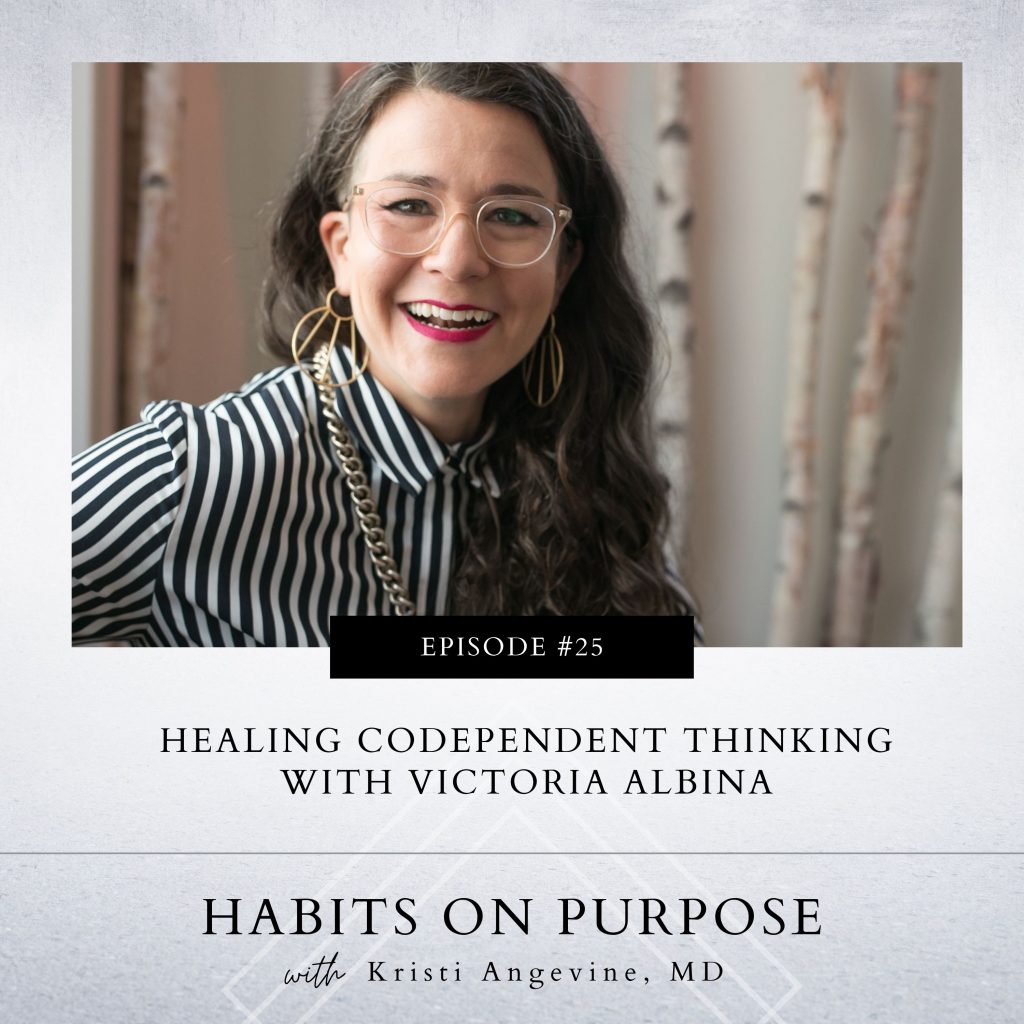
I’m so excited to kick off a series of summer interviews this week! My goal for this series is to have amazing conversations with experts in various fields, and today, you’re hearing from the one and only Victoria Albina: an expert in helping people socialized as women break free from codependent, perfectionist, and people-pleasing thought habits.
Victoria is a Master Certified life coach, UCSF trained Family Nurse Practitioner, breathwork meditation guide, and host of the Feminist Wellness podcast. Her passion lies in helping women realize they are their own best healers, and she’s here today to give us a masterclass on healing codependent thinking through the lens of somatic work, Internal Family Systems, and our nervous systems.
Join Victoria and I this week as we explore what codependent thinking means and how it might be showing up for you in your everyday. We’re diving into how so many of us are chronically disconnected from ourselves, Victoria’s favorite somatic techniques for calming your nervous system and dropping into your body, and what it means to reclaim your body.
Enrollment for the current round of Habits on Purpose for Physicians (HOPP) CME Small Group Coaching Program is closed. If you’re a female physician who wants to better understand your habits and learn to apply pragmatic tools to create new ones, click this link to learn about the program and click here to sign up for the waitlist for the next round.
What you'll learn from this episode:
- What codependent thinking means, and how codependent thinking comes up for Victoria’s clients.
- Where perfectionism and people-pleasing intersect with codependency.
- Victoria’s take on somatic practices, and how they fit into her coaching work.
- Why we’re so reluctant to slow down and feel our emotions.
- The intersection of our thoughts and our socialization.
- Why it’s vital for us to be in conversation with our bodily sensations.
- The reason thoughts that aren’t serving you seem to keep coming back.
- Victoria’s favorite techniques for connecting in somatically.
Listen to the Full Episode:
Featured on the Show:
- Follow me on Instagram!
- Click here to join the mailing list.
- Enrollment for the current round of Habits on Purpose for Physicians (HOPP) CME Small Group Coaching Program is closed. If you’re a female physician who wants to better understand your habits and learn to apply pragmatic tools to create new ones, click this link to learn about the program and click here to sign up for the waitlist for the next round.
- Join the Habits on Purpose Facebook group!
- Click here to send me any questions that you would like addressed on the podcast!
- Victoria Albina: Website | Instagram | Facebook | Podcast
- Check out Victoria’s six-month coaching program, Anchored!
- Grab Victoria’s suite of free meditations and nervous system orienting exercises!
- Get on the waitlist for Victoria’s Somatic Advanced Certification!
- Dick Schwartz – Internal Family Systems
- Molecules of Emotion by Candace Pert
- Jane Clapp
- Susan McConnell
Full Episode Transcript:
Welcome to Episode 25. This is Kristi and I'm so excited to tell you that today is the start of a series of summer interviews where I get to have some amazing conversations with experts in several different fields.
In this episode, you'll hear from the lovely Victoria Albina. Victoria is a Master Certified Life Coach, a University of California San Francisco trained Family Nurse Practitioner, and breathwork meditation guide. She has a passion for helping women realize that they are their own best healers, and she works with her clients to help them break free from codependency, perfectionism and people pleasing.
She's also the host of the Feminist Wellness podcast, which you should totally go check out after you listen to this episode. And, she holds a Master's Degree in Public Health from Boston University School of Public Health and a Bachelor's in Latin American Studies from Oberlin College.
Listen in as we talk about a whole range of topics from somatic practices, the connection between perfectionism and codependence, how to be in conversation with and more connected to your emotions in your body, and so much more.
Welcome to Habits On Purpose, a podcast for high-achieving women who want to create lifelong habits and feel as good on the inside as they look on paper. You'll get practical strategies for mindset shifts that will help you finally understand the root causes of why you think, feel, and act as you do so you can learn to create habits that give more than they take. And now, here's your host physician and Master Certified Life Coach Kristi Angevine.
Kristi Angevine: Hello, everybody. I am so tickled to bring to you another Summer 2022 interview and this time, we have the pleasure of having a conversation with the lovely, the one and only, Victoria Albina.
Those of you who do not follow Victoria Albina yet, by the end of this conversation you will want to, and we'll tell you how you can find her. Basically, she is a nurse practitioner who does a lot of work with codependency, perfectionism, people pleasing, from a perspective with a lot of thought work meeting somatics. We'll let her talk about all of those things. She is the host of the Feminist Wellness podcast. So, Victoria, welcome to the Habits On Purpose podcast.
Victoria Albina: Hi, thank you so much for having me. I'm delighted to be here.
Kristi: So, why don't you share with our listeners, just for a moment, so they can get a sense of where in the world you are. Like, from your view right now? What is it that you can see? Besides me.
Victoria: Besides you. Mostly you, honestly. But all sorts of beautiful trees, and my garden and all the tomatoes looking out plump and delicious. And, hopefully I'll get some of the strawberries before the bunnies. But honestly, who am I to take strawberries from bunnies? I feel like if I tend to them and just get those bunnies a delicious summer treat; if I get one, I'll be happy. You know what I mean?
Kristi: Absolutely. We have donated a lot of our seedlings to the beautiful chipmunks and ground squirrels that live here in Central Oregon. So, yes, I can totally relate. And you know, we are speaking, and I'm in Oregon and you are in New York, so we are on opposite sides of this lovely country. And, what I would love for you to do, for those who have not heard of you, is could you just give a brief introduction of who you are and what you do.
Victoria: Yeah, so my name, again, is Victoria Albina. I use she/her pronouns. I live on occupied Munsee-Lenape territory, in the Hudson Valley of New York State, having fled Brooklyn during the pandemic, as so many of us did. I am a UCSF trained Functional Medicine Nurse Practitioner. My previous specialty was Functional GI, gastroenterology.
I am a Master Certified Life Coach through the Life Coach School, and I'm trained in Somatics through the Sensorimotor Psychotherapy Institute as a coach. My passion, as you said, is helping humans socialized as women to overcome codependency, perfectionism, and people pleasing.
Kristi: That is amazing. I love it. I wish you could... I feel like there's like starbursts shooting out from you, right now. Like, “Ta-da!” Alright, so, for those of you who are listening, I know many of you can relate to people pleasing and perfectionism. So, Victoria, one of the things that I suspect some of my listeners might not quite understand is codependency. And so, just for those who when they hear that they think, “Oh, not me. Number one, I don't understand. Number two, if I do understand it's definitely not me.” Can you define it for them?
Victoria: With immense joy, because I think there's so much confusion around this term that pigeonholes it into being ‘those other people’, and keeps folks, who could really benefit from some support around this way of thinking, from getting the help they deserve.
So, I define codependent thinking as chronically outsourcing our sense of wealth, of wellness, but I guess wealth, too; wellness, worth, and value to everyone and everything outside of ourselves, instead of looking inside and knowing that we are vital and important from that internal authority.
It's a framework for living, it's not an identity or an identification, in my way of moving through the world. I don't think that serves us, to label ourselves. But it's a set of thought habits and somatic experiences that keep us stuck wanting other people to validate us, so that we can feel worthy of love. It says, “I'm not okay, if you're not okay. And I'm not okay, if you don't think I'm okay. And tell me I'm okay in the exact way I need you to, without my telling you.”
Kristi: I love how you define that, because it's such an easy way to relate to, in ways that I think we can miss. So, I'm curious, do you see that in your clients? Like, where they have this sort of, if we're going to call it like a collection of thoughts and feelings, that we could put under the umbrella term as some ‘codependent flavored’ thoughts, and feelings, and beliefs. Do you see them missing it? It's so integrated into how they have lived that they don't see it?
Victoria: Yeah, absolutely. I think, largely, because if we think about children, and how we develop a sense of identity and the development of our nervous system, it largely happens at ages zero to seven, when our brains are in theta state. We're these little sponges taking in programming. And so, we take in what's modeled for us by our parents, what's either implicitly or explicitly taught to us. And we turn that into our identity, the blueprint for living, the story about ‘how I should be’ and ‘what makes me worthy.’
Because remember, we're the only species that's boring, completely useless. I say that with love to any listeners who are newborns. I don't mean to be disrespectful to you, but kid, what are you up to? Like, you need grownups or you can't get by.
So, kids are so smart. And they say, “Oh, my parents interact in this way. That must be the right way.” Right? So, when codependent, perfectionist, and people pleasing living is modeled in the home, of course, we take it on. And of course, it becomes normal, not just for our minds, but for our bodies, our nervous system, and our inner children.
So yeah, it's the soup we’re swimming in. It's really hard to see. I also think that there's this thing that happens in the cultural milieu, where codependency is seen as this label, and people don't want to take on labels because like, that sucks, right? And it's seen as really being within that paradigm of the enabling wife of the alcoholic man. That's how people often think about it. Sure, that can be part of the story, but I don't think it's the entirety of it.
Kristi: Oh, absolutely not. I love that you touched on the fact that sometimes, when we attach a label to something in a pathologizing way, or a syndromic way, and we see it only through the narrowest of ways… it's, you know, the enabler of the abusive partner, who's typically white, an alcoholic, and male.
When we only see that, then we miss all the more subtle, nuanced manifestations of it. Just because we just assumed that that's not us. And nobody wants to be labeled because, especially in the way our current psychiatric and psychological paradigms, are the ideas that the labels are problems,
Victoria: And, that they're permanent. Kristi: Yeah, they're fixed. And, they're definitely an indictment on you as a person, not just some thoughts and some feelings that you may have largely learned.
Victoria: It's a huge part of my work; is helping people to see that there is, to borrow a term from Internal Family Systems, Dick Schwartz's work, there's a protector part inside that is keeping us acting in the way we always have. Because, science, right? Because that's what nervous systems do. They reenact the past in an attempt to, hopefully, have it come out differently, result differently, this time.
But we're doing the same thing. And, we're projecting our old attachment, to our childhood attachment figures, onto new people and new situations. So, I spend so many beautiful hours, every single week, with my clients, helping them to drop the shame, the blame, the guilt that comes with having these thought habits. Because for the past 30, 40, 50 years before they came to me, they didn't see them as thought habits. Like you said, it's like, “Aw, man, I'm broken.”
Kristi: Yeah, so I love you have that container in which they can so safely explore. And, I love that you referenced Dick Schwartz and, I was about to say, internal family medicine because I was thinking… [crosstalk].
So, when we're talking about this alternate, and much more comprehensive view of codependence, can you talk a little bit about where you see perfectionism interacting with, or showing up, or intersecting with codependence?
Victoria: It makes perfect sense. If your story, within your nervous, is, “I must be what other people want me to be, in order to be safe. I need them to be okay, in order to be safe. They need to approve of me, in order to be safe,” then, it's absolute genius to want to be perfect. Because then, if you're infallible, you’re infallible, right?
You're not going to upset anyone, if you do it perfectly. No one's going to be mad at you. No one's going to tell you you're not worthy. No one is going to say anything or raise an eyebrow. Because often, we're hyper-vigilant to facial cues, body language. No one is going to, in any way, imply that there could ever be something wrong with you, if you strive to be perfect. And therefore, it won't validate that internal story we carry around that says, “I have to be perfect or I'm worthless.”
Kristi: Everybody listening; if you can see how this can show up, just in your day-to-day? Maybe with an expression that comes across your kid's face or your partner face, or one of your colleagues at work. How those subtle signs that, “Maybe I'm not doing it as well as I should. I should do better.” How those things can very much fall into that story of perfectionism. That can so deeply relate to, “I'm not okay, if you're not okay. And I'm not okay, if you're not thinking that I'm okay.” It’s a cycle.
Victoria: Yeah, absolutely. And I'd say people pleasing is part and parcel of that, as well. For sure. Because within that, we need to keep all the people pleased at all times, once again, lest they think anything other than you are perfect. Because if they don't like everything we are doing, if they are displeased, then we are unsafe in our bodies. We are unsafe emotionally.
And again, you know, I think it bears repeating and repeating and repeating; if you're listening, and this is resonating for you, there's nothing wrong with you. You're not broken. It's not your fault. These are really understandable ways of relating to the world, when you learned that this was how you're supposed to relate to the world. Like, how else are you going to do it? How else?
Kristi: It's just so fortunate that we can, from an older state, actually look back and go, “Oh. This is how this makes such beautiful sense. This is what I learned from my caregivers, with their best intentions possible, at the time. This is maybe, just how I learned. And these are the messages I'm getting from the current society, in which I live. This is what I inherited from my training.” So, it makes beautiful sense.
And yet now, I like to paint that glimmer of hope for those listening, number one, you're not broken. And number two, once we have that realization of how beautifully things make sense, we realize we actually do have agency over understanding our thoughts. Understanding our emotions in a new way, that wasn’t available to us between the ages of zero and seven, but is available now. That is such the world. Number one, you make sense; you're not broken. And number two, now, what do we do about it? Right?
Victoria: Yeah, absolutely. I'd also love to take this opportunity, because I'll take the slightest opportunity to throw the patriarchy all the way under the bus, so... Oh, I shall, thank you.
Kristi: In case you needed some fireworks to go with that, I will happily supply them.
Victoria: So, white settler colonialism, the patriarchy, misogyny, late-stage capitalism, these oppressive systems, that do oppress different bodies in different ways and to different levels, they really benefit when, humans socialized as women, are detached from our bodies, detached from our emotions. When we're playing out the stories we've been told about what it means to be a good girl, a good mother, a good wife.
When we continue to play that out, again, not blaming or shaming the woman herself, but the systems that lead us to believe there's this one way to prove our lovability, to gain our lovability, as though it was something we had to work for. Which, I know, neither of us believe, right?
And, you know, the patriarchy hurts humans of all genders. Because boys are taught not to have feelings as well, not to express them, to hold in their anger. And we are seeing, played out writ large in this nation, how that's working out for us, vis-à-vis school shootings, right? That folks, socialized as boys and men, are not getting the care they need for their mental health. It hurts us all.
Kristi: Yes, it 100% hurts us all. I think this is the perfect opportunity to pivot to the somatic aspect of the work that you do. Because I think, when we are socialized in the way that we are, and there's a really specific advantage to live in our heads, be very analytical, be very hyper vigilant. Many of my listeners are physicians or high achievers, and their vocation is in fields where it really serves them well to be highly detail-oriented and very attuned to other people around them.
And when we have that experience, which works very well to a certain extent, to be all in our heads, it relates to all the things you just said, we can miss out on some of the other aspects of our experience. And so, one of the things that I think we both teach, is that emotions are things that we experience in our bodies. And even if we don't consciously acknowledge that we're having them, physiologically they are having an impact.
They are going on in our experience, whether or not we shine the spotlight on them. I don't exactly remember where I heard you say this, but at some point in time, I heard you say something like, embodiment is medicine. It's in the embodiment...
So, for the listeners out there who are quite in your heads, embodiment, meaning, and Victoria can speak too, the idea of being very much in tune with your physical body and not just in your cerebral mind. Actually, having like, not only just an awareness, but an appreciation of that. Can you elaborate a little bit on how… What you see the field of somatics to be, and how it fits in with the coaching that you do?
Victoria: Just to speak to the embodiment piece, because I know your listeners are nerdy, nerdy nerds, which is a compliment, it's the greatest compliment. What we're talking about is enteroception. So, we, most of us have a connection with exteroception, our nervous system is picking up clues and cues from the outside world, and we're making sense of them.
But enteroception, within ception, right? We get that; we're nerds. The knowing of; that's what we lose touch with. So, when you're like, is this evidence based? It is the most. It's sort of anatomy 101, polyvagal theory 101, the vagus nerve 101, which we all learned in A&P before we even got into our clinical training programs. We just forget it along the way.
Particularly because medical training, even for NP’s, demands that we detach from ourselves. To be able to see 4,000 patients in a day, and also to be able to see truly terrible things, and to hold space for the horrors of the human condition. To be able to be functional and write the prescription and chart about it. You know?
So, to go back to your question. Somatics comes from the Greek word “soma,” meaning body. It’s the study of the human body. A translation I recently heard of soma is: The body in its wholeness. My goodness, did I love that. Isn't that so…? Because, it really is that return to a connection with ourself and our wholeness. The entirety of our felt experience, not just extero, but enteroception, having a connection with and an understanding of the felt somatic experience of being alive.
We all have this. It's a mandatory part of being an animal, like you said, we just get shut down to it. So, who hasn't had butterflies in their tummy? Who hasn't felt really stressed and been like, “Oh, I have this wicked headache.” Sorry, that's a hella headache, for the West Coast, just wanted to translate there. But we sort of stop there, and we take an Advil™ and we turn it off, instead of getting into a conversation with our body, with our spirit, with the energetics within ourselves.
Again, to speak to the evidence-based, because I think that's really, really particularly important here. Let's think about biochemistry and what Candace Pert calls the “molecules of emotion.” Every time you have a thought, and have a feeling and response, triggered, of course, by your nervous system, molecules, or at least biochemicals are released, right?
You're getting serotonin, dopamine, you're getting endorphins, you're getting oxytocin, I'm getting oxytocin from looking at you. I'm coregulated, I feel love, I feel connection, and love talking with fellow coaches. And so, that's happening in our bodies, regardless of whether we connect. So, when we do take the time to connect in with our bodies, and to open up that line of conversation, we benefit so greatly from the wisdom; the intelligence, the brilliance that lives within the body, that can help us to see where our energy is getting stuck, where we are out of connection.
From there, and having held space for that, what we need to shift and change in our internal conversation, so that we can move forward unencumbered by those old stories we lead ages zero to seven. Because the body, the nervous system, will continue to reenact old situations trying to get a new ending. Whether you step… You know, it's just going to do it.
So, you have two options: You can step in and intervene on your own best behalf; be your own self-advocate, with yourself. Or, continue to reenact, which is really painful and unnecessary.
Kristi: I was just about to say that; reenactments. It's just, it's so painful.
Victoria: It sucks! It's the worst. I mean, genocide’s worse, but it's pretty bad. It's like in the top ten worst things?
Kristi: Yeah, it's pretty bad. So, for the listener out there, who is… Who I can so relate to, who feels like they're walking… Like they’re a brain without a body. They're so great at analysis. They're so great. Many of my listeners are life coaches, school trained coaches, who were drawn towards the coaching because of the T-line; they love the thought work. They’re like, “Well, if I can just change my thoughts, then I can change it all. Just skip over that little F-line,” right?
For those people, who are like, “Okay, so, somatics sounds intellectually kind of interesting. But what the heck are you talking about? Like, feeling something in my body?” I have my thing that I say, but what would you say to the person who's just like, “What do you mean, feel it in my body? Experience it differently, have a different relationship to the butterflies in my stomach, like, what are you talking about?”
Victoria: So, if you pause, and you talk to that sensation in your body. If you get in contact with it, and you start by saying ‘hello’ to it. If you start by letting it know that today, you are going to be its friend and not its foe, then you can actually open up a conversation with it, instead of buffering against it.
Because, that's what so many of us do. We don't realize we're buffering. For folks who don't know that, who aren't coaches, who don't know the term ‘buffering’, is when we turn away from an emotion instead of being present with it, by whatever means we have available; it can be overexercising, overeating, overdrinking, Netflix, etc. And buffering can be the act of saying, “Oh, I have butterflies in my belly, but back to the to-do list.” So, we just gloss over the felt experience of being a human.
But when we turn towards it, and we get into conversation, and we'd say, “Belly, what's up? What do you need? What can you teach me? What's going on?” Then, let's say it's anxiety; then, instead of just experiencing that anxiety, believing it, the whatever story it's telling, and repeating that T-line, that thought line over and over and over again, we can start to change the relationship from the location of the body, from the felt experience of being alive.
What this does, I'm going to back it up to the science once more, because let me introduce the concept of what the literature calls the “window of tolerance”. Which is, how much input the nervous system can take in, can tolerate, before we leave ventral vagal, which is the safe and social, calm, connected part of the nervous system.
Where thyroid function, digestive function, heart-lung function, reproductive function, all of that is buzzing along. Cognitive function is at its best. Our mood is optimal, for whatever that means for you. You're able to have conversation. You're able to ID. You're able to do the things you want to do in the world.
Let's say you're driving on I-95; never a good idea. And, somebody cuts in front of you. The first guy cuts in front of you, right? Yeah, I-95, just skip that somehow; using magic, I guess. Because you're in Massachusetts, let's be real. The first masshole drives in front of you and cuts you off, and you're like, “Rude,” and you feel a little quick zoom of energy, a little zap in your belly. That's called sympathetic activation; fight-or-flight, led by adrenaline, norepinephrine, eventually, cortisol. Your body's saying, “Watch out kitten, you're in danger.”
Then, the second car, zoom, cuts you off. You feel another surge of adrenaline, another fight-or-flight moment, but your nervous system is fine. You can come back into balance and you can keep driving safely, you can keep up a conversation. Then, the third car, and the fourth, and by the fifth, you roll down your window; you're shaking your fist, you're screaming, you're slamming on the horn.
You're in full-on fight-or-flight, flooded with adrenaline, which is horrible for your organs, BT dubs, and your blood vessels, etc. Your body goes into that state of full-on fight-or-flight where you're just freaking out. And, it was the fifth car that exceeded your window of tolerance in your nervous system.
Now, I don't like to encourage my clients, or anyone on the planet, to tolerate more than what we tolerate. From our codependent thinking, we tolerate a whole lot of BS in the world and just put up with it, and put up with it, and put up with it. So, I prefer to call it our window of capacity, or what my teacher Jane Clapp calls, the “window of bodily dignity.” Isn’t that gorgeous? It's so lovely. So, how much input can your nervous system take and you stay within your dignity, instead of screaming expletives at the car ahead of you, and slamming on the horn and effectively losing it. Right?
And so, every time you get in touch with those butterflies in your belly, and you bring your awareness to them, you connect in with them. You ask your body: What's making you anxious? What do you need for me? Do you need breath? Do you need a little walk? Do you need me to put some ice pack on my chest? What do you need to come towards ventral vagal?
We are expanding our window of capacity or bodily dignity, to be with that stressor. And so, with time, with attention, with love, compassion, curiosity and care, the things that once stressed us out and took us on a zero to ten scale, from zero to forty-seven, they no longer take us to there. They still register as annoying, or irritating, or like an eye roll, right? Or like, “Ugh!”, but it doesn't take us out of ourselves.
So, what somatics do, is it supports us in staying in presence. And there is nothing that I want more in this life than to be present for all the feelings, all the experiences, right?
Kristi: I love how you pointed out that those experiences that you have can still register. It's not like… We're not advocating for any sort of denialism, like, “No, no, no. We're just like this serene robot. Nothing bothers.” It registers. With the way we process, it is such a different, more collaborative way.
For the listeners who are thinking, “Okay, you mean, you want me to have a conversation with my body?” I just want to point out… Yes, so Victoria does; I do, also. We actually do already have a conversation with our emotions. Except, it usually sounds like, “What's my problem that I'm feeling this way? What's their problem in this way? What's wrong with me? I need to just suck it up, buttercup, and keep on moving…”
We do actually have a conversation with our bodily sensations, and our emotions, and our thoughts. We have conversations all the time. But we're not being explicit about them, or as deliberate and intentional about them, as what Victoria is suggesting. What she's suggesting is bringing calm, tons of curiosity, tons of compassion, to the bodily sensations that are so easy to dismiss, ignore and gloss over.
And it requires, I love that you mentioned a pause, it requires… It felt like a mandatory admission fee for doing this work is to be willing to pause.
Victoria: I love that, “a mandatory admission fee.” Yeah.
Kristi: We just go, go, go, go, go. It's so easy to not even notice, and then actively ignore those sensations. Just like, “You know, I haven't peed for twenty hours. So, why would I pay attention to that subtle buzzing in the back of my palate when I can just keep going?”
Victoria: Totally. And I think, you know, you brought up peeing, so here we go. So much of this starts with the social imperative to ignore our biological impulses. Our biological impulses are the things that a mammal needs to do to sustain mammalian life. So, take a nice deep breath, like actually breathe and not just that shallow, top of the lung breathing. Pee, drink water, eat when you're hungry, rest when you're tired, put your feet up on the wall, burp, pass gas.
It often starts at home, right? We're told what's acceptable and not acceptable from a mammal, which is like talking about white settler colonialism and the Victorians; talking about our digestion, talking about our periods. That these things are a problem, that it's not appropriate, it's impolite. We're taught not to burp. We are taught that our animal is something to be reined in, and controlled, and negated.
When we fast forward into adulthood… When we look at the rates of UTIs, and woman physicians, NPs, RNs, all the allied health professions are like, “Yo, we don't pee, if we even drink water.”
Kristi: Yeah, the basics are definitely sadly missing, in terms of the fundamentals of self-care, when you go into certain fields. The expectation is sort of like, ignore myself. Basically, for the goal of being altruistic, and patient comes first, or whatever that sounds like for whatever your field is, right? It’s not just the clinical fields, right?
Victoria: Right. Of course. Yeah. Teachers, too, and entrepreneurs. All our fellow coaches, we're like, “You know, peeing is not on my Monday, hour one, so I'm just going to not do it. I'm just going to make that real or post that thing,” and negate the animal.
Kristi: So, you brought up something, when you gave the example of the driving and the road rage that happens. What that makes me think of is, I've heard in some of our in our coaching circles and I think you've talked about this before, when our limbic system… When we have, some people will call it their amygdala hijack, when their limbic system goes into fight-or-flight or freeze-or-fun, the response seems so intense and out of, not all of us, potentially out of proportion to what we intellectually see is going on.
A classic situation: Somebody is at work, and somebody tells them, “Patient so-and-so is on the line, and they're really upset,” and they, clients of mine, will just either freeze, or they will just feel mortified and their whole day will go to shit with anxiety, and catastrophizing, and all the stress, and enmeshment. Intellectually, they're like, “Okay, I get this isn't a big deal.” But physically, emotionally, all the things, it is a big deal.
I've heard you talk specifically, about how our socialization and the thoughts that we feed our limbic system, very much shape how those responses can come out. Can you talk to that a little bit? About the intersection between our thoughts and our socialization, and those really intense responses that, we intellectually get, are out of proportion, and yet they recur?
Victoria: I think it comes down to, if we really boil it down, it comes to safety. So, what do human mammals want? We want… Our subconscious mind wants to two things; it's all it cares about. Significance and belonging. “I matter to you. We're part of the same collective.” And that's the Ouroboros, it's the snake eating its head. It's the endless circle, connection, and belonging.
The reason that that's the primary human imperative, is because that's how we've always sourced safety back in the day. And so, if you think about the limbic system, my goodness, is that an evolutionarily ancient part of the human mammal, and it evolved in a time where we lived in these small clusters. Way even before there were villages, it was just your teeny tiny community.
You had to have each other's backs because there were lions, and tigers, and bears, oh, my. I'm sorry; I couldn't help myself. But really, there were very large predators, and there were very small ones. There were spiders, and snakes, and crawly things that we had to keep an eye on. And, we had to do it for each other because we are very small. And, bears is very big; bears is very, very big. There was a 600-pounder walking down my road, not that long ago. Isn’t that wild? 600 pounds! It’s a very much bear.
I mean, to say that I am souvenir size in the height department, is an over exaggeration of how tall I am. I am not fighting no kind of bear. Right? So, I need to sleep with your back against mine. So, that one of us is always looking at the horizon for impending doom. We are set to be hyper vigilant to doom. And so, that's the limbic system. It's always wondering, what's going to murder me next?
If we flash forward to the thoughts we have that keep this painful cycle going, when our brains are set to codependent thinking… I loved the way you called it a “codependent flavor” of thinking. I've never said that. I say ridiculous things, so it's really, truly surprising. So, thank you.
We are constantly searching for things that disprove our worth. That show us we're not worthy of love. Because at our core, what we fear is that we are not worthy of connection and significance, and that they will be taken away from us at any moment.
Often, because we grew up either with immature parents or emotionally immature parents. Parents or caregivers who weren’t attuned to us, which really could just be a generational thing. For those of us raised by boomers or folks older than that, they just didn't get it.
If our parents were absent, or were managing substance use, or were perfectionists who were killing it at their own careers and weren't around for us in the way we needed as kiddos. Parents who demanded, “If it’s not an A+, gold star, big gold trophy,” then like, “Oh, wow. But your sister got an A+. Cool.”
So, all these, whatever your flavor of that narrative is, it keeps us walking on eggshells, emotionally. And then, we back that up with these stories, “I'm not worthy of love.” That is… I like to think about our limbic system of having a series of cassette tapes, because I'm going to proudly claim my GenX status, and I love a good cassette tape, right? Come on, now.
Kristi: I love your use... I heard that on one of your podcast episodes; the cassette tape of the limbic system. I’m completely going to use that. It’s beautiful.
Victoria: Go for it. It's so good, right? And the beauty of it, for those of you who are like, “What's a cassette tape?” It's a form of music that's easily rewritten, right? It's like so easy. You press two buttons, record and play, at the same time, and then you just write over it.
But until we learn tools, like thought work and somatics, and I also use a lot of breath work in my practice, we'll keep playing that same old tape that says, “I'm not worthy of love. The lions are coming. The marauders are coming. No one likes me. No one loves me. I don't belong. Death and doom is nigh.”
Kristi: Yeah, exactly. For those listeners who really love the self-coaching model, and they can see how their thoughts relate to the results, what Victoria is saying is basically: When the core belief, at its essence, a thought that you believe so deeply is, “I'm not worthy, and things are dangerous,” that thought will go and prove itself to be true simply because of repetition.
And yet, it's not fixed. It is malleable. It is open to questioning. And, what Victoria is showing is that there's more than one way to get to the questioning and opening. To see how old stories, old cassette recordings sort of old [inaudible] narratives can be modified in a way that serves you better today. Without flirting with denialism. And, without “should-ing” all over yourself, and saying, “Well, I should just be able to handle this better.” But in a really open, calm, curious way.
Victoria: That's what bringing in the internal family systems work protector parts, bringing in inner child and re-parenting work does. Is that it helps you to really clearly see; my adult self is living from these cassette tapes. And it's actually these inner children that are pressing play. They’re like the DJs of our adult experience. Like, we're at a rave, called life, and the inner children are the DJs and they're passing the baton back-and-forth.
It's your scared four-year-old, it's your obstinate eight-year-old, it's your apathetic fourteen-year-old. All these inner children are just sending different stories into your consciousness, into your cognitive mind, and/or, usually both, into your body.
I think this is important to say, because again, for our nerdy nerds, when we're talking about feelings being sort of trapped in your body, I'm not saying there's sadness in the lower lobe of your left lung. What I'm saying is, I'm referring to tension patterns.
And so, I want to invite you to really bring your awareness into the ways that you hold your body in different moments: What's happening in your jaw. What's happening in your shoulders? Are your shoulders up by your ears? Is your diaphragmatic excursion what it needs to be, meaning, are you breathing shallowly or deeply?
Kristi: Absolutely. I think, for those listeners who are quite used to and have gotten insidiously accustomed to a very hustley existence, that doesn't even feel like a hustle, the idea of slowing down, actually attuned to these things, might make… I'm just going to speak to them directly. It might make you bristle and want to be like, “Hell, no. I need to put this podcast on 2x and listen to it fast, while I get another cup of coffee. And maybe, I can chart while I do this.”
So, I would say, I don't want speak for Victoria, but I have imagined that she also understands that initial reluctance to slow down when you've never done it before, “I haven't been taught how to do it.”
Victoria: Well, it's horrifying to the nervous system as a concept. Because remember, whatever was safe because it's what was modeled for you, and it's what has not murdered you yet... Because remember, the nervous system is all about; can we disprove the null hypothesis that change will murder us? I doubt it.
So yeah, your body's like, “Yo, hustling? I've been hustling since I was four. I'm not stopping. Stopping that was a terrifying idea.” To be real, it's one of the things that I work with my clients on every single day in Anchored. We enjoy peace, calm, happiness, even moderately not annoyed, in the pit of despair. That's terrifying to a nervous system that's not experienced it in 20, 30, 40, 50 years.
I just gave someone the homework to go play yesterday, and she looked at me like I had 4,000 arms growing from my forehead. She was like, “Can you want what? Wait.” Play.
Kristi: Yeah, I'm going to need you to write that down with all the steps, and then also show me the evidence for why that makes any sense, because I'm pretty sure you may have just [crosstalk]. Just being honest. Yeah, years ago, I would be like, “I'm pretty sure that makes no sense at all, Victoria.”
Victoria: And, that makes sense. And yet.
Kristi: And, yet, it makes sense that it doesn’t makes sense.
Victoria: Of course. To return to the human biological imperative, one of them is never ever, ever, ever, ever change. And so, we need to really have that at top of mind when we're doing somatic and nervous system work. And I'd say, thought work, as well. To start with thought work, how many of us, and I do want to invite you to raise your little hand if it's safe to do so, but how many of us have thought worked the same goddamn thing 273,000 times? Only to have that same thought…
Kristi: I love that you brought this up.
Victoria: The thought comes back. The thought comes back, an iteration of the thought; or worse, an iteration of the thought. The thought is like, you know that kid’s song, “The cat came back… the very next day…” God, I loved that, when I was eight. It's so annoying, but we say it endlessly. But it comes back, and it comes back, and it comes back.
Because when we're seeking to exercise, without addressing the somatic or nervous system, or resonance of that thought, again, that tension pattern in the body will hold. And it'll hold on for dear goddamn life, until you can be in conversation with it. Until you can bring either movement or stillness to it, whatever it may need. Until you can give it the time and the space to release, in order to come to its own resolution. Did that make sense?
Kristi: No. It made sense to me.
Victoria: Yeah. But you're my kind of nerd. Nerds of a feather.
Kristi: It made sense to me, and I imagine it made sense to my listeners. I mean, I almost don't have anything to add. The only thing I would think to say is to the listener who instantly bristles and really doesn't understand that fully. When you're looking at thoughts that can come back, the reason they keep coming back…
What I teach is that until we understand why they're there, intellectually… Create a little model and write down, “Oh, this thought creates this feeling. It does all this stuff. And so, I'll just think a new thought. I'll do this.” That will keep us on the surface, because we won't really deeply understand what part of us that thought is coming from; to which part does that thought make sense?
If we don't fully understand it, like how we feel it in our body or why it's there in the first place, it's sure as hell, going to just come back. Because it’s like, “We didn't fully get to know each other. So, I'm just going to come back in this other situation, in a different iteration. But it's still me, like in a costume.” Same thought, different costume. Many listeners will be like, “Well, but what's...”
So, this brings me to something I did want to talk to you about. Many of my clients will use this work against themselves. They will say things like, “Well, I understand it's just my thoughts. And I really understand this thought. I've gotten to know it, and yet it comes back. There's something, I must be doing that work wrong. I must not be doing somatics right. I should already… I understand these things, I'm a doctor, I'm a lawyer, I'm a teacher, I'm smart. Why? What's wrong with me that it’s continuing to come back?”
Victoria: It's not about smart. Smart’s the thing that got us here, that got us to live from the neck up. I'm not trying to say smart’s the problem, but maybe I am. That overreliance on smarts, that is the thing that keeps us out of connection with the body. So, it's about dropping the smarts at the door, and being willing to get in touch with the feelings in our body. And, to give them space to work it out. Yeah.
Kristi: What I will hear a lot of times, is people who are unfamiliar with the working with their body part, when it comes to things like overthinking and catastrophizing. They will be like, “Well, those things, those smarts that got me here, number one, is just dangerous to stop them. And when I'm overthinking it, when I'm catastrophizing, I'm seeing all the potential dangers, and therefore I can prepare for them. And if I can prepare for them, then I'll be safe.” It's like the loop of, let me just continue the overthinking. What is your take on that?
Victoria: What I will say, is that you are exhausting yourself when you do that. And, you're not actually preparing for or preventing any darn thing. Now, come on. Your gal is a Nurse Practitioner; I am practical to the deepest core of my animal. We prepare for life, right? We do future planning in a smart way, right? Like, I put money in retirement. I'm not sick…
Because people will conflate this. “If I'm supposed to be really present. How do I plan for the future?” No one's out here saying don't plan for the future. But what I'm saying, is when you spend this present moment, rolling around in every potential catastrophic outcome, that is statistically unlikely come to pass, you are wasting this one precious moment; which is the only moment that you are promised in this life.
So, you get to make a choice: Do I want to spend now enjoying now? Learning how to be present for now? Connecting in with life, with the world, looking at a flower out your window? Or, do you want to spend this moment worrying about an improbable possibility?
It's funny, you bring this up today. So, I moved over the weekend. My partner went to a thing in Boston last weekend, and came home with COVID. Luckily, I didn't see them. They stayed in the car and tested, and were like, “I have the COVID,” so they didn't come home. I’m fine. It means that I was home alone for these two nights, in this big house full of boxes.
I got into bed, and I didn't set the… I live in a place where nobody needs an alarm system. But after so long in Brooklyn, what I’ll say is, my brain is like, “Yo, you should have an alarm.” I couldn't get it set up. So, anyway, I'm lying in bed and my brain is offering me the 6 million thousand kajillion ways that someone's going to break into the house and murderate me, in horrifying Hollywood level ways. Which are statistically not… Come on, a chipmunk is probably more likely to get in here, you know?
And so, I lay there and I thought to myself, “I have two options. If I'm going to get murderated in the night, I can either go into it as rested as possible. Or, I can lie awake and contemplate the many ways, while flooding my body with adrenaline and cortisol, thus down regulating my thyroid function.”
I'm looking for some nice T3-T4 conversion over here, to give me some energy, while messing up my digestion. While messing up my period, and my reproductive function. Collagen overturn… All those expensive creams I put on my face before bed, and then, I'm effectively ruining them by lying in bed soaked in cortisol of my own creation. When you look at the list of what sympathetic activation does to a mammal, it's not a great choice for wellness, for longevity.
So, we think if we prepare for all the things, we're going to save ourselves from, it's actually doing us this huge physiologic disservice.
Kristi: Totally. Yeah, the irony of wanting to prepare.
Victoria: The irony, right! So, I decided if I'm going to get murdered, I'd like to have some nice sleep before. Let me just get… Why not? Why not go into it rested? At least, if it's going to happen… Just to fill folks in, I did not get murderated last night, which is really… In case folks are wondering if you're having conversation with a ghost, at least as far as I know. I guess I don't have proof positive.
Kristi: I love it that this brings up that idea of the all-or-nothing thinking. It goes with it. Just the idea that; either I can prepare and catastrophize, and I do that. Or, I just go belly up and I just leave all the doors open, because if they’re going to come in and murder me, I might as well just make it easier.
When really, there's so many things in between.
Victoria: I went and locked the garage.
Kristi: I can lock the door. I can do some things, in between. And, the in between, that gray zone, for many of us, can feel… It's just as wildly uncomfortable as play, and rest, and leisure, and relaxation, when you have not practiced the gray zone.
Victoria: Well, limbic systems are black-and-white machines. They're all-or-nothing machines, because they have to be able to say, “Tabby cat. Lion. Stick in the grass. Cobra. That is a venomous Viper. And, that's fine. The red berry of doom, or just a strawberry that I cultivate for bunnies.” Right? Our limbic system needs to know that, but it doesn't mean that adult us, like you said, has no other options.
Kristi: Yeah, I think this is, I mean, this whole conversation speaks to the vast importance of redesigning our relationship with our bodies, in a way that serves us where we're not completely denying how our body is. And we're also, not just kowtowing and pandering to the alarm system when it goes off. But, we're being present in a way where we can decide on purpose. How do I want this relationship to go? What do I want to make these feelings mean? How do I want to explore them in a way that actually allows real exploration, not just sort of cursory… That was anxiety, let's move on to a new model.”
Victoria: Exactly. And I'd be happy to share some, I know you're a practical gal, too, some techniques that folks could use to connect in somatically.
Kristi: You are reading my mind, this is perfect. Because I like to give my listeners something actionable and concrete that they can sink their teeth into. Even if they're new to this, this is something that is accessible. If you've got something, that would be amazing.
Victoria: With great delight. So, the following two techniques, and I'll offer two because not everything works for every body, can be done either for sympathetic activation, which is that fight-or-flight, that adrenalized state, to calm us down. Or, if we're feeling checked out, we can't connect with motivation, we're feeling a little low, a little out of it, just a little frozen, we've gotten overwhelmed.
There's the overwhelm of sympathetic, which is, “Okay, there's way too much to do. I got to do all the things. Let me run around like a chicken with my head cut off.” And, there's the overwhelm of dorsal which is, “What? Wait, where am I? Oh, I'm at work. Okay. Was I supposed to do…? I don't know anything.” That kind of glazed over, deer-in-the-headlights, possum playing possum, frozen. So, dorsal is called freeze, the freeze state. And, those are the two extremes of the nervous system response and polyvagal.
There's a time and a place where we want to bring ourselves back into ventral vagal; the calm, connected, collected part of it. Which is what I did for myself last night in bed. I did some somatic practices, as well as thought work to change the story, right? So, I changed my tea from, “I need to sit here and ruminate,” to, “I might as well get some sleep if life is uncertain, and this is going to happen anyway.”
The first practice is to take your thumb and all your fingers, and if you don't have the ability to move your hands, that's totally fine, you can picture hands in your mind. If you can visualize hands, you can adapt this to your physical capacity. So, I take my thumb and I tap it to my first finger. If I am feeling revved up and sympathetic, I want to do this…
Actually, let me start with dorsal. If I'm feeling shut down, checked out, frozen, and I want to bring in a little get-up-and-go, bring in a little motion and energy, that helps me to do life; I'll do it quickly. So, I'll tap my thumb to my first finger and say “one”. Thumb to New York finger, “two”. Ring finger, “three”. Pinky, “four”. And then, come back from your pinky, 4-3-2-1-1-2-3-4. You just keep going and going and going and you feel it. Can you feel how it kind of like revs you up a little bit?
Kristi: If you guys could see us right now, Victoria and I are doing our little fingers.
Victoria: Right on. So then, if you're feeling that revved up, and you'll see, of course, why I wanted to do this second, so I don't leave people revved up. You do the same thing, but really slow. Thumb to your first finger, “one”. New York finger, “two”. Ring finger, “three”. Pinky, “four”. And then, you'd come back. So, that's a really beautiful one calm down or bring in some get-up-and-go.
The next one, which I absolutely love, is called, This Is My Arm. And, I usually start with my hand. But this is my arm. This is a powerful practice of bodily reclamation, which is a huge part of somatics, because we are so divorced from our physical experience. It's…
Oh, I love this quote from Susan McConnell, who does Somatic IFS; she's such a goddess, total shero. And, she says that somatics is the felt shift from, ‘I have a body’ to ‘I am a body’.
Kristi: I love that quote of hers.
Victoria: Yeah, love it. And so, one of the ways in, is through this practice. It’s about bodily reclamation, as well as grounding our nervous system. You start with one of your paws, and you touch the other paw. And, I like to say it out loud, to name the part of me I'm touching, and to play with the emphasis. So, “This is my hand. This is my hand, this is my hand.” It does different things for your nervous system.
If you're like, “I don't know where to start with connecting with my nervous system,” feel what it's like to say, “This is my arm.” What happens in your belly? What happens in your shoulders? “This is my arm. This is my arm.” Just connect in with a different experience.
So, I'm doing a light patting, you may or may not be able to hear, and that's what you would do if you want to bring in a little get-up-and-go. That's what I do first thing in the morning, part of my morning ritual. Which is really just a few minutes because that's all you need, don't need to get perfectionist and overdo it.
And then, you can do a long, slow massaging, like a stroking of your arm and your hand, if you want to calm the system down. Then, you'd move to your chest, your belly, your thighs, your butt, your pelvis, the whole animal. Or, as much as the animal you feel comfortable working with and have access to. There are two beautiful ways to ground and calm the nervous system, and really are, again, at its core, about bodily reclamation, because it's your body after all.
Kristi: That phrase sums up so much of this work; bodily reclamation. So, for those of you who are listening, I would say, as long as you're not driving and as long as you're safe, you should pick one of those and just take three or four minutes, and do one of them, whichever one is right for you.
Victoria: Honestly, ten seconds.
Kristi: Oh my gosh, perfect. Ten seconds; so beautiful, so accessible. I'm imagining… So, hearing you say, as you talked about this, having a morning ritual that really does get you in touch with your body. We can tell the listeners that you can do this.
You can do this when you go to the bathroom. You can do this when you wash your hands. You can do this when you're in the car. You can do some variation of this, for tiny little bits through the day. So, it doesn't have to be this big ordeal. But it can be little tiny bits that can help you reconnect in ways that may seem a little bit foreign or kind of far off, if you've been chronically disconnected and disembodied for years.
Victoria: And every time you do it, when you're not worked up, when you don't “need” it, you're showing your body, while it's in that balanced nervous system state of ventral vagal, that it's safe to do it. It's safe to be in your body, it doesn't have to be a scary thing. And for those who have trauma, which makes being in your body an inaccessible thing; cool, cool, all good.
You don't have to deeply connect in with the felt sensation. You can stay on the surface. This is my hand. This is my thumb touching my fingers. It doesn't have to go any deeper than that, until it's emotionally safe to go deeper.
Kristi: Exactly. Why don't you tell everybody how they can find you, where they can find you. I know you have a six-month program called Anchored. I don't know when it enrolls next, but why don't you tell people where they can go, when they want to continue like stalking you online, and learning all the things that you teach.
Victoria: I love it. So, you can follow me on the gram; IGiveGoodGram@VictoriaAlbinaWellness. You can head over to my website, VictoriaAlbina.com/anchored to learn more about my six-month program. And, I have a surprise. You ready?
Kristi: I love a surprise.
Victoria: Okay, good. So, I made a set of meditations and nervous system orienting exercises available just for your listeners. If they head on over to VictoriaAlbina.com/habits on purpose, you can download that whole suite right to your email inbox for $0.00, for being a listener of your beautiful and amazing show. Yay.
Kristi: Guys, you know exactly where to go now. It’s so wonderful.
Victoria: It's so fun. Yeah.
Kristi: Thank you for doing that for them.
Victoria: Oh, my pleasure. My pleasure. It's such a delight. And, my podcast is called Feminist Wellness. It's for humans of all the many genders, and it's free in all the places.
Kristi: I love it. Okay, so, for other listeners, I think Victoria and I could probably talk for about five hours.
Victoria: About 5,000, probably.
Kristi: Five thousand. Hopefully this gave you a beautiful overview of the importance of embodiment, of somatics. Of that really interesting intersection between our socialization, and how we experience things on a day-to-day basis. And, all the complexity of the neurobiology, and our central nervous system, and how that intersects with all the thought work; which is sometimes so accessible, and sometimes not.
I think just having this conversation really validates so much of my experiences, when we do have that flavor of codependency, with perfectionism, and people pleasing, and overthinking, and all the things that many of my listeners have. I really appreciate you coming on.
Victoria: My pleasure. And, I just realized I forgot to tell you the most exciting news. Are you ready?
Kristi: Oh, of course.
Victoria: I'm doing a Somatic Advanced Certification.
Kristi: This is amazing! So perfect.
Victoria: Isn't it exciting? We are gathering folks on the wait-list now. If you head to VictoriaAlbina.com/somatic ac, you can fill out the little form there, and get on the wait-list; which is so exciting.
Kristi: Okay, this is amazing. I love it. Thank you for sharing that. I know everybody listening is going to want to find you and learn all the things.
Victoria: It's going to be super dope.
Kristi: That's awesome. Thank you so much for your time.
Victoria: Thank you for having me.
If you want to learn more about how to better understand your patterns, stop feeling reactionary, and get back into the proverbial driver’s seat with your habits, you’ll want to join my email list which you can find linked in the show notes. Or, if you go to www.HabitsOnPurpose.com you’ll find it right there.
If you’re serious about taking this work deeper and going from an intellectual understanding to off the page implementation, I offer coaching in two flavors: individual deep-dive coaching with the somatic and cognitive approach, and a small group coaching program. The small group is currently for women physicians only, and comes with CME credits. You can be the first to learn more about the individual or group coaching options by getting on the email list.
Thanks for listening to Habits On Purpose. If you want more information on Kristi Angevine or the resources from the podcast, visit www.HabitsOnPurpose.com. Tune in next week for another episode.
Enjoy the show:

